

Published Jul 16, 2026 | 6:13 PM ⚊ Updated Jul 16, 2026 | 6:17 PM

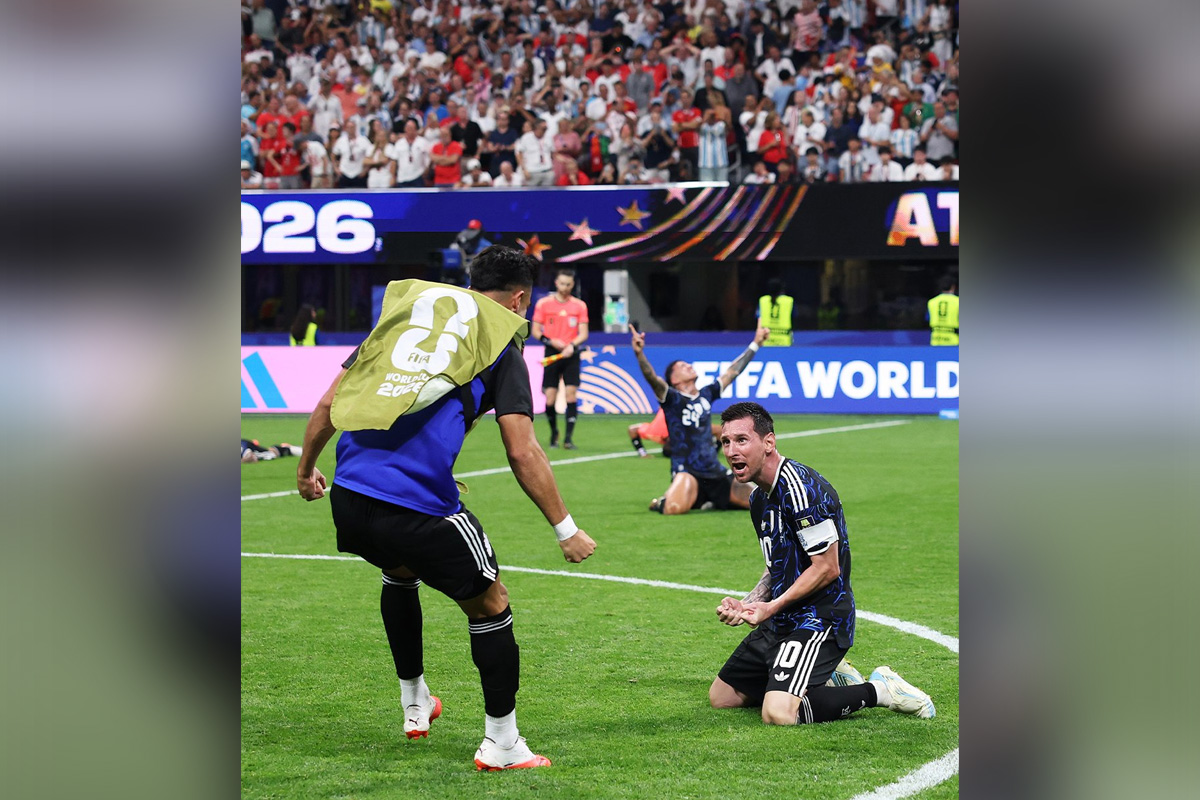
Lionel Messi celebrates Argentina's 2–1 victory over England in the FIFA World Cup 2026 semi-final. (Photo | x.com/FIFAWorldCup)

Synopsis: Ironic as it was, England lost their shot at World Cup glory the moment they scored their goal in the semi-final against Argentina. Defending a lead too early was always fraught with danger. More so, when a certain Lionel Andrés Messi was lurking around…
There comes a moment in every great knockout match when football ceases to be about tactics and begins to test temperament.
It rarely arrives with the opening whistle or even with the first goal. It comes later, when the scoreboard begins to influence imagination. Players start looking at the clock instead of the spaces around them. Coaches begin calculating probabilities instead of possibilities. A team that has spent an hour trying to score suddenly finds itself wondering how not to concede.
Football history has been shaped as much by such moments of hesitation as by moments of brilliance.
England discovered that truth in Atlanta.
Long before Lionel Messi’s two decisive assists and Lautaro Martínez’s dramatic winner sent Argentina into another World Cup final, the match had already begun to change. It changed not because Argentina suddenly became irresistible, but because England gradually abandoned the instincts that had made them the better side for almost an hour.
Every World Cup produces one match that grows larger than its scoreline. This semi-final became a study in fear and ambition.
Football is full of clichés, but one has survived every generation.
The most dangerous lead is 1-0.
A one-goal advantage creates an illusion of security. Every pass becomes slightly safer. Every run becomes slightly shorter. Every decision begins favouring caution over imagination.
Managers know this feeling well. Some resist it. Others surrender to it.
Thomas Tuchel has spent two decades proving himself to be among Europe’s finest tacticians. Few coaches organise a defence better. Yet football has an old habit of punishing even its sharpest minds when they begin protecting a future that has not yet arrived.
England’s performance during the opening hour deserved admiration. Declan Rice dictated midfield with authority. Jude Bellingham carried the ball through pressure. Anthony Gordon constantly stretched Argentina’s back line. Lionel Scaloni sensed before kick-off that England would turn the contest into a physical battle. That explains why he preferred Giuliano Simeone’s relentless energy to Rodrigo De Paul’s experience. Every duel carried consequence. Every loose ball demanded commitment.
When Gordon finally broke the deadlock in the fifty-fifth minute, England appeared to have seized control of the evening.
What happened next remains one of football’s oldest paradoxes.
The goal changed the team in front, for the worse.
Football has a wonderfully visual phrase for retreat.
“Park the bus.”
Under certain circumstances, it is perfectly rational. A narrow lead in the closing minutes often demands compact defending and emotional discipline.
The mistake lies not in defending.
It lies in defending too early.
There is a world of difference between protecting a lead with five minutes remaining and attempting the same exercise with more than half an hour left.
England gradually withdrew into themselves. Their midfield retreated towards the penalty area. Harry Kane became increasingly isolated. Full-backs stopped overlapping. Possession, once an instrument of control, became something willingly surrendered.
The numbers merely confirmed what the eye could already see.
Argentina monopolised the ball.
England defended territory.
One team continued playing.
The other waited.
After the final whistle, Tuchel admitted that his substitutions had made England too passive. Harry Kane acknowledged that England had drifted away from the attacking football that had brought them success. International analysis reached the same conclusion. England had not been overwhelmed. They had quietly invited pressure upon themselves.
Football punishes invitations.
At thirty-nine, Lionel Messi no longer dominates through acceleration. He dominates through anticipation.
England spent an hour denying him central spaces. Messi responded by drifting towards the left flank. The adjustment looked minor. It changed the architecture of the match.
Every defender who moved towards him opened another passing lane. Every compact defensive block became slightly wider.
Great footballers do not merely read space. They reorganise it.
England expected crosses into a crowded penalty area.
Messi waited.
Enzo Fernández had slipped unnoticed into an unmarked pocket outside the box.
The pass arrived with astonishing precision.
The finish curled beautifully into the corner.
The equaliser altered more than the scoreboard.
It altered belief.
Football possesses a strange emotional logic.
One goal rarely arrives alone.
It changes the emotional climate of a match. Confidence migrates from one team to another. Legs that had appeared heavy suddenly feel lighter. Decisions become quicker. Passes become sharper. The opposition begins seeing danger everywhere.
The equaliser transformed Atlanta.
Until Enzo Fernández found the net, England had been defending a lead. After it, they were defending themselves.
History has seen this pattern before. Manchester United stunned Bayern Munich in the closing minutes of the 1999 Champions League final. Liverpool overturned a three-goal deficit against Milan in Istanbul. Argentina themselves travelled from despair to ecstasy against France in the World Cup final at Lusail in 2022. Football changes direction with astonishing speed because momentum is never merely physical. It is psychological.
England had spent half an hour absorbing pressure.
Argentina had spent the same half hour gathering belief.
That difference proved decisive.
Lionel Scaloni rarely commands the attention reserved for celebrity managers. He avoids theatrical gestures and seldom dominates post-match headlines. Yet he has quietly assembled one of international football’s most resilient teams.
Atlanta offered another reminder of that achievement.
Scaloni recognised that England’s compact defensive shape demanded patience rather than desperation. Argentina resisted the temptation to force hopeful balls into crowded central areas. They stretched the pitch, recycled possession and waited for England’s discipline to weaken.
The approach reflected more than tactical intelligence.
It reflected trust.
Scaloni trusted sustained pressure to create openings and, above all, trusted Messi to recognise them.
By now, Messi had become less a striker than an architect. His influence could not be measured through distance covered or sprints completed. It was measured through the questions he forced England’s defenders to answer.
Each answer created another opening.
Deep into stoppage time, Alexis Mac Allister struck the crossbar. England survived.
For a moment.
The rebound fell kindly for Messi.
Many great players would have attempted the spectacular.
Messi chose the simpler solution.
With his weaker right foot, he delivered a cross of extraordinary precision towards Lautaro Martínez. The finish demanded little imagination because the pass had already done the difficult work.
That sequence captured something fundamental about Messi’s greatness.
He has never been obsessed with proving himself. He has always been obsessed with solving football’s problems.
Great players seek memorable moments.
The greatest players create them for others.
Martínez’s winner secured Argentina’s place in another World Cup final.
Messi’s pass ensured that everyone would remember how they arrived there.
The immediate debate after the match centred on Thomas Tuchel.
Should he have continued attacking? Should Bukayo Saka have entered earlier? Did England retreat too soon?
These are legitimate football questions.
They are also incomplete.
England’s defeat was as much psychological as tactical.
Every knockout tournament eventually asks the same question. Will a team continue chasing victory, or will it begin protecting it?
England chose preservation.
Argentina chose possibility.
The distinction appeared subtle. Its consequences were enormous.
Football has consistently rewarded teams that remain faithful to their identity under pressure. Brazil in 1970, Spain under Vicente del Bosque and now Argentina under Lionel Scaloni understood that attacking is not simply a strategy. It is a way of refusing fear.
The safest way to protect a lead is often to keep playing.
Every World Cup leaves behind unforgettable goals, tactical innovations and endless debate. Atlanta left behind something older.
A reminder that football rarely rewards the team that begins protecting victory before it has truly earned it.
For almost an hour, England played with authority, conviction and clarity. Then the scoreboard began to influence imagination. The future appeared close enough to defend, even though there was still too much football left to play.
Argentina never stopped believing another opportunity would arrive.
Eventually, it did.
The official record will remember this as a 2-1 victory that carried Argentina into another World Cup final.
The deeper story lies elsewhere.
This was not simply a comeback.
It was a lesson in temperament.
One team defended a lead.
The other defended an idea.
In the end, the idea proved stronger.
Also Read: ‘At home I am alone, not here…’: The joy of watching the football World Cup on community screens
From Our Archives | When Messi didn’t come: Anatomy of a football fiasco in Kerala
(Ashutosh Kumar Thakur is a writer and cultural commentator based in Bengaluru. He writes on literature, society, sports, politics and South Asian cultural histories for leading publications.)
(Edited by R Rajesh Kumar.)



