

Published May 03, 2026 | 8:00 AM ⚊ Updated May 03, 2026 | 8:00 AM

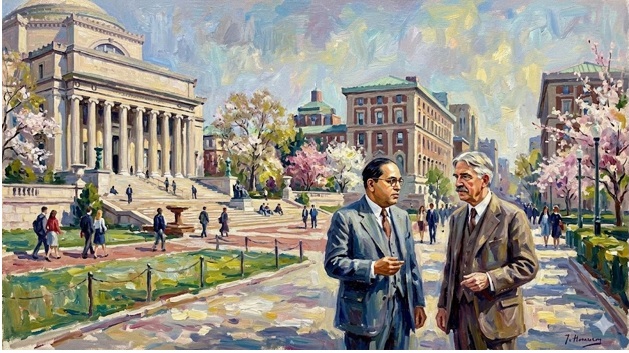
Ambedkar’s intellectual bond with American philosophy was forged at Columbia University between 1913 and 1916. (Supplied)

Synopsis: The establishment of the SAAP Ambedkar Prize signals a global rediscovery of Dr BR Ambedkar’s pragmatism. By applying a “social razor” to inherited dogmas, Ambedkar’s philosophy offers a surgical methodology for excising communal clutter and restoring individual dignity within modern democracy.
The Society for the Advancement of American Philosophy (SAAP) recently announced the establishment of the Bhimrao Ambedkar Prize in Global Pragmatism. This landmark award—the first from an American scholarly organisation to bear his name—honours research into the intellectual intersections between American philosophy and thinkers across the Global South.
It signals a long-overdue recognition of Ambedkar’s role not just as a statesman or the “Father of the Indian Constitution,” but as a visionary philosopher who bridged the gap between Western pragmatic thought and Eastern social reform.
For the contemporary Indian Republic, increasingly besieged by the dense “intellectual clutter” of majoritarianism, communalism, and casteism, this recognition serves as an invitation to rediscover the “social razor” Ambedkar wielded to excise the dogmas of the past.
Ambedkar’s intellectual bond with American philosophy was forged at Columbia University between 1913 and 1916. It was here, under the tutelage of the legendary pragmatic thinker John Dewey, that Ambedkar moved beyond the mere study of law and economics into the realm of social surgery.
As Anand Teltumbde notes in The Republic of Caste: Thinking Equality in the Time of Neoliberal Hindutva (2018), “under the influence of John Dewey, his professor at Columbia University, he [Ambedkar] remained a pragmatist in dealing with history… What is called Ambedkarism actually boils down to pragmatism, a way of practically resolving particular issues with available resources, rather than relying on grand narratives and a politics of overhaul.”
By applying these methods, Ambedkar did not merely import American ideas; he evolved pragmatist thought into a global force, tailoring it to address the unique, layered complexities of the Indian experience.
Also Read: It’s time to Ambedkarise public policy
Despite its profound impact, the influence of Deweyan pragmatism on Ambedkar has remained historically underplayed in the mainstream narrative of Indian independence. In his seminal work, The Evolution of Pragmatism in India: An Intellectual Biography of B.R. Ambedkar (2023), Scott R. Stroud argues that this connection is a “grand tale” yet to be fully unearthed.
Stroud posits that Ambedkar’s story marks “pragmatism’s entrance into Indian intellectual and political circles.” To fully understand Ambedkar as an anti-caste activist, one must see how he utilised Dewey’s Instrumentalism—the idea that ideas are tools for problem-solving rather than descriptions of an ultimate reality—as a weapon against social stagnation.
For Ambedkar, the “truth” of a social system was found in its consequences. If a system like the Varna order resulted in the degradation of human potential, no amount of metaphysical or scriptural justification could make it “true” or “just.” This commitment to dynamics over metaphysics allowed him to view history not as a static burden to be carried, but as a series of experiments. If an experiment failed to produce dignity, the pragmatist’s duty was to discard it and design a new one.
Ambedkar’s embrace of Buddhism represented the ultimate synthesis of this pragmatic philosophy. It was not a retreat into mysticism or a search for other-worldly salvation; rather, it was a strategic transformation of religion into a functional instrument for social reconstruction.
Echoing the 14th-century philosopher William of Ockham’s penchant for intellectual parsimony, Ambedkar applied a “social razor” to the Buddhist tradition. He meticulously stripped away supernatural elements—such as the soul (Atman), infallible scriptures, and a version of karma rooted in past lives—which he saw as “superfluous entities” that justified suffering rather than solving it.
By redefining the Dhamma as a secular code of “Right Relations,” Ambedkar pivoted the focus of the faith from divine salvation to the empirical advancement of liberty, equality, and fraternity. He emphasised the Buddha as a Margadata (a guide who shows the path) rather than a Mokshadata (a saviour who grants salvation).
In this framework, Buddhism becomes a practical, reason-based methodology for dismantling caste hierarchies. Spiritual conversion, in the Ambedkarite sense, was not a flight from the world’s problems but a “strategic refinement” of his lifelong battle against social tyranny.
Also Read: Delimitation, democracy and federal balance: An Ambedkarite view
While Dewey provided the methodological core, Ambedkar’s pragmatism was refined by a diverse circle of scholars at Columbia who emphasised the social utility of knowledge. Edwin RA Seligman, a towering figure in institutional economics, provided a materialist lens that allowed Ambedkar to analyse the caste system as a pragmatic economic problem.
Under Seligman’s influence, Ambedkar saw caste not merely as a religious error but as a “division of labourers”—a rigid economic structure that stifled mobility and production.
Simultaneously, from sociologists like Franklin Giddings, he adopted the empirical tools to analyse group behaviour and “consciousness of kind.” This helped him understand why communal silos persist and how they might be broken down.
Furthermore, the analytical scepticism of Bertrand Russell and the liberal empiricism of John Stuart Mill offered him a “logical razor” to defend individual liberty against the rising tide of majoritarian tyranny.
Together, these multidisciplinary influences allowed Ambedkar to synthesise a unique form of pragmatism designed to strip away the “social scholasticism” of India and replace it with a lean, functional democracy focused on the material and legal advancement of the individual.
Also Read: Dr BR Ambedkar rejected Hindutva and the Sangh Parivar vilified him
This multidisciplinary toolkit culminated in Ambedkar’s distinct vision of social democracy. He aired these ideas most notably in 1919 while deposing before the Southborough Commission regarding voting reform. Long before the Constitution was drafted, Ambedkar was arguing that political democracy (the ritual of the ballot box) is a hollow structure if it is not built upon a social democracy (the reality of “one man, one value”).
Influenced by Dewey’s concept of “social endosmosis,” Ambedkar viewed democracy not merely as a parliamentary mechanism but as a “mode of associated living.” Social endosmosis refers to the free flow of communication, empathy, and shared experience across group boundaries. Ambedkar realised that the caste system acts as a series of impermeable walls—”water-tight compartments”—that prevent this flow, thereby poisoning the body politic. His pragmatic solution was to insist that the state proactively excise inherited social dogmas and economic inequities. By doing so, he sought to foster a constitutional morality where the spirit of the law overrides communal prejudice, ensuring that the republic is built upon a shared temperament of dignity rather than majoritarian dominance.
Also Read: Ambedkar’s electoral defeats and the role of Hindutva organisations
Ambedkar’s mastery also extended to the realm of communication, where he employed what can be termed “reconstructive rhetoric.” This was a technique of channelling meliorative, pragmatic themes through the creative use of texts, authors, and traditions. His strategy serves as a quintessential application of Donald C. Bryant’s dictum that rhetoric is the function of “adjusting ideas to people and people to ideas.”
Ambedkar faced a monumental task: he had to adjust the “alien” universal abstractions of Western constitutionalism—liberty, equality, and fraternity—to the particular, lived realities of an Indian public steeped in hierarchy. Simultaneously, he had to work to adjust the consciousness of the oppressed masses, moving them from a state of fatalism to one of political agency. By treating communication as an instrument of “social surgery,” Ambedkar utilised Bryantian rhetoric to mediate between the static traditions of the past and the functional necessities of a modern democracy. This “Navayana Pragmatism” ensured that the “clutter” of social scholasticism was replaced by a shared, pragmatic language of individual rights.
Also Read: Dr BR Ambedkar rejected Hindutva and the Sangh Parivar vilified him
The contemporary Indian landscape, increasingly crowded by the “intellectual clutter” of majoritarianism and communalism, finds its most potent intellectual antidote in this Ockhamite legacy. Much like the 14th-century philosopher used his “razor” to slice through the bloated metaphysics of medieval scholasticism, Ambedkar applied a surgical pragmatism to the Indian social order. He relentlessly stripped away the sacred justifications for hierarchy, reducing complex theological defences of inequality to a singular, utilitarian question: Does a system serve the dignity and liberty of the individual?
Ambedkar’s approach was deeply rooted in the nominalist tradition pioneered by Ockham, which posits that only individual, particular things are real, while abstract “universals” (like the “nation” or the “social order”) are merely names. This philosophical shift allowed Ambedkar to reject the abstract “glory” of a civilisation in favour of the tangible rights of the person. He realised that a republic’s health depends on its ability to prioritise practical results over the preservation of rigid traditions.
Ultimately, Dr Ambedkar squarely fills the vacancy of a modern William of Ockham for the Indian Republic. Where Ockham dismantled the complex “scholastic” thought that stifled intellectual growth in the Middle Ages, Ambedkar dismantled the “social scholasticism” of the caste system that stifled human potential in South Asia. He functioned as a “conceptual iconoclast” who sought to excise the superfluous dogmas that stifle progress.
In an era where corruption and identity politics threaten to dull the blade of reason, Ambedkar’s “social razor” remains the essential tool for carving out a secular, egalitarian democracy. He stands as a persistent, practical guide, using the principle of parsimony to prune the thickets of social tyranny and restore the primacy of individual justice. Through the lens of global pragmatism, we see that Ambedkar’s project is not a relic of the past, but an ongoing methodology—a razor that must be kept sharp if the Indian Republic is to remain truly free.
(Faisal C.K. is Deputy Law Secretary to the Government of Kerala. Views are personal. Edited by Majnu Babu).



