
Published Jun 23, 2026 | 5:45 PM ⚊ Updated Jul 03, 2026 | 10:55 AM

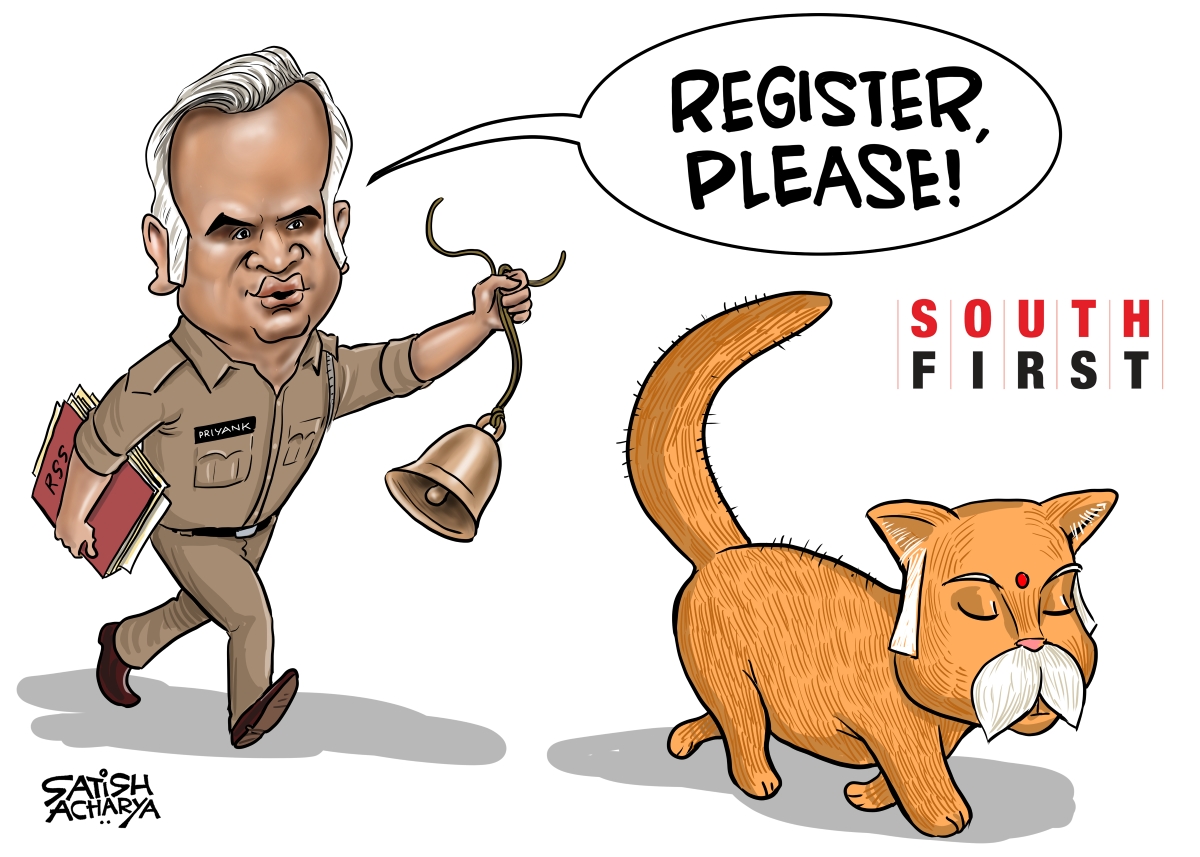
Belling the RSS cat. (Cartoon: Satish Acharya)

Synopsis: Very few Congress leaders take on the RSS in the manner that Rahul Gandhi does. Priyank Kharge is one of them. Don’t expect him to stop with his eight-question challenge to BJP’s ideological head.
Call it irony in formal English or “UNO reverse” in internet slang, the Rashtriya Swayam Sevak Sangh (RSS) has found itself in a “Hum Kagaz Nahi Dikhayenge” moment, courtesy of Karnataka Home Minister Priyank Kharge.
Hum Kagaz Nahi Dikhayenge (We will not disclose the documents)—a poem by Varun Grover—became an anthem of resistance during the protests against CAA-NRC in 2019-2020.
The lines became a literary tool to reject an attempt by the BJP-led Union government to force Indians to prove their nationality and legal citizenship. Coupled with CAA, the Centre’s move would eventually protect Hindus who fail the test of NRC but deem all others “illegals foreigners”.
As suspected, it proved to be a tool to target lakhs of Muslims in BJP-ruled Assam. The grand plan, several critics pointed out, was simply a means of achieving the RSS’ stated mission and vision of Hindu Rashtra as envisioned by its stalwart Madhav Golwalkar.
Leaders of RSS and BJP, while vehemently defending the CAA-NRC, insisted that documented Indians had little reason to worry. After all, if one has the documents to prove their identity and legality, why fret or fear the government’s demand to disclose information?
Yet, six years down the line, RSS—the ideological parent of Bharatiya Janata Party (BJP), the party in power that demanded documents from Indians to prove their citizenship—is offended that it is being asked to disclose its own identity and documentation.
Karnataka Home Minister Priyank Kharge hasn’t just ruffled feathers; he has challenged the notion that RSS is above questioning. For far too long, narratives like “criticising RSS = criticising Hindus”, “criticism of RSS will cost one politically”, “a smart politician won’t antagonise RSS” etc have been carefully built, aided and abetted by a pliant media.
Priyank Kharge demanding accountability and transparency from the RSS has paved the way for more leaders as well as citizens to challenge these narratives and ask questions of an organisation that boasts of its presence across the country with over 57,000 shakhas and more than 15 lakh members.
The RSS deems itself a “body of individuals”—”an organisation made up of volunteers who come together for nation building”. It is neither registered nor pays taxes. Yet, it is an organisation that has a say in who should be the Prime Minister of India.
The coveted post of BJP National General Secretary (Organisation) is held by an RSS member—BL Santhosh. An RSS appointee holds the post at State units of the party as well. The RSS is the powerhouse that fuels the BJP.
“Even a street vendor, NGO, charitable organisation is registered in India. Why not an organisation that has lakhs of members and carries out flag marches in public places with a lathi in hand?” Priyank Kharge asked.
The minister raised eight questions to the RSS in a letter addressed to its chief Mohan Bhagwat, who previously has publicly announced that RSS is open to government scrutiny. “Since we are a body of individuals, we don’t need to pay taxes. The government doesn’t ask for our accounts, but we audit everything and account for every single rupee. If the government ever asks for our audits, we will submit it,” Mohan Bhagwat is seen saying in an RSS meet in a video posted by Kharge.
While the organisation has not responded to Priyank Kharge’s questions directly, several volunteers, including legal eagles like Mahesh Jethmalani, have provided long, colourful justifications, generously peppered with flavours of self-aggrandised nationalism, for RSS not registering itself or being transparent. On the other hand, leaders of the BJP, like MP Ramesh Jigajinagi, have asked why a “Dalit person” Priyank Kharge should be concerned with RSS, turning a legal question into a social issue.
Is the RSS above questioning or is the RSS above questioning by a “Dalit man”, as the BJP MP put it?
One could argue that an Ambedkarite Dalit is the ideal contender to take on Brahminical patriarchy entrenched in majoritarian nationalism. It is like a contest between a secular, egalitarian Constitution and innately discriminatory Manuvaada.
Kharge insists his demand is rooted in legality, not ideology.
“I am not interested in their philosophy. They can practise what they want but as the Home Minister of Karnataka, it is my responsibility to know what this organisation, with lakhs of members, holding flag marches and discussions on India’s policies, politics and society, is doing and why. This query is rooted in legality and constitutionality,” Priyank Kharge told South First.
Shashi Tharoor, in a previous conversation with this reporter, had described Congress as “an umbrella organisation that has people from all ideologies”. Yet, taking a strong political stance on ideological integrity when it comes to RSS has been a rarity in Congress.
Very few leaders in the party directly take on the RSS like Rahul Gandhi does. Now, in a post-Siddaramaiah era in Karnataka, Priyank Kharge has emerged as a voice of ideological clarity of the Congress, coupling it with his role as Home Minister to demand accountability from RSS.
“Opposition parties are under the misconception that they lose elections to the BJP. No. They lose elections to the RSS,” a senior Congress leader said, pointing to how the organisation has been circumventing ways to avoid scrutiny while it continues to power the electoral juggernaut that is the BJP.
RSS should expect more letters/notices from the Karnataka government doubling down on its demand for clarity and transparency. Especially when RSS applies for permissions to hold public events the next time in Karnataka. A plan has been put in place for the next one year, and an endgame has begun. There are only two outcomes from it—escalation or complete withdrawal.



