
Published May 26, 2026 | 8:57 AM ⚊ Updated Jun 07, 2026 | 12:03 PM

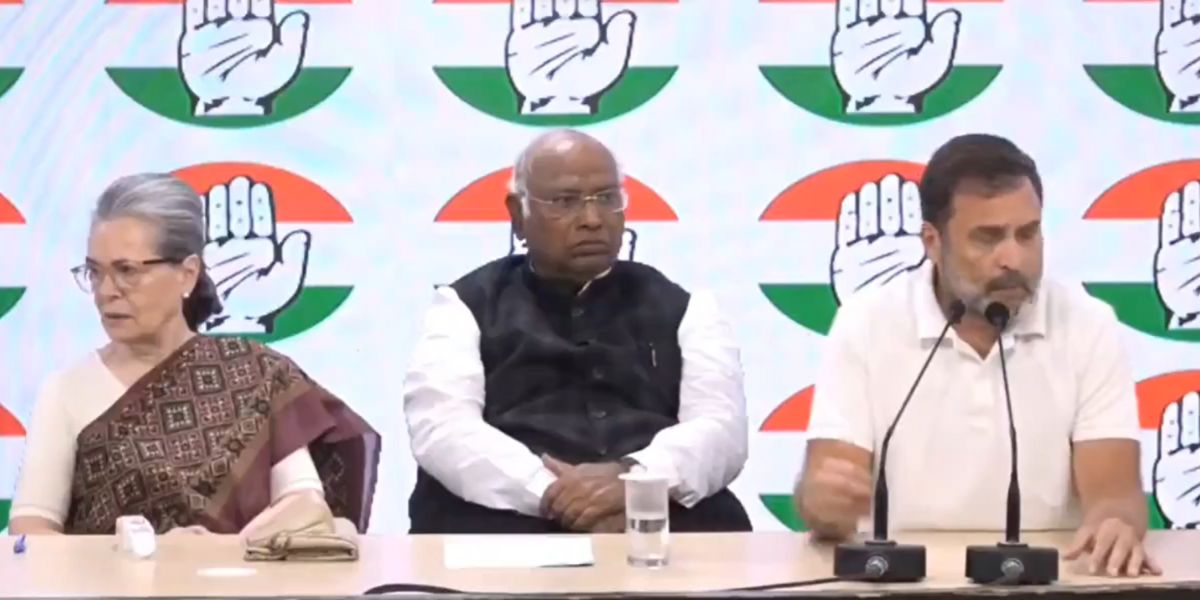
Congress leaders Sonia Gandhi, Mallikarjun Kharge, and Rahul Gandhi addressing a press conference. (Screengrab)

Synopsis: Congress has been a creature of habit, bound by conventions and maintaining the status quo. The party radically changed its approach when it split from the DMK alliance in Tamil Nadu and the way it chose its chief minister in Kerala. Perhaps Congress’ new leadership style reflects that while taking on a political rival like the BJP, convention and status quo are no longer options.
On 6 May 2026, two days after the results of the Tamil Nadu Assembly polls were announced, the Indian National Congress (INC) did something radical.
It abruptly broke its decades-long alliance with the Dravida Munnetra Kazhagam (DMK) after an electoral rout and joined hands with the Tamilaga Vettri Kazhagam (TVK), which had emerged as the single largest party.
It was out of character for Congress which carries the burden of being a creature of habit. Maintaining status quo — within the party and with allies — has been Congress’ way of functioning, even if that has cost the party elections and frustrated its leaders.
In a flash, Congress had upended all its national equations, ditched MK Stalin’s party and put the Opposition’s INDIA bloc at risk of dissipation. It wasn’t just a breakdown of political partnership but also burning the bridge of personal bond between the first families of both parties.
DMK called it “backstabbing”. BJP called it “opportunistic”. Several people questioned the way Congress split away, rather disgracefully, from a pre-poll alliance, without warning or discussion.
However, for Congress, it was a political necessity — the only way to be part of the government in Tamil Nadu after nearly six decades. For years, Congress has been in the winning coalition but never part of the government. It took a massive electoral loss for the party’s leadership to finally gave in to the cadres’ demand in Tamil Nadu to split from DMK.
It smashed the status quo in Tamil Nadu of putting up with an ally despite no share in power. It wasn’t something anyone expected, especially the BJP that dreams of a “Congress-free India”. With a swift move, Congress was in power in four out of the five Southern states.
Also Read: Karnataka CM Siddaramaiah to discuss ‘cabinet and chair’ with AICC leadership
At the same time, a different kind of status quo was smashed in neighbouring Kerala. Congress’s decision-making has conventionally meant that the All India Congress Committee (AICC) leadership’s call is final and undisputed.
It has always been a party structured around “high command culture”; currently, the high command means only Sonia Gandhi, Rahul Gandhi and the AICC president.
The chief minister’s selection in Kerala turned this approach upside down, with cadres prevailing over high command. Despite having the support of two-thirds of MLAs and being the high command’s personal pick, AICC General Secretary KC Venugopal was not made the chief minister of Kerala.
Perhaps for the very first time, someone who neither had the majority support of MLAs nor was the high command’s pick was chosen as the chief minister, with cadres, allies and stability in mind. VD Satheesan became the beneficiary of Congress’ radical change of pace — putting cadre before high command.
In both states, Congress’ unconventional approach to challenges has been risky and out of character. But for the grand old party that is stuck in limbo, a violent shake-up has become a necessity for political survival. Bihar assembly polls should have come as a wake up call for Congress. The awakening has come a little late.
While taking on a political rival like the BJP, convention and status quo — within and outside the party — are no longer options. There is a new way of thinking in Congress and several leaders credit it to Rahul Gandhi. His radical opinions seldom find support but when they do, they challenge status quo.
Take Tamil Nadu for example. Rahul Gandhi had been actively advocating for a pre-poll alliance with TVK but status quo was upheld. AICC President Mallikarjun Kharge and Sonia Gandhi chose to go ahead with the DMK partnership. However, post the electoral debacle, Rahul Gandhi’s risky decision prevailed.
DMK leaders insist that Congress would never be forgiven for aligning with TVK which ousted it from power. If one were to draw a parallel, TVK is to DMK what Aam Aadmi Party (AAP) is to Congress. Much like TVK ousted DMK from power, AAP has ousted Congress in Delhi and Punjab. In addition, it has been a constant vote cutter, costing Congress heavily in elections in several states.
Yet, even within the Opposition’s INDIA bloc, Congress, by virtue of being the oldest and largest party, had to accept and accommodate immediate rivals like AAP. Would DMK ever accept TVK as a partner in a similar bloc? Accommodating parties for the “larger good” has been a status quo for Congress.
Splitting away from an ally and joining hands with an ally’s rival, is a radical change of approach.
Also Read: Congress slams Union government over high fuel prices
Whether this wave of radical decision-making would impact Karnataka as well is the big question now. With Siddaramaiah completing three years in office as the chief minister, deputy chief minister DK Shivakumar’s aides have stepped up the demand for a change of guard. It isn’t an easy decision.
“Indecisiveness is a congenital defect of the Congress. Instead of addressing issues immediately, the leadership lets them fester. That needs to change,” a senior Congress leader told South First while stressing on the need for AICC leadership to clarify if a change is imminent. Even so, the leader agreed that in recent times, Congress leadership’s decisions have been unusual and risky.
If Siddaramaiah is replaced as chief minister, Congress runs the risk of losing its only OBC chief minister and alienating its biggest vote-getter in Karnataka.
Siddaramaiah is the undisputed mass leader of Congress in Karnataka capable of commanding a majority of Kuruba and Muslim votes. Come 2028, Congress needs Siddaramaiah and his AHINDA (Kannada acronym for Minorities, Backward Classes and Dalit) appeal to counter unavoidable anti-incumbency.
At the same time, if Shivakumar is not given the opportunity to lead the state, Congress runs the risk of losing its troubleshooter and allowing animosity to brew, damaging its electoral prospects.
Conventionally, Congress wouldn’t disturb the status quo in Karnataka and dislodge a massively popular Siddaramaiah to make way for Shivakumar, who will be the future of the party. Will a third player emerge as a beneficiary of this tug of war? Given Congress’ radical streak in recent decisions, their approach may surprise many.
(Edited by Muhammed Fazil.)



