

Published Aug 28, 2026 | 2:26 PM ⚊ Updated Aug 28, 2026 | 2:26 PM


Synopsis: “There’s nothing left in the village.” “I can’t find my own family.” “We’re finished, Arjun.” Nepal’s worst flash flood has devastated villages and shattered families. Experts warn that with the Himalayas warming, we may see more such catastrophes as glaciers shrink and the snow melts.
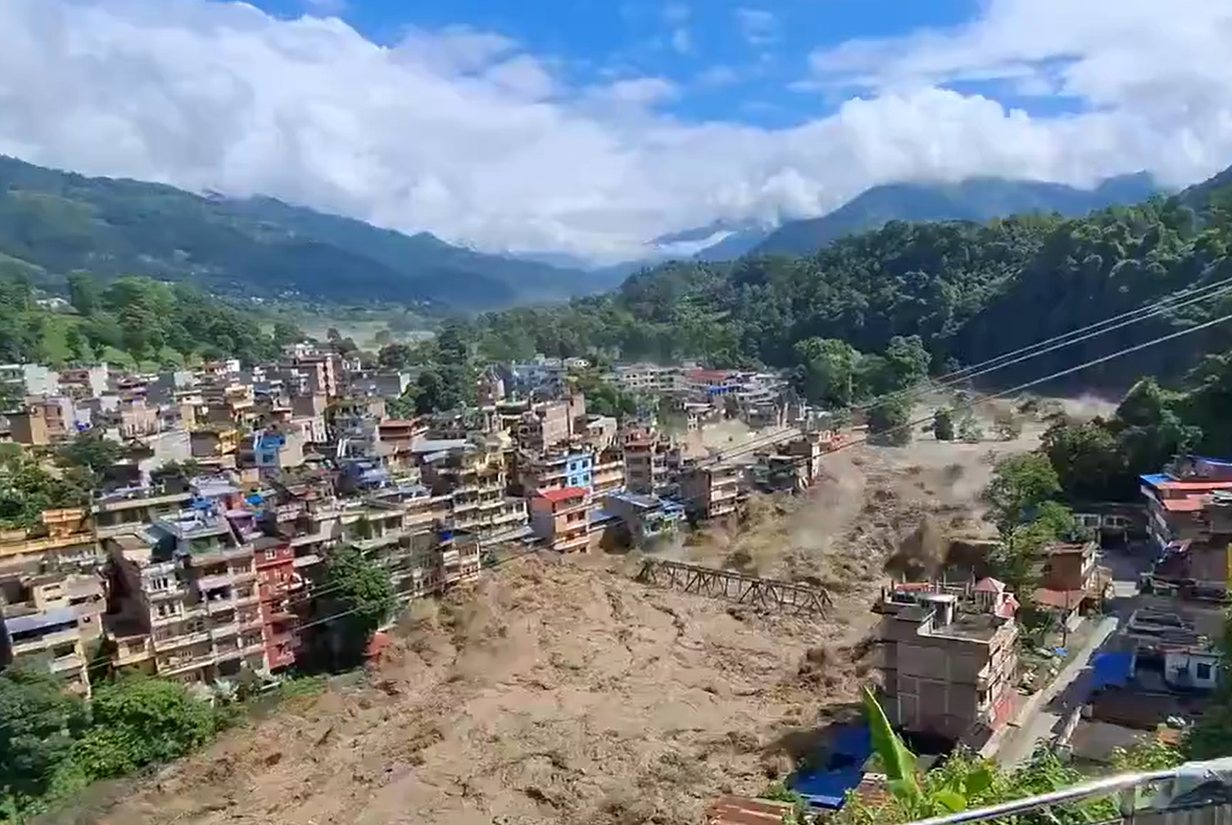
Policemen fleeing for dear life, almost an entire village swept away, and morgues running out of space as the bodies began piling up. Nepal’s worst flash flood has left behind a trail of haunting memories.
The glacial collapse at 8:37 am on August 26 sent mud, rock and ice hurtling down “like a bomb”, in the words of a survivor. As the toll continues to mount, deeply disturbing stories are beginning to emerge.
Nearly 500 people have been confirmed dead in the disaster, while another 1,400 are said to be missing. Many of them are Indians.
On Friday morning, there was some good news. Sixty-three of the seventy-three Indians working at the Upper Trishuli-1 hydroelectric power project site, which was hit by the flash flood, were said to have been rescued.
Kathmandu Post’s health reporter Arjun Poudel, for whom ‘everyone I have ever loved outside my own front door’ is from Trishuli, shared a moving account of the fury his village witnessed.
After hearing of the tragedy from his wife, Arjun made frantic calls to relatives and friends before one of them gave him the news he was dreading: “There’s nothing left in the village (Sole). You can imagine the rest yourself.”
“There is no road left, no electricity, no phone signal, no internet. Downstream, the flood took the headgate of the Trishuli hydropower station, and then the power station itself. I remember that even during the years of nationwide load-shedding, back in 2010-11, our village never once lost power. Now the whole district sits in the dark,” he narrated.
Arjun’s eldest aunt, her son and his wife, his other aunt, her grandson and his wife and his maternal uncle were among the dead.
“I can’t find my own family, bhai,” a teacher said when Arjun reached him. “Ninety per cent of the houses in Betrawati (a market town that neighbours Sole) are gone. The school van was swept off too. There’s a boy near me with a broken leg. Another man beside him—broken leg; his eye is hurt badly. If you can get a helicopter here, please, send one.”
Betrawati, Arjun recounted, is where Nepal and Tibet signed a peace treaty and where the Uttar Ganga dham, one of Nepal’s most sacred Hindu pilgrimage sites, is situated. Thousands honour the dead on Pushya Amavasya here.
“All of it—the temples, the treaty ground, the pilgrimage site—is rubble now,” he wrote.
A fellow journalist, Niranjan, lost his father, mother, uncle, aunt, and his little sister Himani to the flood. “We’re finished, Arjun,” he said.
In another report, Kathmandu Post quoted a resident recalling: “I was asleep when the whole hillside suddenly started shaking as if there had been an earthquake.”
“The houses began trembling. There was no time to think about what was happening. I ran outside in whatever clothes I was wearing, just trying to save my life,” the survivor recalled. The officers at the police post he headed to in search of reassurance were themselves scrambling towards safety when he reached there.
Meanwhile, the Post reported that morgues in Nuwakot, Dhading and Nawalparasi were struggling to cope with the incoming dead. Temporary morgues are being set up to handle the crisis.
“Bodies are still being recovered. The district does not have the infrastructure to manage such a large number of bodies,” Chief District Officer Jagadishwor Upadhyay was quoted as saying. “We are coordinating with neighbouring districts and Pokhara to manage them.”
Professor Y Nithiyanandam, Head of the Geospatial Research Program at Takshashila Institution, said the glacial collapse “originated on the Nepal side, on the north face of Langtang Lirung inside Langtang National Park”.
“Satellite imagery suggests this was not simply a glacier calving event but a large bedrock slope failure that carried part of the overlying glacier with it. The collapse, at roughly 5,100–5,200 m elevation, generated the seismic signal initially mistaken for an earthquake. The resulting ice-rock avalanche entered the Lhende Khola valley, close to the Nepal–Tibet boundary,” he went on to share in a post.
The International Centre for Integrated Mountain Development (ICIMOD), an intergovernmental scientific institution, in its analysis found that water levels in downstream rivers had risen by between seven and nine metres within a span of 30 minutes, underlining the magnitude of the floods.
“The sheer wave of debris suggests there could have been a landslide first; the water built up, dammed the river, and then it burst in one huge great flood,” Mike Searle, professor of earth sciences at Oxford University, told the BBC.
He said “two different processes – tectonics with the Himalayas uplifting, and then climate change with increasingly high temperatures and melting of glaciers” were possibly behind the tragedy. “The whole thing is combining to form these catastrophic disasters that we are now seeing on a regular basis,” Professor Searle said.
Early in 2026, ICIMOD released a report that the Hindu Kush Himalaya glaciers were losing ice at twice the rate recorded in the early 2000s.
“The logic is that with a warming planet, you will see shrinking glaciers, lots of snow melt. The permafrost that is partially holding some mountainsides together is warming and thawing and degrading.
“So you are going to get more landslides, debris flows, glacial meltwater, lake outbursts, glacier collapses, because climate warming ultimately destabilises these high mountain environments,” Dr Simon Cook, a glacier expert with the University of Dundee, explained to the BBC.
Also Read:
(Edited by R Rajesh Kumar.)



