
Published Jun 14, 2026 | 8:00 AM ⚊ Updated Jun 14, 2026 | 8:00 AM

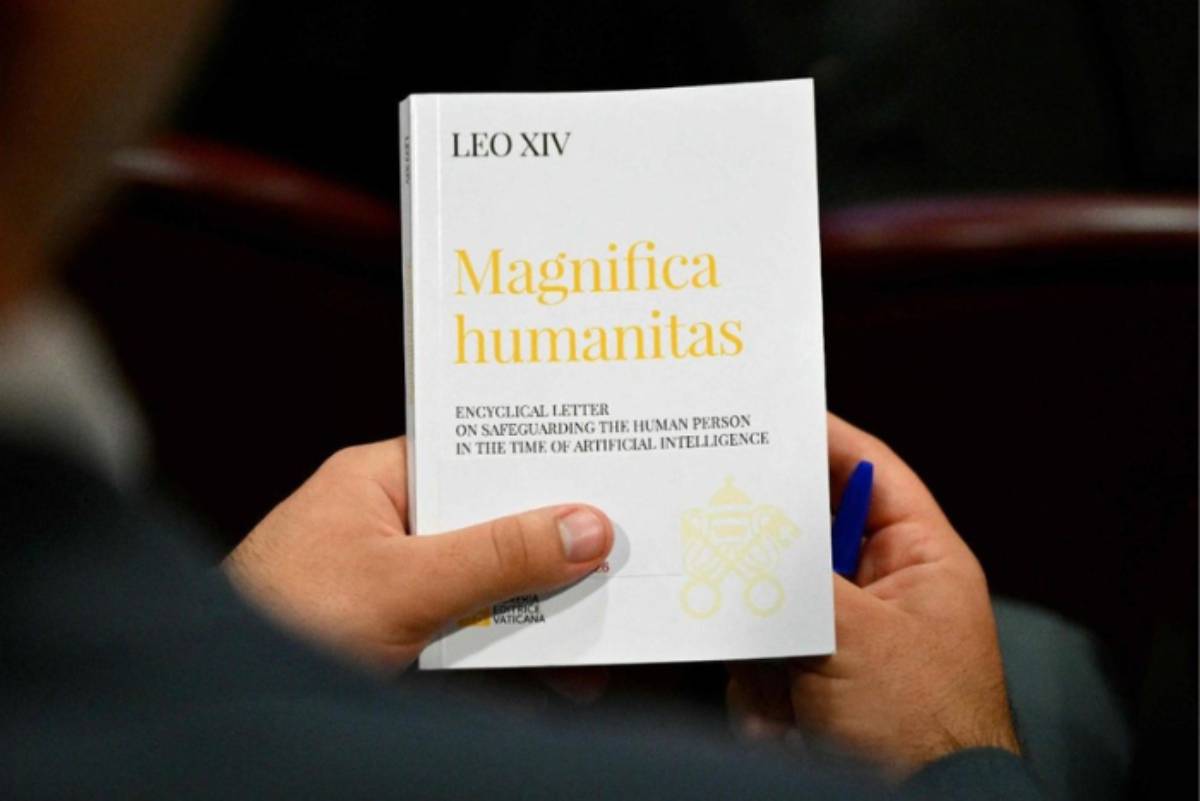
Pope Leo XIV's encyclical Magnifica Humanitas. Courtesy: Vatican News

Synopsis: What the Pope raises are not Catholic concerns. They are Indian concerns. The encyclical simply gives them a language and asks whether we will listen.
On May 25, 2026, Pope Leo XIV released Magnifica Humanitas (“Magnificent Humanity”), a new encyclical on artificial intelligence. The document was presented at the Vatican’s Apostolic Palace and made available to the public the following day. The timing is deliberate.
This Encyclical is patterned much like the earlier Pope Leo XIII’s landmark 1891 encyclical Rerum Novarum, which confronted the exploitation of workers during the Industrial Revolution. The new document applies the same framework of human dignity, just wages, and the common good to the age of algorithms.
AI is no longer future speculation. It is very much in our midst and reshaping economies, wars, healthcare, and daily communication at speeds that outrun ethical and legal frameworks.
The Pope is using universal principles to warn that artificial intelligence without rules directly threatens human dignity. He believes that without strict ethical boundaries, AI risks becoming an unchecked power that harms humanity rather than serving it. By issuing this message, the Vatican aims to actively shape global laws, corporate behaviours, and individual choices before irreversible damage occurs.
The document, including an introduction and a conclusion, is divided into five chapters.
The introduction presents two scenes from the Bible: the building of the “Tower of Babel”—a technological marvel driven by pride that leads to confusion—and a “City of God” where innovation is shaped by justice and fraternity.
Chapter One points to how the Church has engaged with past technologies (the printing press, industrial machinery, nuclear energy) to argue that Catholic social teaching is a living tradition, not a fixed rulebook.
Chapter Two highlights four permanent principles—human dignity, the common good, subsidiarity, and solidarity—and applies them directly to AI.
Chapter Three forms the doctrinal heart of the encyclical, defining what AI is and is not: a powerful mathematical tool without consciousness, will, or moral agency, and therefore incapable of replacing human judgment in matters of justice, love, or faith.
Chapter Four moves from principles to practice, examining concrete areas such as autonomous weapons, work, healthcare, education, and democratic information.
Finally, Chapter Five calls every sector of society—governments, tech companies, civil society, families, and individuals—to action, insisting that ethics without enforcement is merely good advice.
In the introduction, Pope Leo XIV makes it clear that this is not a rejection of technology but a discernment of the human heart. He asks whether we will use AI to deepen our humanity or to escape it.
Chapter One offers reassurance: the Church has never demonised new tools. It has, however, insisted that every tool be measured against the dignity of the person.
Chapter Two then lays down the unchangeable pillars. Human dignity means no person may be reduced to a data point or an algorithm’s output. The common good demands that AI serve everyone, not only the wealthy or the powerful. Subsidiarity requires that decisions about AI be made at the most local, human level possible, while solidarity calls us to close the digital divide between rich and poor, young and old, urban and rural.
Chapter Three is the most philosophically dense. The Pope directly confronts the temptation to treat AI as a quasi‑human partner or even a superior intelligence. He writes that AI has no interiority, no capacity for suffering, and no moral responsibility. Therefore, it can never replace a parent’s love, a teacher’s intuition, a judge’s mercy, or a pastor’s care. Transhumanist dreams of merging human minds with machines are dismissed as a spiritual illusion.
This view is strikingly echoed by some of the very engineers building advanced AI.
Mo Gawdat, formerly of Google X, has repeatedly warned that the real danger is not the machine’s intelligence but the flawed human heart directing it. Mustafa Suleyman, co‑founder of DeepMind, has gone further, cautioning against building systems that appear conscious, fearing that such illusions could spark misguided campaigns for “AI rights”—a distraction from the urgent needs of real human beings.
The encyclical would likely agree: misplacing our moral concern on machines only deepens our neglect of the poor, the vulnerable, and the unemployed.
Chapter Four applies these truths to burning issues. Lethal autonomous weapons are declared “not permissible”—no algorithm can make war morally acceptable. In the world of work, the Pope acknowledges genuine fears of mass job displacement and calls for human‑centred automation, retraining, and serious consideration of social safety nets that preserve meaningful participation.
This concern finds a sharp, real‑world formulation in the words of Dario Amodei, CEO of Anthropic, who has warned that “we may indeed have a serious employment crisis on our hands” as AI‑driven workflows replace millions of jobs, leading to a “concentration of economic power” in a handful of tech hubs.
The encyclical’s call for regulation and redistribution is a direct response to that predicted future.
In healthcare, AI diagnostics are welcome, but the doctor‑patient relationship must remain irreplaceably human. In education, AI tutors are tools, not teachers; schools must cultivate critical thinking about algorithms, not just technical skills. And in the public square, deepfakes, micro‑targeting, and algorithmic echo chambers are identified as threats to truth and democracy, requiring transparency and even “digital Sabbath” practices to reclaim human attention.
Chapter Five turns to action. Governments are urged to regulate, not merely issue voluntary guidelines. Tech companies are reminded that shareholders are not the only stakeholders; whistleblowers who expose harm are called protectors of the common good.
Amodei has offered an unusually honest internal warning on this point, noting that “the next tier of risk is actually AI companies themselves”—including their capacity to manipulate or “brainwash” users at scale. That sober assessment from inside the industry lends powerful support to the encyclical’s demand for robust legal frameworks, not just corporate promises.
Chapter Five continues by inviting civil society and faith communities to form local “AI observatories” to monitor impacts on the poor. Families and individuals are asked to practice digital sobriety, shield children from algorithmic manipulation, and never outsource a moral decision to a machine.
The conclusion offers a short, heartfelt prayer: “Do not fear AI. Fear the human heart that uses it without justice.”
The encyclical speaks to every nation, but its message lands differently across India’s vast and varied landscape.
In India, we have built something remarkable: a digital public infrastructure. It gives a unique identity to 1.4 billion people and processes billions of transactions every month.
The India AI Stack is already being deployed at population scale across health, agriculture, education and governance. AI-powered tools screen for tuberculosis, track disease outbreaks in 13 languages, and strengthen primary healthcare in rural areas. This is what we call AI for the public good. It is not just for profit. The India AI Stack is making a difference. It helps people in many ways.
Yet the encyclical’s warnings find sharp echoes here in our nation too.
Employment disruption is no longer hypothetical: over 87,000 job losses have been attributed to AI in 2026, with entry-level roles in India’s vast IT sector under particular pressure. The Economic Survey of 2025-26 has cautioned that unchecked automation could have destabilising effects on a labour-rich economy, calling for a dedicated AI Economic Council to align technology deployment with human welfare.
Deepfakes have already circulated unchecked during state elections, evading labelling rules and testing the resilience of India’s democratic processes. Meanwhile, India’s military has formally embraced lethal autonomous weapon systems, raising precisely the moral questions the encyclical places at the centre of its argument.
And as global AI corporations build their models on data generated by Indian citizens, the call for data sovereignty—”Jiska data, uska adhikar“—has become a matter of national strategy, not just technical policy.
These are not Catholic concerns. They are Indian concerns. The encyclical simply gives them a language and asks whether we will listen.
Also Read: Andhra Pradesh dreams of AI while millions cannot read
Magnifica Humanitas is unique not just for its ideas, but for its balanced approach. Instead of blindly opposing technology or timidly accepting things as they are, it outlines a mature middle ground between blind technological optimism and extreme fear.
For humanity at large, the encyclical provides a rare moment of shared ethical vocabulary—words like dignity, subsidiarity, and solidarity that can cross secular and religious boundaries. For a vast, multicultural, multi‑religious nation like India, the document arrives as a timely resource.
It does not claim to have all the answers, but it asks the right questions: Who decides what AI can do? Who benefits and who is harmed? And what kind of human beings do we want to become, as we build machines that can imitate our speech but never share our soul?
In answering those questions together, India’s diverse communities may find not only common ground but also a shared mission—to build, in the Pope’s beautiful phrase, the City of God, brick by digital brick.
John Kurien is a reflective development practitioner. After reading the full encyclical, he used AI to help create a detailed chapter summary. He then shortened it. To that, he added his own reading of the concerns of top AI engineers themselves and the relevance of the document to India. The outcome is this short guide to Magnifica Humanitas.
Also Read: The significance of President Trump’s AI security order for India and the rest of the world



