

Published Dec 21, 2025 | 11:21 AM ⚊ Updated Dec 21, 2025 | 11:21 AM

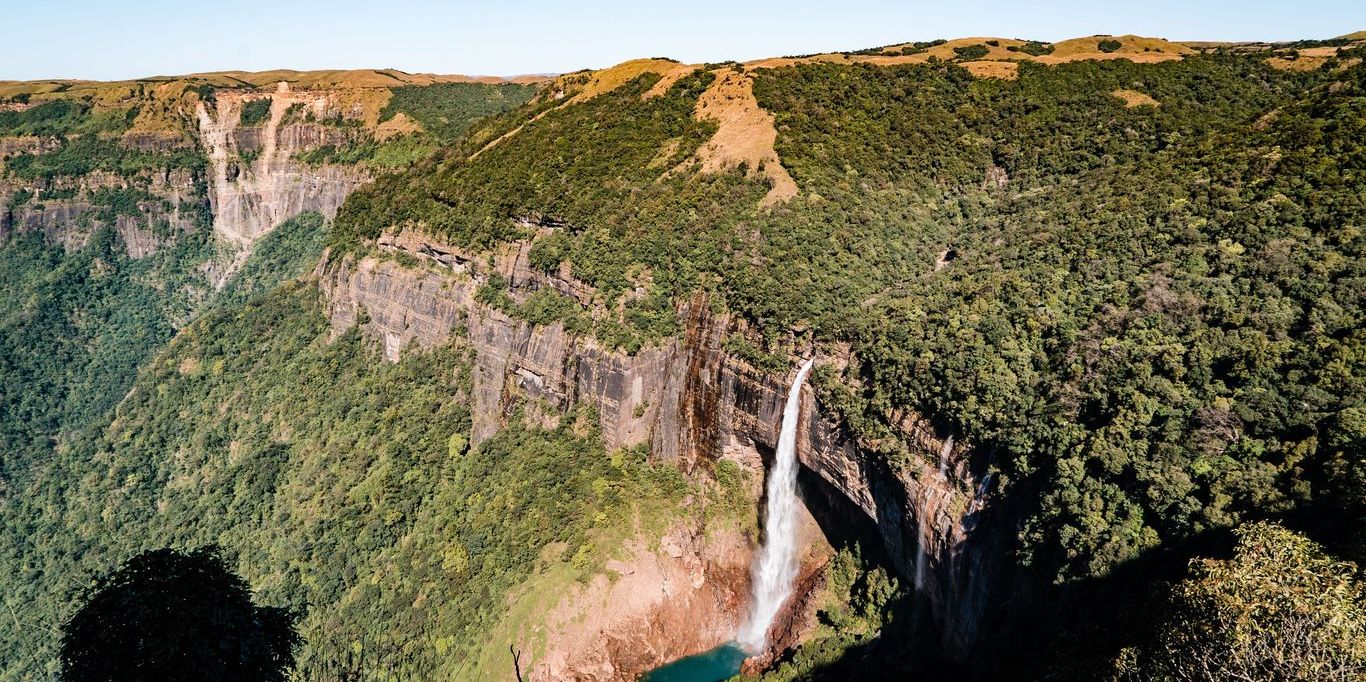
Barehipani Falls in Odisha.
Synopsis: The Odisha government is set to hand over forest land to the multinational corporate entity Vedanta Private Limited for bauxite mining. In the process, it risks displacing Adivasi communities and undermining the constitutional protections guaranteed to them under the Fifth Schedule. Complaints have also been lodged with the Union Ministry of Tribal Affairs over alleged fake gram sabhas, through which the state government claims to have obtained consent from local communities.
In Odisha, the state government is working head over heels to hand over forest land to a multinational corporate company, Vedanta Private Limited, for bauxite mining, and in the process to displace Adivasis — that is, to destroy the protections granted to Adivasis under the Fifth Schedule of the Constitution.
Not just the government; constitutional institutions and even the judicial system are deeply immersed in doing the same. In this process, which will destroy the livelihood, security, and lives of local Adivasi people, and the forest as a whole, countless illegalities, manipulations, and violations of law are taking place.
And even after all this, if one asks whether there is any long-term public interest involved in this project, the answer is no. This is merely a scheme to generate enormous profits for a single corporate entity — Vedanta. Serving Vedanta alone has become the government’s idea of performing its duty.
Recently, in the first week of December, the Forest Advisory Committee recommended to the Odisha state government that permission be granted to hand over 708.24 hectares (nearly 1,700 acres) of land, falling under the Fifth Schedule of the Constitution, in the Sijimali forest area of Rayagada and Kalahandi districts, to Vedanta for bauxite mining.
This permission is called a state-level first-stage approval. The Forest Advisory Committee is a statutory body functioning under the Union Ministry of Environment, Forest and Climate Change. It is empowered to examine proposals seeking diversion of forest land in the country for non-forest purposes —industrial projects, mining, and infrastructure — and to recommend either approval or rejection.
While the recommendation at present is to hand over 1,700 acres of forest land for mining, in reality, the total area of bauxite mining leased out to Vedanta here is 1,548.76 hectares (nearly 3,800 acres).
Although this recommendation for approval came in the first week of December, the mining project itself has been underway for nearly two years, and it is riddled with numerous illegalities from the very beginning.
First and foremost, since this is a Fifth Schedule area, the Constitution mandates that any transfer of land — whether to non-Adivasis, private companies, or even the government — can take place only after consultations with local Adivasis and after obtaining their prior consent.
In the total mining area, about half the land is forest land — land under the collective management of Adivasi communities. It is land on which Adivasis live, cultivate, and ensure that no harm comes to the forest.
Therefore, this land falls not only under the Fifth Schedule of the Constitution but also under several laws, including the Forest Conservation Act, 1980; the Orissa Scheduled Areas Transfer of Immovable Property Regulations, 1956; the Panchayat (Extension to Scheduled Areas) Act, 1996; and the Forest Rights Act, 2006. All these laws clearly stipulate that no land transfer can take place without the informed and free consent of local Adivasis.
To get around these legal requirements, the state government and Vedanta company together claimed that they had obtained the consent of Adivasis by conducting so-called gram sabhas in 10 villages in December 2023 — under heavy armed police protection and through the intimidation of Vedanta company staff.
It is the government officials who are supposed to certify that a gram sabha was held and that a particular resolution was passed there. Instead, they fabricated fraudulent certificates stating that resolutions favourable to Vedanta were passed.
In the villages of Kantamal, Aliguna, Bundel, Katibhat, Pelankona, Dumarpadar, Sagabari, and Malipadar under the Sunger village panchayat of Kashipur block in Rayagada district, and in the villages of Chulbadi and Tizmali under the Talampadar village panchayat of Thuamul Rampur block in Kalahandi district, the Adivasis state that the gram sabhas were conducted in a violent, coercive manner, under confinement and with false certifications.
Therefore, they argue that the resolutions and permissions claimed to have been passed in these gram sabhas are completely invalid.
This is not merely an allegation made by Adivasis. In February 2024, replies given by the Kalahandi District Collector-cum-Magistrate to applications filed under the Right to Information Act also revealed that villagers were forcibly made to affix their thumb impressions on gram sabha resolutions under coercive conditions.
In those RTI replies, the Collector himself admitted that large numbers of police were deployed at the locations where the gram sabhas were held, and that local goons and company officials were also present.
An even more bizarre fact emerged from the Collector’s reply. These 10 villages fall under two gram panchayats, meaning there are two sarpanches. Although all 10 gram sabhas were supposedly held on the same date and at the same time, both sarpanches signed as having participated in all 10 sabhas.
Likewise, government officials also signed, claiming that they had participated simultaneously in meetings held at different locations. This clearly proves that all those signatures were forged.
After these RTI disclosures, complaints were lodged with the Union Ministry of Tribal Affairs regarding the fake gram sabhas. The Ministry directed the Odisha state government to conduct an inquiry into the matter. However, even after a year, the Odisha government has not carried out any such inquiry.
In this situation, in September 2024, the Adivasis themselves independently conducted gram sabhas and passed resolutions opposing the mining project. They demanded that FIRs be registered and cases filed against those who had conducted the fake gram sabhas. But the government did not take any action whatsoever.
In other words, it has been conclusively established that the gram sabhas claimed by the government never took place, and that signatures and thumb impressions were forcibly obtained from Adivasis.
The deployment of large numbers of police, company officials, goons, and government officials who had no legitimate reason to be present at the gram sabhas clearly shows that the purpose was not to gather genuine public opinion but merely to intimidate people.
Another ploy adopted by the government to bypass legal provisions was to create an industrial development corporation on behalf of the state government, first transfer all this land to a so-called land bank under its control, and then hand it over to Vedanta through the back door.
Yet another illegality relates to the statutory process of preparing an Environmental Impact Assessment (EIA). Before conducting gram sabhas and obtaining the consent of Adivasis, state government agencies are required to prepare an EIA report. This report must comprehensively, scientifically, and in detail describe the region and the consequences of converting it to non-forest use.
It must assess how much forest will be destroyed, what will happen to wildlife, which plant species will become extinct, what water resources exist in the area, which human communities inhabit it, what damage will be caused to historical, cultural, and heritage resources, and overall what harm will be done to the environment.
On the basis of such an assessment, the benefits and losses of the proposed diversion must be evaluated. This is a mandatory legal process. Instead, the Odisha government prepared a token, incomplete, biased, and corporate-friendly EIA report. Even though Adivasis, people’s organisations, and civil society groups in the area strongly objected to this report, the government paid no heed.
On top of all this, for the past two years, the government has deployed massive police and paramilitary forces in the region to intimidate and repress Adivasis who are resisting the mining project, and the Adivasi organisation leading this resistance, ‘Ma Mati Mali Surakhya Manch’.
Alongside them, goons appointed by the company have also been attacking villages, Adivasis, and leaders. From June 2025 onwards, prohibitory orders have been imposed throughout the region. A terrifying situation has prevailed in which people in plain clothes pick up Adivasis and whisk them away in vehicles, leaving it unclear whether they are police, Vedanta company goons, or some other anti-social elements.
Overall, the local administrative machinery, the district administration, and the state government are working not for the people but exclusively for Vedanta.
In such a climate of fear, Adivasis are scared to step out of their homes, to take someone who is ill to a hospital, to buy daily necessities, or even to go to weekly markets or nearby towns.
On 7 December, in broad daylight at Sunger Chowk in Kashipur block, nine Adivasi leaders — men and women — were abducted, booked in false cases, and jailed. Even lawyers who are arguing in courts on behalf of the Adivasis are being threatened by the Vedanta company, while the state machinery has taken no action at all.
Are there still people in this country who believe that elected governments function in the public interest, that they work for the people, and that they operate constitutionally and lawfully?
(Views are personal.)


