


Published Dec 28, 2025 | 4:59 PM ⚊ Updated Dec 28, 2025 | 4:59 PM

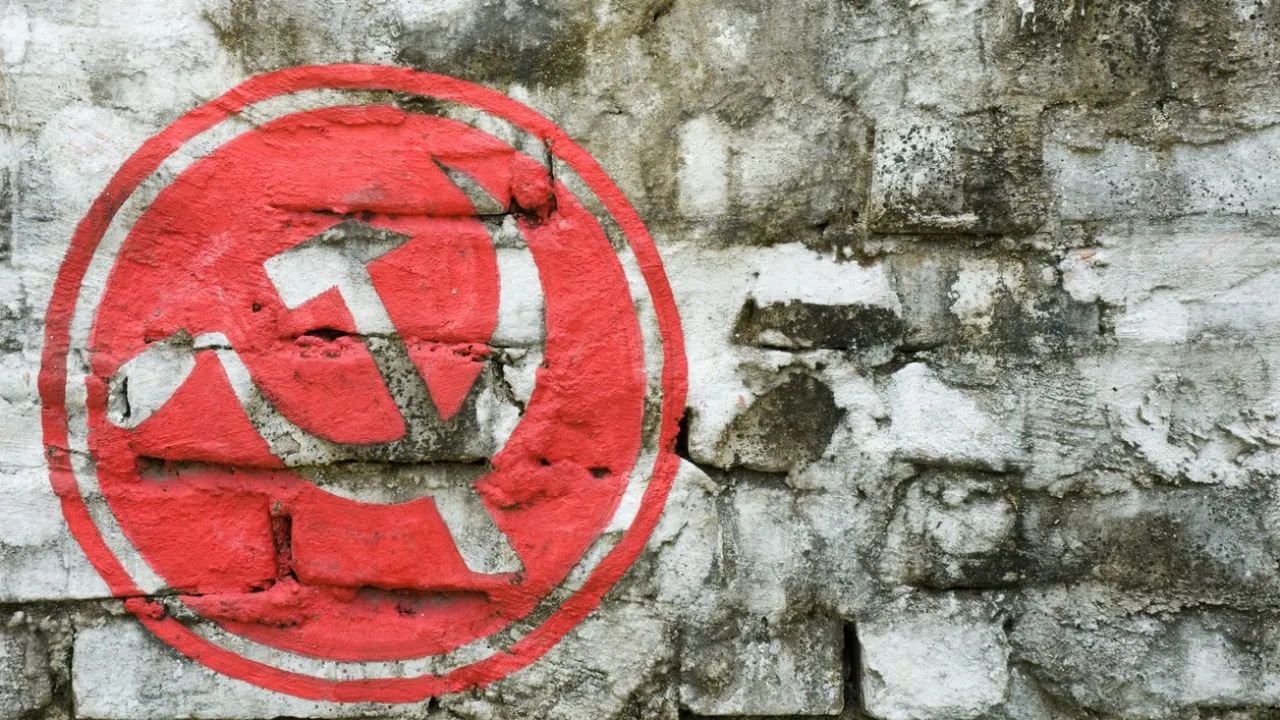
CPI (Maoist).
Synopsis: Several Maoist leaders across Indian states have surrendered recently in the wake of Operation Kagar. However, it remains to be seen whether they can enter electoral politics and navigate its muddy waters. The question that remains is whether a party born from the ashes of a protracted armed rebellion can truly survive and thrive in the cut-throat arena of Indian electoral democracy.
As the clock ticks toward March 2026, India’s security apparatus is pushing hard to conclude Operation Kagar — the Union government’s ambitious plan to eradicate the Maoist armed insurgency once and for all.
In recent months, high-profile surrenders have made headlines: Veteran leaders like Mallojula Venugopal (alias Sonu) and Takkellapalli Vasudeva Rao, along with hundreds of cadres, have laid down their weapons before state authorities. Some media reports suggest that a section of these former rebels, while firmly rejecting armed struggle as outdated, intend to retain their revolutionary ideological core and enter mainstream politics by forming a new party within the constitutional framework.
The question that looms large is straightforward yet profound: Can such a party, born from the ashes of a protracted armed rebellion, truly survive and thrive in the cut-throat arena of Indian electoral democracy?
Historical precedent offers little reason for optimism. Across India, whenever groups or individuals have abandoned the path of armed struggle in favour of parliamentary politics, their electoral performance has rarely matched their earlier revolutionary stature.
In states such as Bihar, Jharkhand, West Bengal and Kerala, the political descendants of erstwhile armed communists — now operating as legal leftist formations — have achieved only sporadic and limited success. Their representatives in state Assemblies or Parliament remain few enough to count on one’s fingers.
These modest gains, often accumulated over decades through patient organisational work, provide no ready template for leaders emerging directly from surrender ceremonies with the baggage of a violent past.
At the heart of the challenge lies the issue of legitimacy and acceptance. Will the former rank-and-file, long conditioned to underground discipline and armed hierarchy, willingly accept these now-disarmed leaders as guides in an open democratic setup? More critically, will the broader electorate — millions of ordinary voters living far beyond the forested conflict zones — extend trust and ballots to figures indelibly associated with decades of insurgency, extortion, and violence?
In the erstwhile Maoist strongholds spanning Chhattisgarh, Odisha, Maharashtra, Madhya Pradesh, Andhra Pradesh and Telangana, whatever influence these leaders once commanded through guerrilla tactics has significantly eroded under relentless counter-insurgency pressure. Converting residual sympathy or fear into sustained electoral support is an entirely different proposition.
India’s contemporary political landscape has become extraordinarily hostile to new entrants. Dominant national and regional parties command a formidable machinery, including sophisticated data analytics, finely tuned caste and community equations, lavish welfare promises, and pervasive media management.
Even well-resourced regional outfits struggle to breach the fortress. Consider the Telugu states of Andhra Pradesh and Telangana, where communist ideology — once a significant force — has now shrunk to isolated pockets in one or two districts.
Even there, communist candidates often win assembly seats only when a major party tacitly steps aside. Non-armed Marxist-Leninist formations have historically managed to send just one or two MLAs to the legislature, and that too in specific constituencies such as Illandu or Sircilla.
The story repeats elsewhere. Non-ideological new parties backed by celebrity charisma or deep pockets — Chiranjeevi’s Prajarajyam Party or Pawan Kalyan’s Jana Sena in Andhra Pradesh — generated considerable initial buzz but ultimately fell short of capturing power.
In Bihar, election strategist Prashant Kishor’s Jan Suraaj Party and, in Tamil Nadu, actor Kamal Haasan’s Makkal Needhi Maiam both polled respectable vote shares yet translated them into negligible seats. These examples underscore a harsh reality: In today’s India, launching a political party is one thing; converting it into an electoral force capable of altering existing power equations is quite another.
For former Maoists, the obstacles are compounded. Leaders who once inspired cadres through Politburo directives issued from jungle hideouts may discover that the mundane routines of electoral politics — endless door-to-door campaigning, coalition negotiations, ideological compromises, and constant fund-raising — offer little scope for the same revolutionary fervour.
The doctrinal rigidity that sustained armed struggle could become a liability when seeking broader alliances or addressing the diverse, often pragmatic aspirations of ordinary voters.
None of this implies that surrendered leaders should be barred from forming parties or contesting elections. Democratic pluralism demands space for new voices, including those seeking redemption through constitutional means. Individuals and groups must retain the right to organise and test their ideas in the public arena. Yet mass support cannot be taken for granted; it must be earned through patient, visible work amid fierce competition.
The immediate post-surrender phase may bring government rehabilitation packages — financial assistance, security cover, perhaps even symbolic encouragement. But sustained political patronage is a different matter. Will state or central governments actively facilitate the integration of these former rebels into the electoral mainstream, or will they remain wary of granting legitimacy to yesterday’s adversaries?
In the end, these remain million-dollar questions hanging over India’s vibrant yet unforgiving democratic experiment. If a new party does indeed emerge from the ranks of surrendered Maoists, its capacity to reshape political dynamics — even in regions where it once held sway — appears limited at best.
The gun may have fallen silent, but the ballot box has its own unforgiving logic. It rarely erases the past overnight, and it demands far more than ideological conviction to win its favour.
Only time — and the crucible of actual elections — will reveal whether these former revolutionaries can successfully trade red stars on olive uniforms for party symbols on ballot papers. For now, grounded realism suggests the journey will be arduous, and success far from assured.
(Views are personal.)


