

Published Jun 30, 2026 | 2:28 PM ⚊ Updated Jun 30, 2026 | 2:28 PM

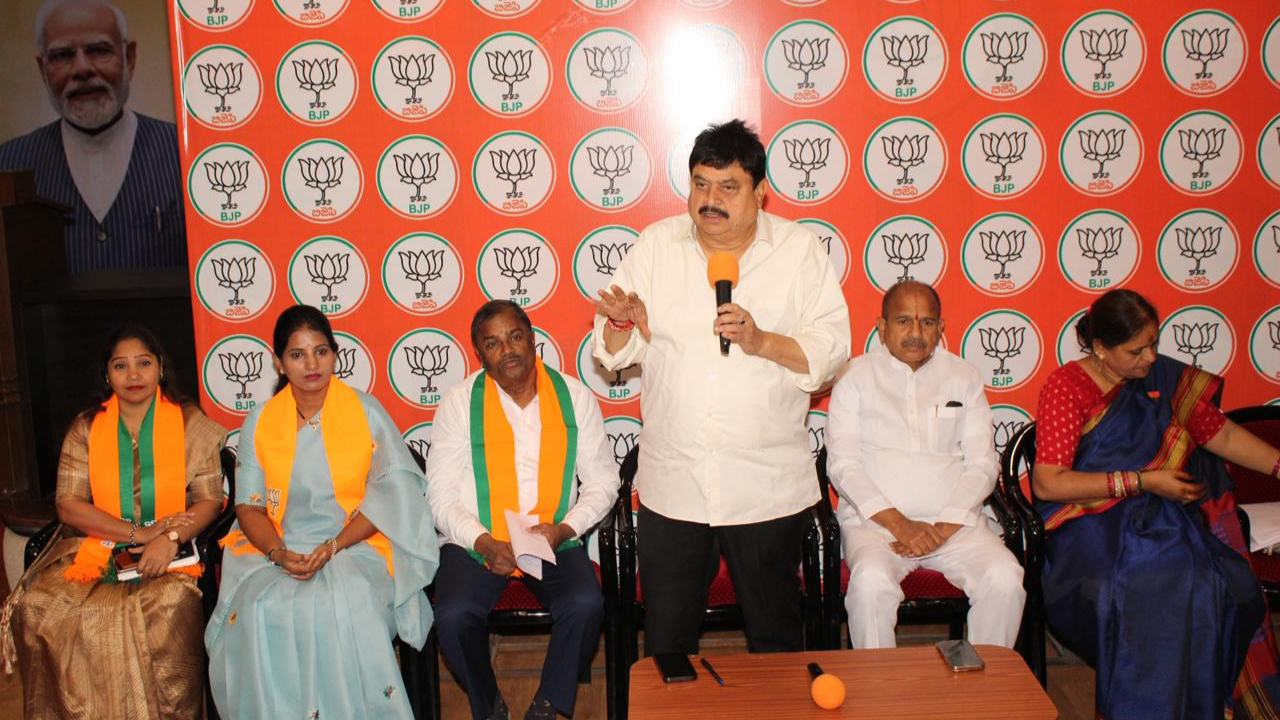
Telangana BJP president N Ramchander Rao. Credit: x.com/BJP4Telangana

Synopsis: The BJP is trying to project confidence by announcing that it will contest the next Telangana Assembly elections on its own. But then there is a thin line separating political confidence from political overreach. Which of these is it?
The Bharatiya Janata Party’s (BJP) announcement that it will contest the next Assembly elections in Telangana on its own is significant less for its immediate electoral implications than for the political message it seeks to convey. Made well ahead of any election schedule, the declaration appears intended to shape public perception rather than reflect a conclusion drawn from an imminent electoral contest. It is a statement of political intent, but whether it is also a realistic assessment of the party’s strength remains uncertain.
The BJP enters this phase with greater confidence than at any previous point in Telangana. Its improved performance in the 2024 Lok Sabha elections marked an important milestone in the party’s expansion in the State. Winning eight seats and securing over 35% vote share in the 2024 parliamentary elections enabled the BJP to emerge as a credible player in a political landscape that had long been dominated by regional forces. Those gains understandably emboldened the party leadership to project itself as an independent alternative capable of challenging both the ruling Congress and the Bharat Rashtra Samithi (BRS).
Yet, parliamentary success and Assembly success are rarely interchangeable in Telangana. The electorate has repeatedly demonstrated its ability to distinguish between national and State elections. While national issues, leadership, and broader ideological considerations often influence parliamentary voting, Assembly elections are shaped more decisively by local governance, welfare delivery, caste equations, regional aspirations, and the credibility of constituency-level leadership. A party’s performance in one election cannot automatically be treated as an indicator of its prospects in another.
The BJP’s declaration must therefore be understood as part of a larger political strategy. By ruling out dependence on pre-poll alliances, the party seeks to project confidence and organisational maturity. It is also attempting to dispel the perception that its growth in Telangana is contingent upon support from regional partners. In politics, perception often precedes reality. A party that projects itself as capable of governing independently is more likely to attract political workers, local leaders, and undecided voters than one perceived as seeking alliances before entering the electoral arena.
The principal audience for this message is arguably the politically neutral voter. Telangana has a sizeable section of floating voters whose choices are influenced not by long-term party loyalties but by evolving political circumstances. Such voters often gravitate towards parties that appear confident, stable, and electorally viable. The BJP’s declaration may therefore be seen as an attempt to reinforce the perception that it has moved beyond being a marginal force and is now prepared to stake an independent claim to power.
At the same time, caution is warranted before reading too much into the announcement. The next Assembly election remains some distance away, and the State’s political environment could undergo substantial changes before voters return to the polling booths. Electoral fortunes are shaped by governance, economic conditions, candidate selection, local alliances, and unforeseen political developments. Assertions made in the absence of an immediate electoral test inevitably carry an element of political theatre.
Also Read: Revanth Reddy unruffled as the Telangana Congress kettle threatens to boil over
The BJP’s organisational expansion, though visible, is still a work in progress. Compared with the Congress and the BRS, both of which possess deeply entrenched grassroots structures built over decades, the BJP continues to strengthen its presence in several districts. Winning parliamentary constituencies is one challenge; translating that support into victories across 119 Assembly segments requires a far more extensive organisational network and sustained engagement with local issues. Confidence alone cannot substitute for organisational depth.
The announcement also serves an important internal purpose. Political parties frequently use such declarations to energise their cadre, reassure workers about the leadership’s direction, and encourage prospective entrants who prefer to associate with parties perceived to be on an upward trajectory. In that sense, the statement is as much about organisational consolidation as it is about electoral positioning.
There is, however, a fine line between political confidence and political overreach. If the BJP’s assertion is supported by continued expansion at the grassroots, effective leadership, and consistent electoral gains in local body institutions and by-elections, the declaration will be viewed as an early articulation of a genuine political transformation. If not, it risks being dismissed as a rhetorical exercise aimed primarily at dominating the political discourse.
Ultimately, the significance of the BJP’s announcement lies not in the declaration itself but in its ability to convert political messaging into electoral credibility. For the moment, the party has succeeded in placing itself at the centre of Telangana’s political conversation. Whether this reflects an irreversible shift in the State’s political balance or is merely an exercise in strategic signalling will be determined only when the electorate delivers its verdict.
Until then, the BJP’s going-it-alone poll call is best understood as a calculated attempt to shape perceptions, consolidate its organisation, and attract the support of politically uncommitted voters. It is a strategy that acknowledges the growing space the party occupies in Telangana politics, while also reminding observers that political narratives, however compelling, must eventually withstand the test of the ballot box.
Also Read: Are thirty-seven per cent of voters in Telangana suspect? Seriously!
(Edited by R Rajesh Kumar.)



