

Published Jul 14, 2026 | 12:02 PM ⚊ Updated Jul 14, 2026 | 12:02 PM


Synopsis: As demand surges, the debate should no longer be framed as air-conditioners versus coolers. The real question is which cooling technology will be the apt one.
The lingering impact of the Super El Niño has pushed several regions into what can only be described as a second summer. With temperatures soaring well above the seasonal average, the prolonged heat is unleashing severe heatwave conditions and scorching vast stretches of the country. Now comes an evaporative revolution that provides an alternative to ACs.
Every summer, India’s heatwaves expose an uncomfortable truth: the country’s cooling challenge is no longer merely about comfort. It has become a matter of public health, economic productivity and climate resilience. Among the stark figures to consider is an International Labour Organisation finding that rising heat stress could wipe out as many as 34 million full-time jobs in the country by the end of the next four years. The International Energy Association has also projected that demand for cooling in India “will more than double as incomes rise and temperatures increase” by 2035.
As temperatures repeatedly soar above 45°C across several regions, the instinctive response has been to install more air-conditioners. Yet this is an increasingly unsustainable solution. Conventional air-conditioners consume enormous amounts of electricity, strain power infrastructure, increase carbon emissions and contribute to the urban heat island effect by releasing waste heat into the surrounding environment.
India’s response to rising temperatures therefore requires a fundamental shift—from dependence on mechanical refrigeration to climate-responsive cooling technologies. Among these, evaporative cooling deserves far greater policy attention than it currently receives.
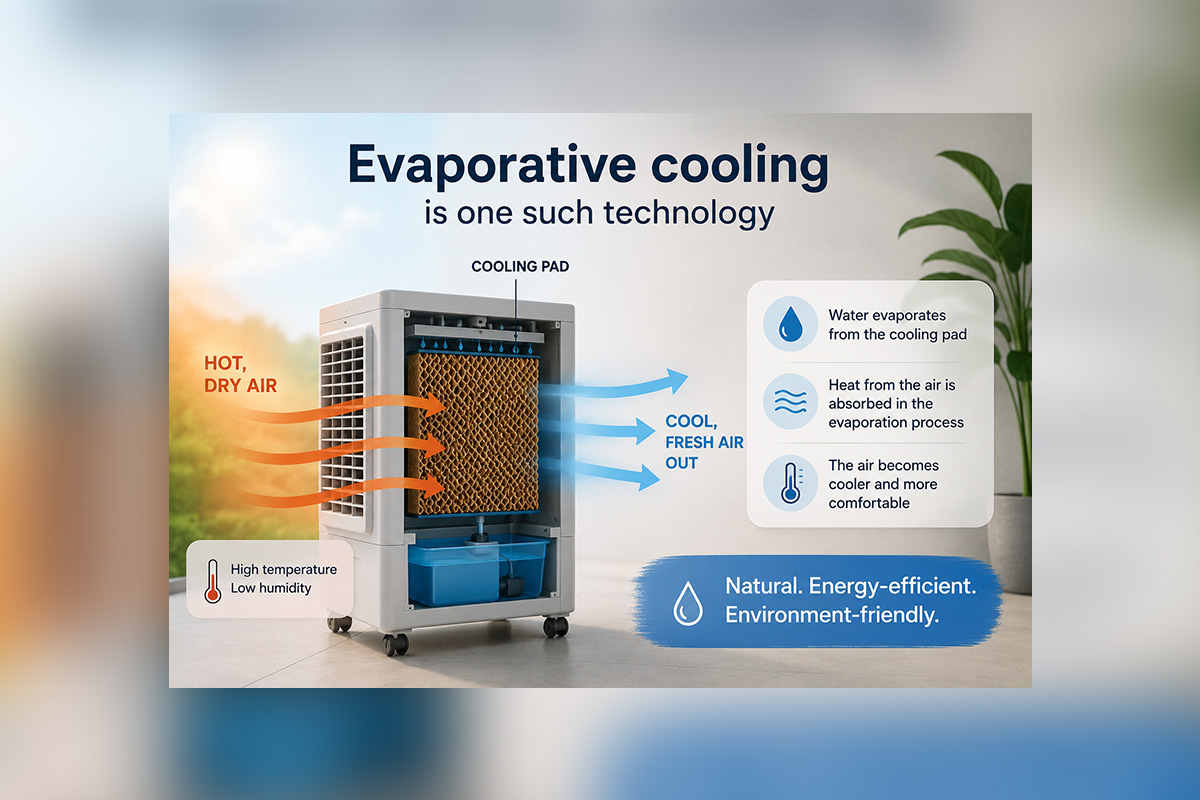
The science behind evaporative cooling is remarkably simple. As water evaporates, it absorbs heat from the surrounding air, reducing the air temperature naturally. Modern evaporative cooling systems use this principle to provide thermal comfort while consuming only a fraction of the electricity required by compressor-based air-conditioners. In hot and dry climatic conditions, these systems can lower indoor temperatures significantly while using nearly 70 to 90 per cent less electricity.
Far from being an outdated technology confined to traditional desert coolers, evaporative cooling has evolved considerably. Advanced direct and indirect evaporative cooling systems are now used in factories, airports, commercial complexes, educational institutions and warehouses across many countries. They offer an economical and environmentally sustainable alternative for buildings where precise temperature control is unnecessary but comfortable working conditions are essential.
India recognised the importance of sustainable cooling through the India Cooling Action Plan, which envisioned reducing cooling demand, improving energy efficiency and promoting climate-sensitive buildings. Yet, despite this forward-looking policy, public discourse continues to equate cooling almost exclusively with air-conditioners. The enormous potential of evaporative cooling remains largely overlooked in government programmes, urban planning and building design.
This disconnect is becoming increasingly costly as India’s heat risk intensifies. Heatwaves are no longer exceptional events confined to a few northwestern states. They have become recurring climatic realities affecting large parts of the country with increasing frequency and duration. Rising temperatures have disrupted agriculture, reduced labour productivity, increased hospital admissions and placed immense pressure on electricity grids during peak summer months.
Cooling, therefore, must be viewed as essential public infrastructure rather than a luxury appliance.
Also Read: The human body has limits. Climate change is testing them on the playing field
The first policy priority should be the design of buildings. India’s rapidly expanding urban landscape presents a unique opportunity to reduce future cooling demand before it is created. Every new government office, school, hospital, warehouse and affordable housing project should incorporate passive cooling principles. Better building orientation, reflective roofing materials, shaded windows, natural ventilation, thicker walls and increased tree cover can substantially reduce indoor temperatures without consuming additional energy.
Evaporative cooling can complement these passive measures effectively. Instead of relying entirely on energy-intensive refrigeration, buildings can combine natural ventilation with evaporative systems to achieve thermal comfort at far lower operating costs. Such integrated design approaches are especially suitable for the dry and semi-arid regions of Rajasthan, Telangana, Andhra Pradesh, Karnataka, Maharashtra and parts of central India.
Unfortunately, many Indian cities continue to move in the opposite direction. Rapid concretisation, shrinking green spaces, glass-clad buildings and disappearing water bodies have intensified the urban heat island effect. Municipal Heat Action Plans often focus on emergency responses such as drinking water kiosks, medical preparedness and public advisories. While these measures save lives during extreme heat events, they do little to address the structural factors that make cities increasingly hotter year after year.
Industrial policy presents another untapped opportunity. Manufacturing units, textile mills, logistics parks, automobile plants and food processing industries primarily require comfortable working environments rather than precision air-conditioning. Modern evaporative cooling systems can significantly reduce electricity consumption while improving worker productivity and occupational safety. For a country aspiring to become a global manufacturing hub, affordable industrial cooling should be regarded as an economic competitiveness issue rather than merely an energy concern.
Critics often point to water consumption as a limitation of evaporative cooling. The concern is valid, particularly in water-stressed regions. However, the comparison should not be simplistic. Conventional air-conditioners depend on electricity, much of which continues to be generated by thermal power plants that themselves consume substantial quantities of water. When evaluated across the entire energy cycle, evaporative cooling often presents a more balanced environmental footprint, especially in regions where climatic conditions favour efficient evaporation.
Technological innovations are further expanding the scope of evaporative cooling.
Indirect evaporative cooling systems reduce indoor humidity while delivering cooler air. Hybrid systems combine evaporative pre-cooling with refrigeration, reducing compressor loads and improving overall efficiency. Smart sensors, automated humidity controls, recycled water systems and solar-powered cooling units are making these technologies more reliable and adaptable to diverse climatic conditions.
The challenge now lies in policy integration. Building codes, urban development policies, Smart Cities initiatives, affordable housing schemes and state-level Heat Action Plans should all converge around climate-responsive cooling strategies. Financial incentives for energy-efficient cooling technologies, mandatory thermal performance standards for public buildings and greater investment in research and domestic manufacturing can accelerate adoption.
Equally important is changing public perception. The debate should no longer be framed as air-conditioners versus coolers. The real question is which cooling technology is most appropriate for a given climate, building type and economic context. There is little justification for deploying energy-intensive refrigeration in areas where evaporative cooling can deliver comparable comfort at a fraction of the environmental and financial cost.
India’s battle against extreme heat will not be won simply by installing millions of additional air-conditioners. It will be won by designing cooler cities, constructing climate-sensitive buildings and embracing technologies that work with nature rather than against it. Evaporative cooling is one such technology. Properly integrated into India’s cooling policy, urban planning and industrial strategy, it can become an indispensable tool for adapting to a hotter future while keeping both energy consumption and emissions under control.
Also Read: Extreme heat drives Tamil Nadu’s outdoor labourers to brink
(Edited by R Rajesh Kumar.)



