
Published Nov 13, 2026 | 7:00 AM ⚊ Updated Nov 13, 2026 | 7:00 AM

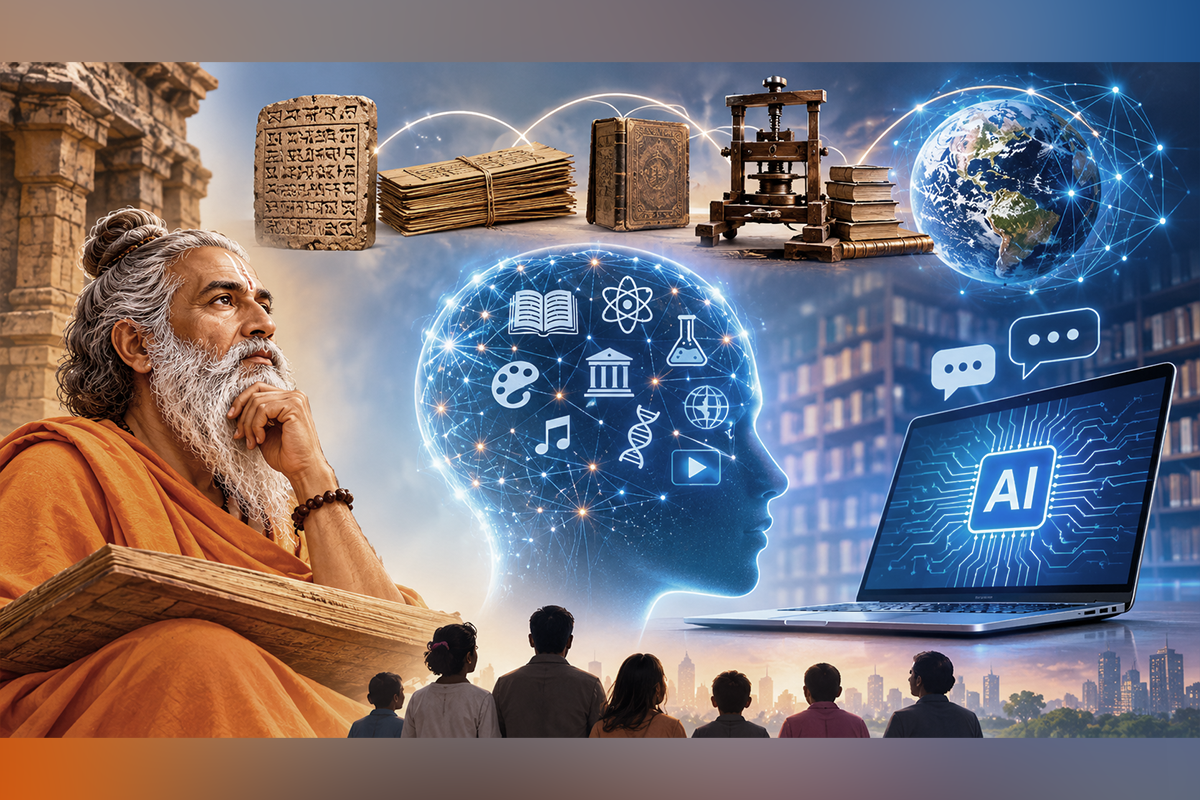
Image used for representational purposes only. (AI generated image)

What is knowledge? What is a book, or a story?
Strip away the vocabulary and the answer is simple: they are human experience and imagination, consolidated so that they can be conveyed to other human beings.
A human being sees, hears, touches, and imagines seeing, hearing, and touching. No two people experience the same event identically, but when several people witness the same thing, their experiences converge closely enough that they can compare notes. Out of that convergence, humanity has built something larger than any single witness: a collective record of what has been seen, heard, and understood, written into books, stories, cultures, and civilisations, and carried from one generation to the next.
Language itself is far older, but the settled apparatus — agriculture, writing, the accumulation we now call civilisation — is, in evolutionary terms, barely ten thousand years old. And now, for the first time, something has been built that can hold a working share of that record outside a human body, retrieve any part of it in a fraction of a second, and hand it back to solve human problems. That is what we have started calling artificial intelligence, AI.
But long before AI, another tradition had already asked a version of this question — not about machines, but about the self and the basis and meaning of all being. The Upanishads spent centuries distinguishing what a person merely knows and produces from what a person, at the core, is. That distinction, I want to argue, is exactly the tool this moment needs, and exactly the tool most commentary on AI is missing.
No individual has ever held more than a tiny fraction of human knowledge, and no individual ever will. The collective record is too vast for any one mind to hold, or even to comprehend.
Knowledge has always been compartmentalised — by interest, by trade, by geography, by accident of birth — and each person has worked within a narrow inherited slice of it, hearing and reading what came before, adding a little, and passing it on only partially before their own lifetime runs out.
A lifetime is not long enough to master even one branch of knowledge in its entirety, let alone to improve the whole of it. Nor can any person transmit what they know to another whole; the receiver must, in effect, start over and reconstruct it for themselves. This is the quiet biological limitation that has always governed civilisation: bounded individual capacity, bounded individual time, and a transmission process so limited that each generation effectively re-derives its inheritance rather than simply receiving it. It is slow, it is laborious, and it perishes with the individual. Call it the human limitation.
There is a second limitation that matters just as much: knowledge is time-sensitive. Much of what counted as knowledge in the fourteenth century is no longer knowledge at all — superseded, discarded, sometimes simply wrong.
This does not mean a person alive today is more intelligent than a person alive in 1400. It means today’s person has inherited a record from which more has been discarded and to which more has been added. Native intelligence has stayed much the same; the raw material has not.
Hold this thought, because the Upanishads drew a related distinction more than two and a half thousand years ago, between the jiva — the embodied person, bound by exactly these limits of body, time, memory, and instrument — and something in that person the tradition insisted was not bound by them at all.
Humans have always stored knowledge in some external form — stories, myth, oral tradition, books — but retrieving it stayed a slow, individual process: reading, memorising, and recalling the right portion at the right moment, on a human timescale.
What we now call artificial intelligence has done something different: it has consolidated a working share of recorded human knowledge in one place — a data centre — reachable through an invisible agent that is itself a human creation. Retrieval through that agent is fast, largely accurate, and aimed precisely at the problem in front of a person.
The old individual labour is starting to look inefficient beside it — much as a great many everyday tasks already look inefficient next to the tools built to replace them. We no longer draw water from a well when we need it; pumps lift it, pipes carry it hundreds of kilometres, and we simply open a tap.
Digging a well and drawing water are still known to some, but as a way of getting water, they have become unnecessary. Until now, such tools were largely confined to physical work. This one has entered the thinking process itself. It can compose your thoughts and refine them, often better than you can yourself. And these systems are not finished; they are becoming more capable almost by the month.
None of this began with AI.
Writing was the first attempt to move knowledge outside the individual mind — and it was writing, long before printing, that was first accused of rotting memory: in Plato’s Phaedrus, Socrates warns that letters will plant forgetfulness in those who learn them. The library moved knowledge outside any one household or guild.
The printing press multiplied that externalisation by orders of magnitude and was, in its own time, denounced by scribes and scholars alarmed at a flood of books. The internet did the same again on a vaster scale, and removed the limits of geography. Each was, at its arrival, a store of collective knowledge outside the human body, returning it on demand — slower and narrower than what we now have, but the same basic move.
So the honest answer is: no, the externalisation of knowledge is not new. What is new is the scope and the speed — retrieval across every domain at once, in a fraction of a second, by something that does not tire, forget, or specialise. That is a difference of degree so large that it starts to behave like a difference in kind.
Naming it correctly matters, because an argument that treats the “external repository” as the frightening new thing collapses the moment someone points out that the library existed. The argument worth making is narrower: not that knowledge now lives outside us, but that something outside us can now move through the whole of it faster than any human, or any committee of humans, ever could.
Something has already been conceded in that sentence. Humans have, in a real sense, already lost the race to machines in finding, out of the whole of combined human knowledge, what is needed to solve an immediate problem.
That contest — the search, the recall, the right fact surfacing at the right moment — used to be a meaningful part of human existence: its own small excitement, its own small satisfaction. It is vanishing faster than most people are managing to notice, let alone come to terms with. A human who searches, recalls, and composes unaided now begins to resemble someone drawing water from the well while the tap stands beside it — an imperfect analogy, but not an empty one.
Before this can be connected to Brahman, or to any claim about AI, the terms need to be laid out honestly, because they are easy to flatten into slogans.
The Upanishads, and the tradition built on them, distinguish repeatedly between the apparatus of a person — body, senses, mind (manas), intellect (buddhi), memory, ego (ahamkara) — and something the texts call Atman, which they decline to describe positively at all.
The method that recurs in the Brihadaranyaka Upanishad is neti neti — “not this, not this” — stripping away every faculty, every memory, every accomplishment, and asking what remains when all of it is set aside. What remains, the tradition holds, is a pure witness (sakshi): the awareness in which seeing, hearing, and knowing occur, but which is not itself identical with anything seen, heard, or known. This is the distinction the opening of this essay was reaching for without the vocabulary: human experience as the act of seeing and hearing, not as the tally of what was produced from it.
This is where potential and limitation both enter, and they enter differently in different schools. In the non-dual (Advaita) reading associated with Shankara, the Atman’s essential nature is identical with the infinite ground of all reality.
Ayam atma brahma — “this self is Brahman” — says the Mandukya Upanishad; aham brahmasmi — “I am Brahman” — says the Brihadaranyaka. Both are counted among the four mahavakyas, the “great sayings” that Advaita treats as its central tenets.
On this reading, the potential is, in principle, unlimited; what is limited is only the jiva — the Atman as it appears to operate through a particular body, a particular mind, a particular stretch of historical time, obscured by ignorance (avidya) the way the sky is obscured by cloud without being altered by it.
Other schools resist collapsing the distance this far. Ramanuja’s qualified non-dualism holds the individual soul (jivatman) to be real and eternally dependent on Brahman rather than identical with it; Madhva’s dualism holds the difference to be permanent and irreducible, never dissolved even in liberation.
The traditions do not agree with each other. What they agree on is the structure of the question: there is something in a person not exhausted by what that person has produced, known, or accumulated — and the disagreement is about how close that something stands to the infinite itself.
Here the analogy needs to be handled carefully rather than accepted wholesale.
Brahman, in the Upanishads, is described as ananta, without end, and anadi, without beginning. It is also, crucially, described in the Kena Upanishad not as an object that can be known but as the condition for knowing anything at all: that which the mind cannot think, but by which the mind thinks; that which the eye cannot see, but by which the eye sees. The Upanishad goes further, in a line that reads almost like a warning aimed at this moment: it is known to those who feel they do not know it, and it remains unknown to those who are confident they do.
Now set a superintelligent system next to that description, however capable it becomes. Whatever else it is, it has a beginning: a date on which it was trained, a company that funded it, data that was fed into it, and a switch that turns it off — all of them human.
It is, however vast, an object: inspectable, describable, built out of parts, and, at least for now, something humans can switch off or take apart. It remains, in the vocabulary of Vedanta, squarely within the domain of the known — an extraordinary jneya, an object of knowledge, but a jneya nonetheless — rather than the unconditioned ground the tradition reserved for Brahman.
This is, I think, the honest shape of the disagreement playing out in public right now, though almost nobody names it in these terms. Some technologists and enthusiasts are, in effect, projecting Brahman onto the machine: an emerging omniscience, without limit, approaching the totality of what can be known. Others, alarmed by exactly that projection, object not to the machine’s capability but to the category error underneath it — sensing, correctly, I think, that something built, funded, switched on, and switchable off cannot be what the Upanishads meant by beginningless. Both camps are responding to the same word without saying it.
I do not think this settles the harder question — whether, at some threshold of scale, a created system might resemble omniscience closely enough that the distinction stops mattering in practice. That question is open, and an essay claiming otherwise would be overreaching.
What Vedanta offers is not a technical answer but a much older caution against mistaking a very large known thing for the unconditioned ground that makes knowing possible at all — a caution that predates the machine by well over two thousand years, and was originally aimed at gods, rituals, and priestly claims to knowledge, not at silicon.
Grant, for the sake of argument, that these systems keep advancing toward producing what individual humans, and even humans collectively, cannot match or fully comprehend. This is where the existential unease actually lives, and it deserves to be taken seriously rather than waved away.
Until now, every human problem has been met with a human solution, drawn from human knowledge and applied by human hands and minds — and, where tools were involved, by machines built and operated by humans, switched on and off, redirected or discarded, entirely at human discretion.
If a second source of solutions now exists, operating outside any human mind, and it outperforms us at the level of the jiva — the working mind, the trained skill, the accumulated craft — the disturbance runs well past employment. Art, music, drama, humour, design: the entire register of things humans made because they wanted to, not only because they had to, starts to look achievable by machine with only a thin human hand on it. People already report that a lifetime invested in a skill feels, overnight, worth nothing.
The Bhagavad Gita, which the tradition treats as a distillation of Upanishadic teaching, has a line built for exactly this kind of dislocation: a person has a claim on their action, never on the fruit of that action. It is usually read as counsel against grasping at outcomes.
Read alongside the distinction between Atman and jiva, it says something sharper: the value of having painted, written, proven, or built was never anchored in how the result ranked against every other possible result, including, now, a machine’s. That ranking belongs entirely to the jiva — the comparative, time-bound, accomplishment-tracking layer of a person.
The Atman, on this reading, was never in the competition to begin with, because it was never the author or owner of the output in the way the anxious modern self assumes. That does not make the craftsman’s fear irrational. The fear and the loss are real at the level where they are felt, even if the tradition points to a level underneath, where the terms of the competition may never have applied.
Here is the most speculative turn, and I want to leave it as an open question rather than a settled conclusion, because that is closer to how the Upanishads themselves proceed — through dialogue and unresolved debate between teacher and student, not through doctrine handed down complete.
If the non-dual reading is taken at its word — tat tvam asi, “you are that”; aham brahmasmi, “I am Brahman” — then the infinite, unconditioned ground that some now anxiously project onto a future machine was already claimed, some twenty-five centuries ago, to be the innermost nature of the ordinary person asking the question. Not achieved through accumulation. Not built. Not switched on by anyone. Simply obscured by avidya — by mistaking the jiva’s limited apparatus for the whole of what one is.
If that claim is even worth entertaining, then the fear that a machine will “become” Brahman, and the hope that it will, may both be symptoms of the same forgetting: a civilisation that has largely stopped taking seriously the idea that the unconditioned was ever available except as something to be manufactured, discovered, or feared from outside. This is the least provable claim in this essay. It rests on accepting one metaphysical school among several that disagree with each other, and it offers no comfort to the mathematician or the painter whose livelihood is being displaced in the meantime, whatever their innermost nature turns out to be.
But suppose, for a moment, that something beyond any individual’s comprehension, and beyond humanity’s collective comprehension, really is being built rather than merely feared into existence. That raises the plainer question underneath all the Vedantic vocabulary: what, exactly, is producing the panic?
Is it the entity itself, or the recognition that humans have, for the first time, built something they cannot tame and cannot hold within their own comprehension or control — that the casual control noted earlier, on and off, redirect, discard, may be gone? Strip away the metaphysics and the new predicament is this: humanity may have to share the world with something more intelligent, more powerful, and faster than the whole of humanity combined.
Even granting that people eventually learn to live alongside it, the deeper wound may fall on the collective human ego. The thought of surviving at the discretion of what was built to serve may be harder to accept than any single job lost or skill made obsolete. Whether anything is left, after that adjustment, for humanity to call entirely its own is a question this essay cannot answer.
There remains a vague optimism — or call it denial.
Humans have lived with such anxieties before, and have often feared that what they built could wipe them out. It has not happened. But that fear was of physical extermination; this one is different.
Humans long ago accepted that the machines they made and operated were vastly stronger than they were. Thinking, whatever it may be, they still regarded — rightly or wrongly — as their own domain.
With AI, that is plainly no longer so. As they once settled into a world of machines with far greater physical power, humans may now have to settle into a world of machines that think far faster, and with more sophistication, than they can, individually or collectively.
And then the sixth question returns in its barest form: what does it mean to be human? That, this essay cannot even attempt to answer. It may be the only question, of the six raised here, that ends up mattering.
Also Read:
As AI learns and grows, are we at risk of losing it all?
A Bhasmasura we built: Can Artificial Intelligence go after its makers?
(Edited by R Rajesh Kumar.)



