

Published Oct 14, 2026 | 9:45 AM ⚊ Updated Oct 14, 2026 | 9:45 AM

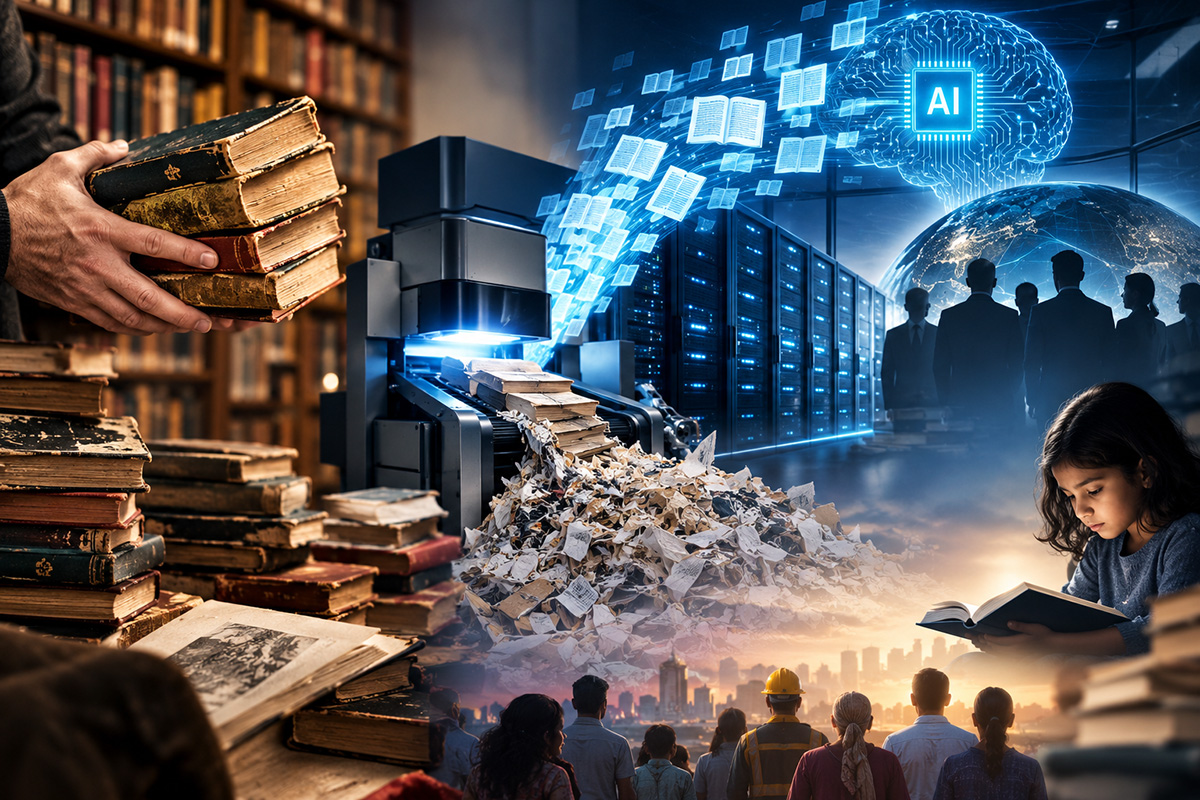
Image used for representational purposes only. (AI generated image)

Synopsis: AI systems are “trapping” knowledge that humanity has accumulated over centuries. If people stop reading original sources and rely instead on AI summaries, critical thinking, creativity, and independent research will weaken. And that is worrisome.
In recent times, companies developing artificial intelligence (AI) have been collecting hundreds of thousands of old, rare, and out-of-print books.
Reports indicate that some AI giants — particularly Anthropic, under a project called “Project Panama” — have purchased millions of books, broken their spines, cut them apart, fed the pages into high-speed scanners to digitise them, and ultimately discarded the physical books as waste.
These companies are buying large numbers of old books and research volumes, focusing especially on “less common, high-quality, out-of-print” titles. Internal documents suggest their goal is “to destructively scan every book in the world.”
Massive purchases of these invaluable books are continuing. Interestingly, there was a strong backlash when ISBNdb, the world’s largest online book database, put up a marketing page offering to supply hundreds of thousands of these books to AI labs. The company had to withdraw the page.
The AI giants are infringing on the copyrights of the authors and publishers of these books in ways that fall outside the reach of the law.
Older books, especially those printed before 2022, are being described as “writings uncontaminated by AI generation”. As a result, they are regarded as ideal for data collection.
Booksellers have, in particular, expressed concern about the manner in which AI companies are buying rare or out-of-print titles in bulk. Once a book has been scanned and its physical copy no longer exists, that knowledge remains locked inside a few corporate servers, under their exclusive control.
AI systems, particularly large language models, are “trapping” knowledge that humanity has accumulated over centuries. Rare volumes, professional reference books, and lesser-known works in the humanities and sciences are being digitised and absorbed into corporate datasets.
If the physical copy of a book disappears, independent researchers, libraries, and ordinary readers may no longer be able to access the source in the future. Knowledge will no longer reside in open libraries but could instead remain within corporate systems. This risks creating a monopoly over knowledge.
If only a few companies possess the most valuable, clean training data, they will dominate the market. They could turn knowledge into a weapon for profit, marketing, and competitive advantage.
Thinkers like Yuval Noah Harari argue that AI could concentrate knowledge and power in the hands of a few, placing democracy and public freedom at risk.
Critics such as former Anthropic and OpenAI researcher Jacob Coxon have warned of worse, raising the doomsday possibility of AI wiping out humanity. Coxon warns that these firms are racing towards self-improving superintelligence, which poses an existential threat to humanity. Surprisingly, some of the bosses of AI giants share these concerns and want the breakneck pace of development to be checked.
By 2026, the AI field has expanded far beyond a handful of companies. Anthropic stands out for developing Claude, OpenAI for ChatGPT and the GPT series, while Google DeepMind has Gemini, Meta has Llama, and xAI has Elon Musk’s Grok. Microsoft, Amazon, Nvidia, Mistral AI, DeepSeek, ByteDance, and others have also entered the arena.
It would be a mistake to think of all of them as mere technology companies. They are developing technologies with the potential to transform — or even destroy — human society, and that brings with it numerous ethical and philosophical questions. Their lack of limits, control, accountability, responsibility, and transparency is genuinely frightening to many.
Another development worth noting is how frontier labs such as Anthropic, Google DeepMind, and OpenAI have recently begun hiring philosophy researchers, intellectuals, and experts from various fields. This has been called the “philosophy majors’ revenge.”
The field of artificial intelligence is no longer limited to coding, neural networks, and data science. It is now grappling with deeper questions about human nature, ethics, consciousness, and values.
As AI’s global presence continues to expand, local resources are also being consumed, the environment is coming under pressure, national security is being threatened in many countries, and millions of people are losing their livelihoods. AI use has increased in intelligence agencies, defence and military sectors.
Data centres required for AI models consume electricity, water, and land, contributing to environmental pollution.
Worryingly, the rise of AI and the threat it poses to jobs worldwide come at a time when the cost of living is rising for ordinary people.
For these and many other reasons, large-scale protests against AI companies — especially OpenAI, Anthropic, Google, and DeepMind — have taken place worldwide in 2026. In the United States alone, 142 protests were held across 42 states in July 2026.
Demonstrations occurred in many European countries too. Even in Visakhapatnam, where a $15-billion Google data centre is being planned, locals are strongly opposing the establishment of data centres.
Then there is the risk of human intelligence being dulled by the proliferation of AI. Books written after countless hours of thinking, observation, and research are not merely sources of information. The intellectual struggle that produces them — and the thought processes, criticisms, and discussions that arise along the way — are essential to society and to human progress.
These form part of our cultural roots. When books stay in libraries, they remain independently accessible to everyone. Once absorbed into an AI model, that information is filtered, altered in many ways, condensed, and reconstructed according to the values and profit motives of the companies involved. If people stop reading books and rely only on AI summaries, critical thinking, creativity, and independent research will weaken.
If the production and distribution of knowledge fall under corporate control, people could become mere consumers and dependents. As we race towards superintelligence without proper controls, this situation could itself become a threat to the very existence of knowledge. When knowledge remains in the hands of a few and is used for profit and power, social inequalities and knowledge gaps will widen.
There is a real danger that people will lose their own intelligence and self-reliance and become dependent on the information AI provides.
Overall, this trend is leading towards the control, monopolisation, and commercialisation of knowledge for corporate profit. Destroying books is not merely a technical necessity. It is a process of turning knowledge into a commodity and a weapon. It is also a challenge to culture and human civilisation.
Knowledge is becoming a market commodity.
Already, crores of people who have been pushed away from education survive through physical labour. AI is threatening even those workers by replacing human effort with robots and advanced technology.
What, then, is to become of these “surplus labourers”? Alongside existing economic inequalities, what will happen to the many people who cannot afford to purchase knowledge in the AI-first era?
Also Read:
A Bhasmasura we built: Can Artificial Intelligence go after its makers?
Tools that enslave: Ivan Illich’s questions for India
Humans First, Machines Second: Reclaiming human agency in the age of artificial intelligence
(Edited by R Rajesh Kumar.)



