

Published May 20, 2026 | 11:38 AM ⚊ Updated May 20, 2026 | 11:38 AM

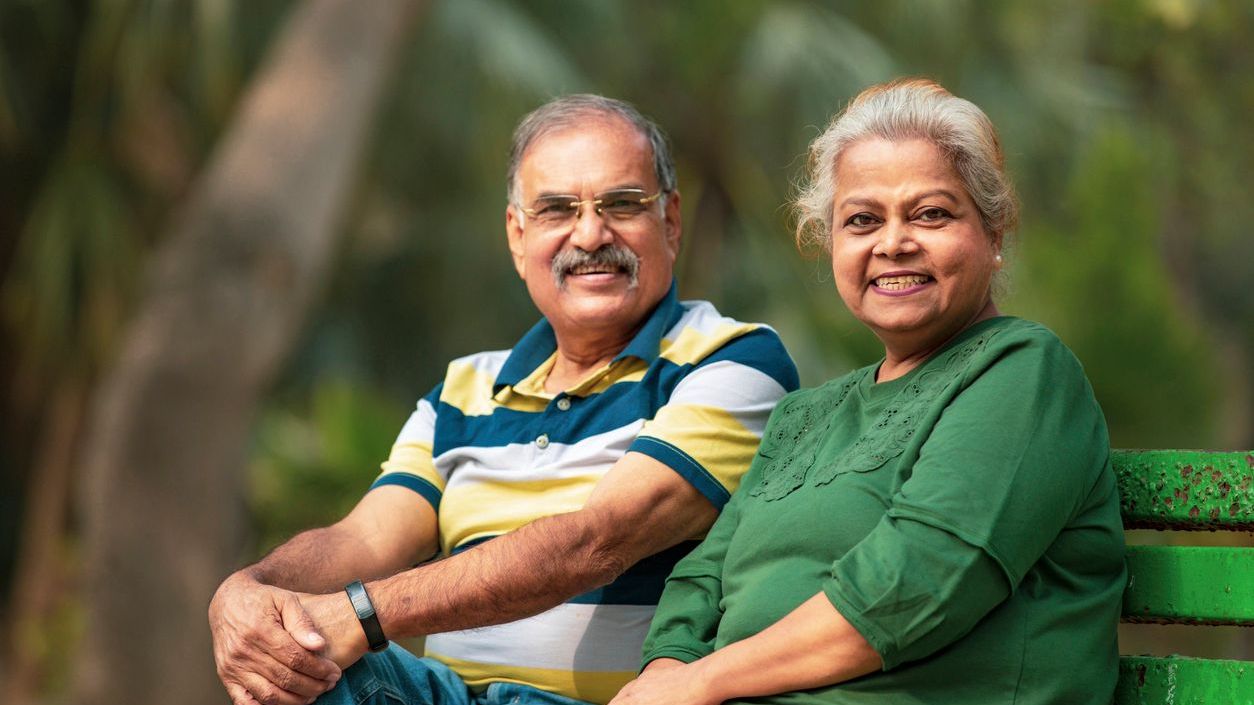
An elderly couple. (iStock)

Synopsis: Kerala’s new UDF government is attempting to prepare for the state’s rapidly ageing population by proposing a separate department for senior citizens and studying countries like Japan, where organised elder-care systems have evolved over decades. The idea reflects both urgency and ambition: While Kerala wants to build stronger healthcare, home care, and welfare support for the elderly, officials also recognise that financial strain, caregiver shortages and changing family structures could make such a transition far more difficult than it appears on paper.
Kerala, long seen as a state grappling with the realities of an ageing population, is now attempting something no other state in the country has tried before.
The newly sworn-in UDF government, led by Chief Minister VD Satheesan, initiated steps to set up a dedicated department for senior citizens, a move aimed at bringing welfare, healthcare, protection and dignity for the elderly under a focused institutional framework.
If the proposal materialises, Kerala is expected to become the first state in India to have an exclusive department for senior citizens.
The government also announced plans to closely study Japan’s elderly welfare system, widely regarded as one of the most comprehensive in the world, to understand how aspects of that model could be adapted to Kerala’s social realities.
The interest in Japan is hardly incidental.
Like Japan, Kerala is witnessing a sharp rise in its elderly population, shrinking family support systems, longer life expectancy and increasing concerns over loneliness, healthcare access and financial security among senior citizens.
Policymakers believe Japan’s experience in community care, assisted living, social participation and elderly-friendly governance could offer valuable lessons for the state.
Yet, the road ahead is unlikely to be simple.
Kerala’s financial constraints, shortage of trained caregivers, changing family structures and the challenge of building large-scale institutional support for the elderly remain significant hurdles.
The state will also have to determine how far a Japanese-style model can be adapted within Kerala’s economic and cultural context while ensuring that welfare measures remain accessible and sustainable.
Also Read: With new government in charge, Kerala’s home birth debate takes centre stage
Kerala is entering a demographic phase unlike any other state in India.
The share of people aged 60 and above is rising at a pace that is already reshaping families, healthcare systems and public policy.
Official projections place Kerala’s elderly population at 18.7 percent in 2026, far above the national average of 11.4 percent.
By 2036, senior citizens are expected to make up 22.8 percent of the state’s population, with the number of elderly doubling from 42 lakh in 2011 to 84 lakh.
The shift is sharper among women, especially in the 80-plus category, where the sex ratio has climbed to 1,416 women for every 1,000 men, bringing concerns of loneliness, poverty and dependence into sharper focus.
The state has responded with measures such as the Kerala State Policy on Ageing 2025, the Kerala State Elderly Commission (KSEC) and the Elderly Budget introduced in 2026-27.
The emphasis is no longer confined to welfare alone. Kerala is now attempting to build a “silver economy” centred on healthy ageing, functional ability, elder care and social participation, even as rising healthcare costs and chronic illnesses place growing pressure on households and the government alike.
Kerala is beginning one of its most ambitious social policy experiments yet — building a care ecosystem for a rapidly greying population by drawing lessons from Japan, the world’s most aged society.
Officials associated with the Kerala Social Security Mission say Japan’s Long-Term Care Insurance system offers lessons that go far beyond welfare schemes or pension support.
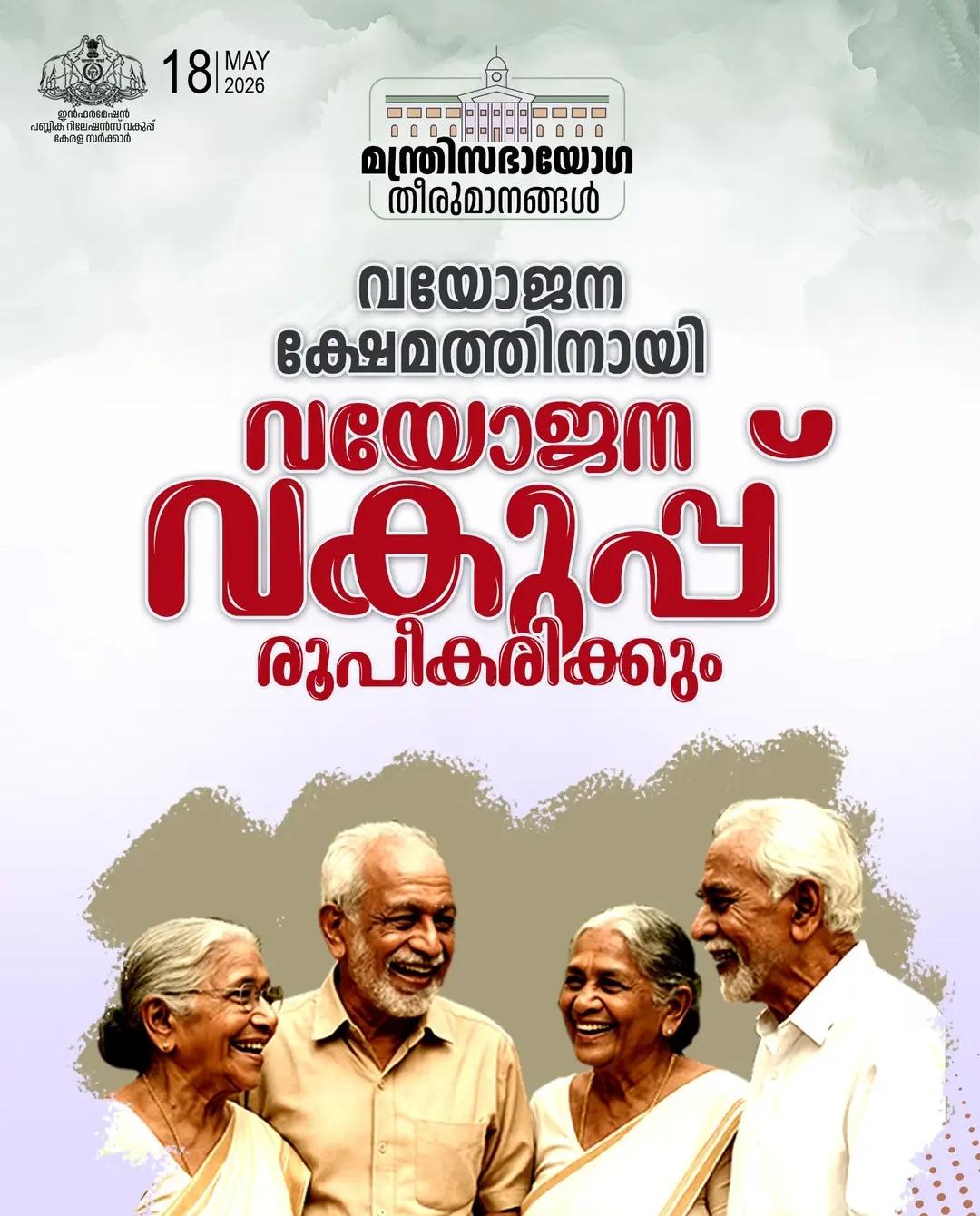
A social media poster from the Government of Kerala regarding constitution of Department for Elderly Welfare
Introduced in 2000, the Kaigo Hoken model turned elderly care into a shared social responsibility at a time when traditional family structures were weakening, and hospitals were becoming overcrowded with long-term patients.
Every Japanese citizen above 40 contributes mandatory premiums, while the system combines insurance payments with public funding to provide services ranging from home care and day-care support to assisted living and institutional care.
Access is determined through need assessments rather than income, reducing the stigma once attached to welfare support.
Yet Kerala’s circumstances are far more fragile. Much of its economy depends on remittances; families are shrinking, migration has left many elderly couples alone, and women continue to shoulder most caregiving responsibilities.
Although pensions account for the overwhelming share of current spending, the larger challenge lies in building trained manpower, strengthening local self-governments, expanding geriatric healthcare and creating sustainable funding mechanisms without worsening the state’s fiscal strain.
According to available financial data, more than 75 percent of Kerala’s elderly population is covered under various pension schemes, including old-age pensions, welfare board pensions, and other social security pensions.
For Kerala, where migration, smaller families and rising life expectancy are changing the social landscape, the attraction lies in the idea of “ageing in place” — helping senior citizens remain within their communities instead of isolating them in institutions.
“Japan itself continues to struggle with soaring care costs and worker shortages despite decades of reforms. Kerala faces the same pressures with fewer resources and a steady outflow of nurses and skilled workers abroad. Programmes such as Vayomithram clinics, Pakalveedu centres, caregiver allowances and volunteer networks have shown promise, but scaling them statewide will test administrative capacity,” said an official with KSSM.
Japan also built a vast support network around local governments, healthcare workers and community-based services, backed by technology, digital monitoring and even robotics to compensate for labour shortages.
Yet the Japanese experience also carries a warning.
The system is under severe financial strain as the elderly population grows faster than the working-age population supporting it.
One in six Japanese citizens is now above 75.
Care facilities face staff shortages, wages remain low, and many rural regions struggle to provide equal access. Even after decades of reform, families continue to shoulder part of the burden.
For Kerala, officials said, Japan’s model is both an inspiration and a cautionary tale — proof that ageing societies need organised care systems, but also a reminder that no welfare structure escapes demographic pressure forever.
Also Read: VD Satheesan’s government unveils first two guarantees in maiden Cabinet meeting
Though a formal order came on 19 May from the General Administration Department regarding the constitution of the Department of Elderly Welfare, with its objective being formulating and implementing new schemes for the welfare of the elderly in the state and coordinating the existing schemes, officials said several administrative and financial exercises will have to be completed before the idea can take shape.
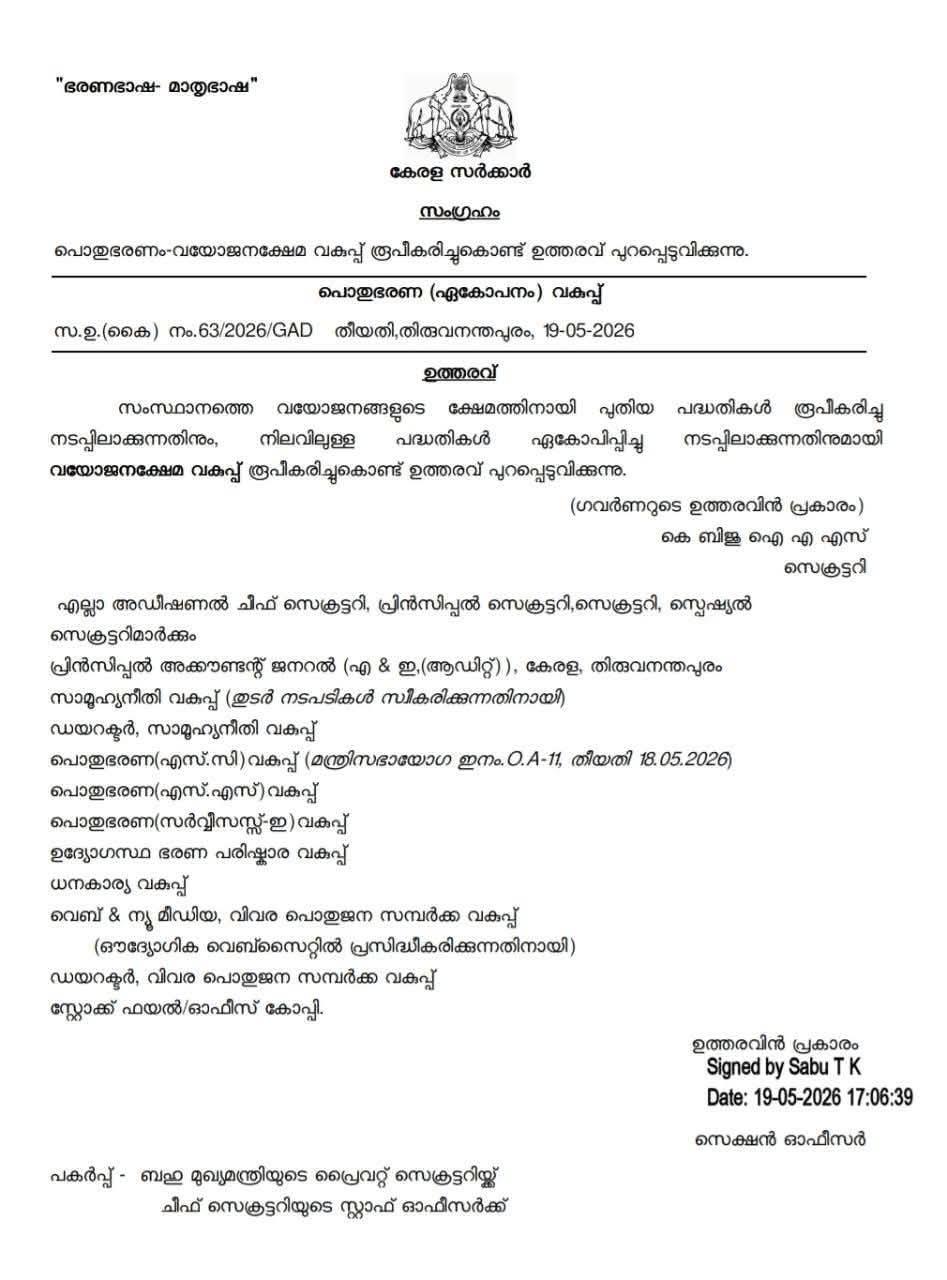
The formal order dated 19 May regarding the constitution of the Department of Elderly Welfare.
Currently, the Social Justice Department (SJD) functions as the nodal agency for elderly welfare, overseeing state-run old-age homes, institutional support systems and community-based care programmes for senior citizens.
A senior official in the department said the process of creating a new department would first require a detailed work study by the Personnel and Administrative Reforms Department.
Inputs from multiple departments would also be needed before decisions are taken on staffing patterns, fund allocation and the overall structure of the proposed department.
“The chief minister made the announcement on 18 May, and an order came out on 19 May. The discussions on how such a department should function are yet to begin,” the official said.
The official pointed out that Kerala is likely to study international models before drawing up its own framework.
Countries such as Sweden, Japan, Germany and Thailand have evolved different approaches to elderly care, ranging from long-term insurance systems and social pensions to home-care networks and community health outreach.
Sweden’s coordinated care systems, Japan’s insurance-backed elderly support structure, Germany’s strong home-care base and Thailand’s community health worker model are among the practices likely to be examined.
Officials said any future plan would have to be adapted to Kerala’s demographic realities, existing welfare schemes and fiscal capacity.
Meanwhile, KSEC chairperson K Somaprasad backed the proposal, saying a dedicated department would bring sharper focus to elderly welfare while reducing the administrative burden on the Social Justice Department. He told South First that a separate department would also mean an exclusive budget head, dedicated plan funds and independent monitoring mechanisms for senior citizens’ welfare programmes.
The rapidly greying population is beginning to push the state to treat ageing not merely as a welfare concern but as a structural social reality.
The state’s evolving strategy, according to officials, will now stretch beyond pensions and institutional care, focusing instead on healthy and active ageing, neighbourhood-based support systems, decentralised home healthcare and the creation of what policymakers describe as a “care economy” and “silver economy.”
“A similar kind of approach is in place in Japan, where the emphasis is on helping older persons remain independent and socially engaged for as long as possible. Kerala has also begun paying closer attention to the feminisation of ageing, with gender-sensitive schemes aimed at addressing the vulnerabilities faced by elderly women, many of whom live alone or without stable income support in later years,” said an official with the SJD.
A major thrust is being placed on “ageing in place” — enabling senior citizens to continue living within their communities through barrier-free public spaces, assisted living support and home-based medical care rather than large-scale institutionalisation.
Japan’s community-linked elderly care systems may become a reference point for such decentralised models.
Healthcare coverage is also expected to change.
The earlier Senior Citizen Health Insurance Scheme (SCHIS) has now been merged with the Karunya Arogya Suraksha Padhathi, Kerala’s comprehensive health insurance programme implemented through the State Health Agency and integrated with Pradhan Mantri Jan Arogya Yojana.
Institutional care continues to remain significant in the state.
Currently, 16 government-run old age homes function directly under the Social Justice Department, while nearly 680 registered old age homes operate under the Orphanage Control Board.
In 2024-25, 37,895 inmates were residing in these facilities with government-supported care and assistance.
Officials said stronger regulation, monitoring and quality assurance mechanisms are becoming increasingly necessary to safeguard the dignity, rights and well-being of elderly residents.
Kerala is also attempting to turn demographic change into an economic opportunity.
The state is exploring specialised elder-care services, assisted living, rehabilitation support, wellness tourism and trained caregiving networks as potential growth sectors — an approach that resembles Japan’s long-developed senior care economy.
(Edited by Muhammed Fazil.)



