


It maintained that the Sanchar Saathi app is secure and intended solely to protect users from online fraudsters and added that six lakh users had downloaded the app in the past 24 hours.

Published Dec 03, 2025 | 4:21 PM ⚊ Updated Dec 03, 2025 | 4:21 PM

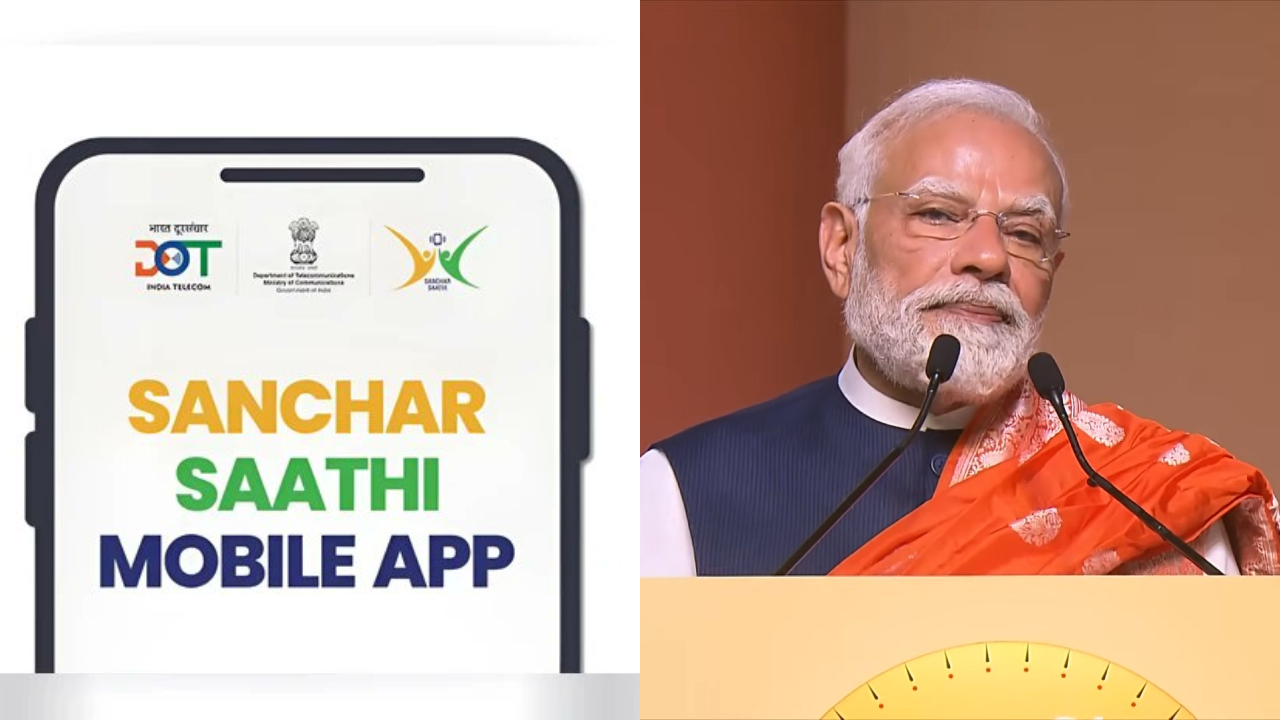
DoT had mandated that every smartphone sold in India from March 2026 must come with Sanchar Saathi pre-installed and non-removable.. Credit: sancharsaathi.gov.in/, x.com/BJPLive
Synopsis: The Union government has decided to withdraw its directive requiring smartphone makers to pre-install the Sanchar Saathi app on all new devices, reversing an order that had triggered public outrage over privacy and user choice. The Centre said the mandate was originally intended to strengthen telecom cyber security, and maintained that the Sanchar Saathi app is secure and meant solely to protect users from online fraudsters.
The Union government has decided to withdraw its directive requiring smartphone manufacturers to pre-install the Sanchar Saathi application on all new devices from early next year, reversing its controversial 28 November order that drew widespread criticism over privacy, data security, and user choice.
In a statement issued on Wednesday, 3 December, the government said the original mandate had been issued “with an intent to provide access to cyber security to all citizens.”
It maintained that the Sanchar Saathi app is secure, meant solely to protect users from online fraudsters. Developed by the Department of Telecommunications (DoT), the app allows users to block stolen phones, report phishing calls and messages, and check device IMEI details.
The original directive had set a 90-day deadline for smartphone manufacturers to preload the Sanchar Saathi app on all new devices.
The Centre had justified the order by citing “serious endangerment” to telecom cyber security, particularly from duplicate or spoofed IMEI numbers often used in financial scams.
It asserted that the app has “no other function other than protecting the users” and said six lakh users had downloaded the app in the last 24 hours, a “10x increase” that it described as an affirmation of trust in the platform.
“Given Sanchar Saathi’s increasing acceptance, Government has decided not to make the pre-installation mandatory for mobile manufacturers,” the statement said.
The directive prompted significant public concern, especially as it reportedly included a clause mandating that the preloaded app should not be user-removable.
Experts expressed scepticism that the app would help curb mobile thefts, noting that the telecom industry has long been working on better mechanisms to combat IMEI-related fraud.
“Even if it is needed—and I’m not convinced it is—let’s assume, for the sake of argument, that this is the only way the government can prevent stolen phones from being resold and used again. Even then, it should be up to each individual whether they want this app on their phone. I don’t see why it should be something users cannot delete, or why such a condition is required,” Pranesh Prakash, an independent tech law and policy research advisor, had earlier told South First.
A long and disturbing history of data leaks across the Union government’s flagship digital programmes further cast serious doubt on whether citizens can trust the government with yet another trove of personal data.
From the world’s largest biometric database to COVID vaccination records and facial recognition travel systems, almost every major Digital India initiative has suffered embarrassing and often massive breaches in the past many years.
“We the People of India are ruled by MOSAD now? Sanchar Saathi’s CHAKSHU doesn’t guarantee you will not be defrauded, just like having a good Constitution in our hands didn’t guarantee our slip into communalism and fascism,” veteran journalist Raju Parulekar said, flagging the ‘intrusive’ nature of the app.
Preloaded apps on both Android and iOS are usually not user-deletable. They also tend to have heightened permissions within the operating system compared with a regular app downloaded by the user through an app store.
Crucially, it is possible for a preloaded app to have enough permissions to control many aspects of the device and monitor or share its contents, even without the user’s permission or awareness.
“The direction by requiring manufacturers and importers of mobile handsets to pre-install the Sanchar Saathi app represents a sharp and deeply worrying expansion of executive control over personal digital devices,” the advocacy group the Internet Freedom Foundation said in a statement.
“It requires that the pre-installed Sanchar Saathi application be ‘readily visible’ and that ‘its functionalities are not disabled or restricted.’ In plain terms, this converts every smartphone sold in India into a vessel for state-mandated software that the user cannot meaningfully refuse, control, or remove. For this to work in practice, the app will almost certainly need system-level or root-level access, similar to carrier or OEM system apps, so that it cannot be disabled. That design choice erodes the protections that normally prevent one app from peering into the data of others, and turns Sanchar Saathi into a permanent, non-consensual point of access sitting inside the operating system of every Indian smartphone user.”
Following the backlash, Telecom Minister Jyotiraditya Scindia had asserted that the app could be deleted if the user preferred.
“This is a completely voluntary and democratic system—users may choose to activate the app and avail its benefits, or if they do not wish to, they can easily delete it from their phone at any time,” he said.
Many critics noted that the app could serve as a point of access for the government into the personal data of smartphone users, with the app functioning as a powerful “spyware.”
The IFF also pointed to the vague and all-encompassing wording of the justification, which it said would grant enormous power to the government.
“The order invokes ‘telecom cyber security’ as a catch-all justification, but it does not define the functional perimeter of the app. Clause 5 of the directions refers to identifying acts that ‘endanger telecom cyber security,’ an expression so vague that it invites function creep as a design feature, not a bug. Today, the app may be framed as a benign IMEI checker. Tomorrow, through a server-side update, it could be repurposed for client-side scanning for ‘banned’ applications, flag VPN usage, correlate SIM activity, or trawl SMS logs in the name of fraud detection,” the IFF said in a statement.
“Nothing in the order constrains these possibilities. In effect, the state is asking every smartphone user in India to accept an open-ended, updatable surveillance capability on their primary personal device, and to do so without the basic guardrails that a constitutional democracy should insist on as a matter of course. IFF is deeply concerned with this direction that sets up a precedent to enforce client-side scanning on all smartphones in India and calls for its recall.”
(Edited by Dese Gowda)


