

Published Nov 07, 2026 | 11:55 AM ⚊ Updated Nov 07, 2026 | 11:55 AM

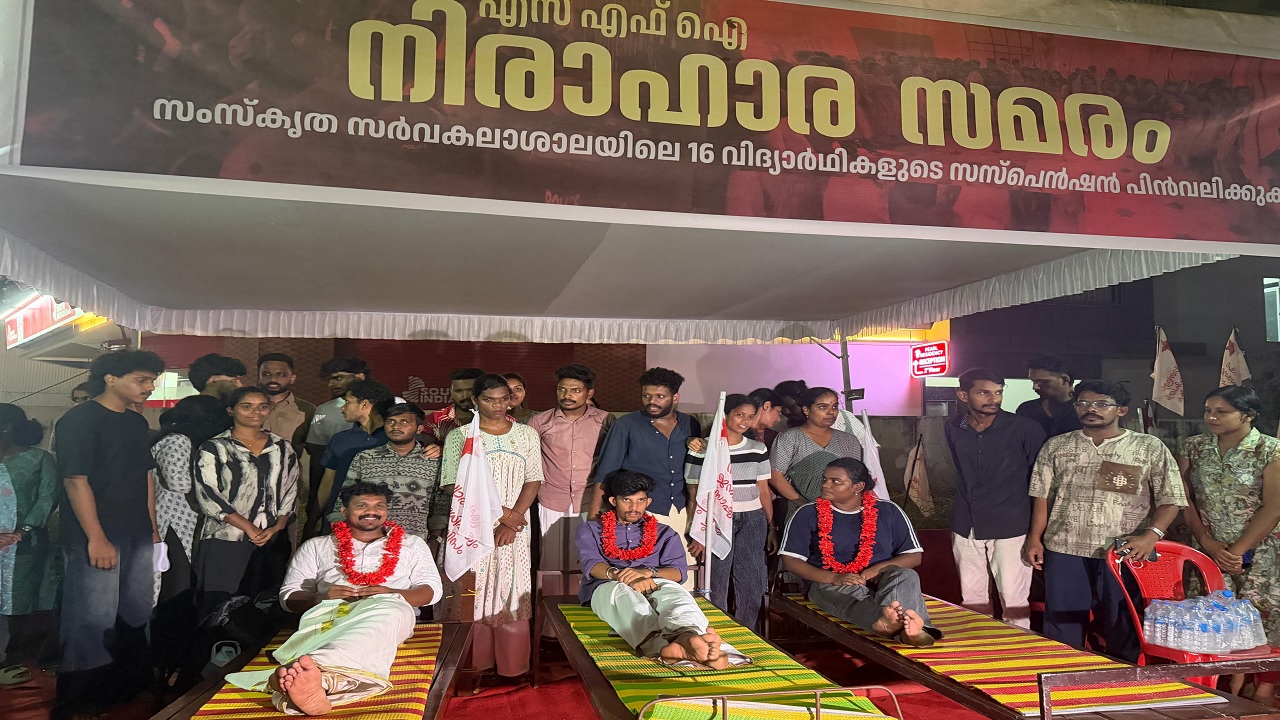
Three students are on a hunger strike at SSUS, Kalady.

Synopsis: The Supreme Court has refused urgent relief to 16 suspended students of the Sree Sankaracharya University of Sanskrit in Kalady, further deepening concerns over their academic futures. Beyond the legal battle over examination eligibility, the case raises larger questions about student politics, judicial observations against campus protests and the unresolved administrative issues that triggered the agitation.
Along the banks of the Periyar in Kalady, the birthplace of Adi Shankaracharya, stands the Sree Sankaracharya University of Sanskrit (SSUS), an institution meant to nurture scholarship, debate, and intellectual inquiry. But the campus, long at the centre of a prolonged student agitation, is now witnessing a battle that extends beyond its administrative corridors.
What began as a protest over alleged infrastructure deficiencies, vacant faculty positions and administrative delays has evolved into a legal and political confrontation following a symbolic “mock funeral” staged by students on August 13, to protest against Vice-Chancellor Ciza Thomas.
On September 1, the university suspended 16 students, accusing them of manhandling the VC and attempting to damage university property. Four Students’ Federation of India (SFI) activists were arrested, and the dispute travelled from the university’s Syndicate to the Kerala High Court and subsequently, the Supreme Court.
With the Supreme Court refusing to intervene in the issue, the university continues to witness a relay hunger strike alongside visits by political leaders.
On November 3, a Division Bench of the Kerala HC, comprising Justices Anil K Narendran and Muralee Krishna S, overturned a Single Judge’s interim order that had allowed the suspended students to appear for their semester examinations.
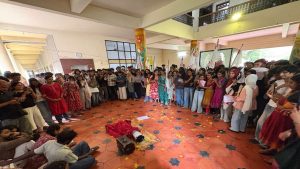
SSUS protest reaches Lok Bhavan amid allegations of manhandling and mock funeral.
The bench held that the students had not established their eligibility under university regulations, including minimum attendance requirements.
It also referred to a 2023 Division Bench ruling in Principal, IES College of Engineering v Anas PM and others, observing that attendance shortages resulting from disciplinary suspension were consequences the affected students would have to bear.
However, what particularly drew attention was the court’s reliance on a 2017 judgment in Dr Antony Thomas v VM Muhammed Rafique.
Quoting the earlier ruling, the bench reiterated that ”political activities like dharna, hunger strikes and other practices like Satyagraha have no place in a constitutional democracy, much less in academic institutions.”
The judgment had further stated that students engaging in such activities could face expulsion or rustication.
The earlier ruling had also invoked Dr BR Ambedkar’s warning against resorting to civil disobedience, non-cooperation and satyagraha when constitutional methods of pursuing political and social objectives were available.
The observations have opened up a larger debate in Keralam, where student politics has historically been an integral part of campus life and political mobilisation.
Supreme Court lawyer Babila Ummer Khan told South First that courts have the authority to make such observations, but their cost, impact and consequences must be considered, as students are involved.
“In recent judgments, Indian courts have increasingly delivered deeply emotive and sharp observations on students. Moving away from purely mechanical interpretations of the law, the judiciary has frequently stepped into the role of a parental protector. The court’s first concern is to protect the peace of the state. Such protests should be treated with utmost sensitivity, as we are dealing with a vulnerable group: students. We know how the Cockroach Janata Party (CJP) was born after the CJI’s ”cockroaches and parasites” remark,” she said.

Dr Ciza Thomas.
For the suspended students at Kalady, the immediate consequence is academic.
Ten undergraduate and postgraduate students missed their first examination on November 4 after the Division Bench order.
Their lawyer, Advocate Subhash Chandran, approached the Supreme Court seeking urgent intervention. He told South First that the petition was filed around 11 pm on November 3 and that the students had requested an urgent hearing before their first examination at 1.30 pm the following day.
The Supreme Court on November 5 refused to interfere in the matter, instead urging the Single Bench of the High Court to expeditiously decide the students’ writ petition challenging their suspension. The court took note of the University’s undertaking that a special exam would be conducted for the affected students if the High Court cancels their suspension.
Despite the legal setback, the agitation has not subsided.
Archana, an MSW postgraduate student, along with research scholars Abhijith and Aswanth, is continuing the indefinite relay hunger strike on campus. The students have said that the protest will continue until their demands are addressed.
“If the three of us are not allowed to continue, another batch of students will take it forward. The main issue is Vice-Chancellor Ciza Thomas’s ego clash with the students after the symbolic cremation protest. That is why she is demanding an apology,” Archana told South First.
Another contentious issue has emerged in the legal proceedings: attendance records.
The university produced documents before the Kerala High Court to establish that the suspended students did not meet the minimum attendance requirements. Students, however, disputed the figures and alleged that the records submitted to the court did not reflect their actual attendance.
The students claimed that most of them had over 80 per cent attendance, with one securing over 95 per cent. They alleged that the records submitted by the university to the court showed much lower figures.
Also Read: Exclusive: Tip of the iceberg? How BLM and R Premkumar spun their alleged grand web of deception
The controversy began on August 13, when students staged a “symbolic funeral” as part of their protest during a Syndicate meeting on the campus.
While the university alleged that the performance was a derogatory “mock funeral” targeting Vice-Chancellor Ciza Thomas, students maintained that it was a creative demonstration by Theatre Department students to highlight the prolonged neglect of their department and non-functional stage spotlights.
Speaking to South First earlier, Adithya, a student, said the protest was intended to draw attention to equipment that had remained unusable for months.
“There was no reference to the Vice-Chancellor. But she took offence at the creative protest personally, leading to a false narrative being spread,” she alleged.
The university, meanwhile, accused students of obstructing the Vice-Chancellor’s vehicle, manhandling her and attempting to damage the vehicle. The students denied the allegations.
A source close to the Vice-Chancellor rejected the suggestion that the dispute was the result of an ego clash between Thomas and the students.
“There is no ego clash. This is the politics of the Left, and they are using students for that,” the source said.
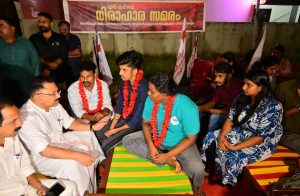
CPI(M) leader K.T. Jaleel visited the protesting students
Two FIRs were registered in connection with the incident. Four SFI activists –Mebin Jose, Basil Scaria, Vijeesh and Yadhu Krishnan– were arrested over alleged confrontation with the police. A separate case was registered following the Vice-Chancellor’s complaint.
The controversy subsequently acquired a political dimension, centred on SFI’s involvement in the protests. Several CPI(M) leaders have visited the protest site and interacted with the students.
Meanwhile, the students argue that the political labelling has overshadowed their original demands.
Asritha N, a PhD scholar in Sanskrit language, told South First that administrative delays and the functioning of the university were among their primary concerns.
“The main issue is that university procedures and functioning are not proper here. For instance, when we submit a request to organise an event, the Vice-Chancellor does not take up the file on time. She examines it only after the stipulated period has passed and then rejects it, citing the deadline. That is not the students’ mistake. Files are not being examined properly,” she alleged.
She said their primary demand was for the Vice-Chancellor to be regularly present on campus.
“The campus has completely changed after her arrival. Her appointment was made by the Governor, and we believe her political alignment is also in tune with the Governor’s politics. Because of the SFI tag and political labelling, the real issues have disappeared. Nobody is listening to what we are fighting for,” Asritha said.
Students have also flagged concerns over basic infrastructure, including the availability of drinking water. They alleged that a water purifier on campus had remained unrepaired despite repeated complaints, with the file awaiting the Vice-Chancellor’s approval.
Students alleged that several departments were functioning largely through guest lecturers because of vacant teaching positions, raising concerns over the student-teacher ratio.
They also said certificates of students who had completed their courses remained pending because the Vice-Chancellor had not signed them.
Rithusha Rithu, the university’s first transgender doctoral scholar, said the suspension dispute had further complicated their academic lives.
According to her, the Syndicate had decided to revoke the suspension of 12 of the 16 students on the condition that they submit written apologies. Four others would continue to remain suspended for two months, reportedly over allegations that they entered the campus despite being under suspension.
“The condition is that our parents should also be present when we submit the apology. But we are on hunger strike. We demand that the suspensions should be withdrawn without any conditions because we are fighting for valid reasons,” she told South First.
Rithusha reiterated the students’ demands for the Vice-Chancellor’s presence, drinking water facilities, adequate faculty appointments and the release of pending certificates.
These concerns are not entirely new.
In their earlier interactions with South First, students had also raised concerns about manuscript-style certificates issued until 2019, errors in the printed certificates introduced in 2025, delays in issuing corrected certificates and pending grace marks for students who participated in NCC activities and South Zone arts festivals.
Research scholars had previously flagged delays in stipend payments and what they described as exploitative working conditions. Students also pointed to inadequate faculty and infrastructure at distance education centres in Payyanur, Tirur, Panmana, Koyilandy and Ettumanoor.
(Edited by Fayisa CA)



