

Published Nov 27, 2026 | 10:00 AM ⚊ Updated Nov 27, 2026 | 10:00 AM

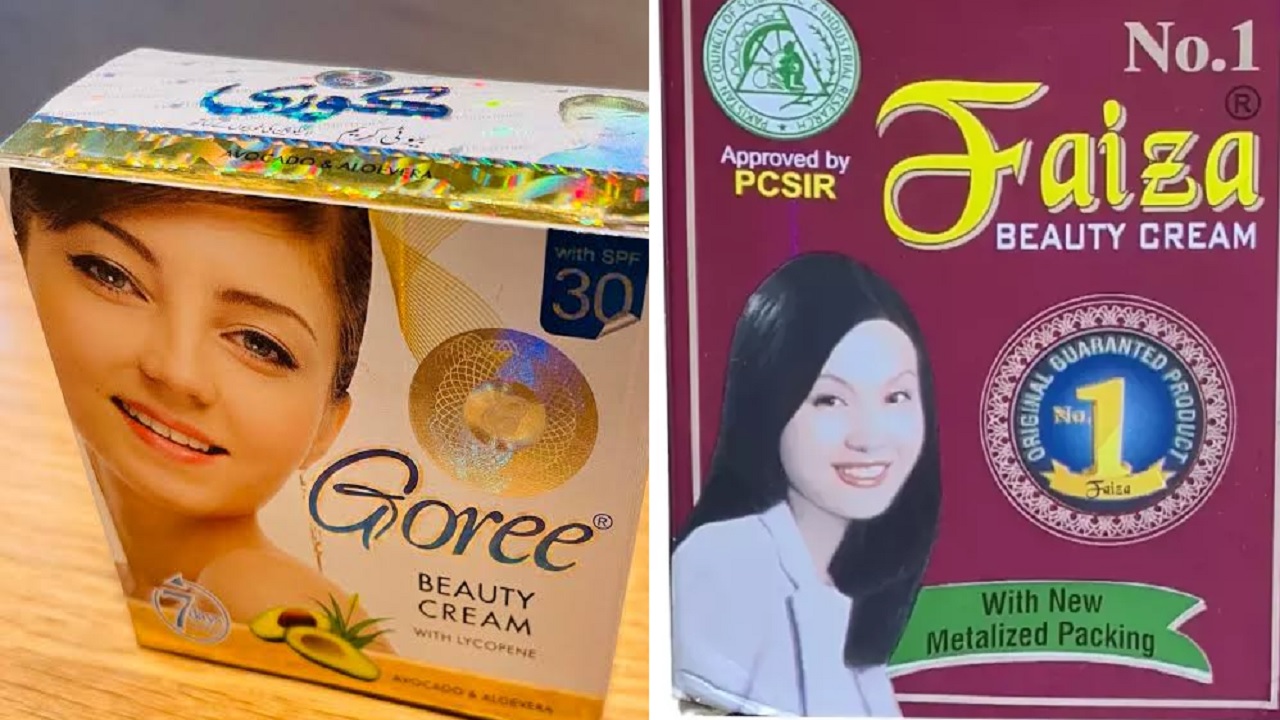
Two Pakistan originated fairness creams that are available in Keralam.

Synopsis: From Pakistan-made fairness creams and Chinese cosmetics to products routed through the UAE, the growing circulation of unauthorised skin-whitening products in Keralam has raised concerns over consumer safety, regulatory loopholes and society’s obsession with fair skin.
Malappuram teenager Ansiya Fathima* has spent much of her life believing that her natural skin tone needed to change.
When she was in Class V, her mother would apply turmeric and red sandalwood paste to her face, hoping to make her complexion fairer. Ansiya initially saw it as another part of her family’s beauty routine.
Only later did she begin questioning why so much attention was paid to her skin tone.
“Most of my family members are fair-skinned. Gradually, I realised that something was not right with me and that it was my skin colour that people wanted to change,” she told South First.
“This insecurity made me follow social media influencers from a young age. I started buying and using the products they recommended. I also used FTUNE cream until reports about its possible health risks emerged. It gave me the fastest results,” she told South First.
FTUNE is a cosmetic cream marketed for skin brightening, dark spots, and even skin tone.
“I am not obsessed with fairness. But society made me feel inferior and took away my confidence because of my complexion,” the girl added.
Ansiya’s experience reflects broader social conditioning that continues to shape beauty choices in Keralam, particularly in the Malabar region, where fairness creams have found a strong market among both women and men.
For many, the attraction is not merely cosmetic.
It is tied to years of being told, directly or indirectly, that fair skin is more desirable. Social media promotions, influencer recommendations and promises of quick results have further strengthened this market.
Also Read: Fairness creams and their dark, heavy secrets
Recent concerns over fairness creams are not limited to one product or one consumer. Reports of serious health complications following the use of certain fairness creams prompted the Keralam Drugs Control Department to investigate. They also raised questions about the products being sold through local cosmetic shops and informal distribution networks.

Salim Kodathur and Shuhaib
One such case involves a 17-year-old girl who reportedly developed kidney disease after using FTUNE cream on her face. Investigators are yet to establish the product’s source.
The four contact numbers provided in its advertisements were found to be inactive. Preliminary findings suggested that the cream was primarily distributed in Kasaragod.
Singer Shuhaib, a friend of singer Salim Kodathur, has also spoken about his experience with Faiza fairness cream, which he used around 10 years ago.
”I initially started using the cream to improve my appearance before attending public events. Over time, I developed symptoms such as swelling in my feet and difficulty urinating,” Salim told South First.
“When my eyes started watering, I underwent medical examinations, which revealed that I had developed a serious kidney ailment. I underwent prolonged treatment, and my condition improved. However, I am still on medication,” he added.
Shuhaib also claimed that four other people who used the same cream had similar health problems.
Also Read: Cinderella, Dubai creams fly off shelves in fair-skin obsessed India
The concerns took on an international dimension, with authorities identifying unauthorised cosmetic products from Pakistan and China being sold in Keralam.
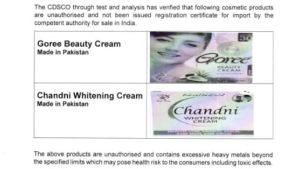
Public health alert issued by CDSCO
On 8 September 2026, the Directorate General of Health Services under the Union Health Ministry, through the Central Drugs Standard Control Organisation (CDSCO), issued a public health alert warning consumers against using certain unauthorised cosmetic products.
The notice specifically identified Goree Beauty Cream and Chandni Whitening Cream, both manufactured in Pakistan. CDSCO clarified that these products had not been issued the mandatory registration certificates required for import into India.
More importantly, testing and analysis by the regulatory authority found that the products contained heavy metals at levels above the specified permissible limits, potentially exposing consumers to toxic effects.
The CDSCO advised consumers against purchasing or using these products, including similarly named products, and warned establishments and individuals against selling, distributing or advertising them.
The notice also reiterated that cosmetic manufacturing and imports in India are regulated under the Drugs and Cosmetics Act, 1940, and the Cosmetics Rules, 2020. Cosmetics manufactured for sale and distribution require a licence from the respective State Licensing Authority, while imported cosmetics must be registered with the Central Licensing Authority.
The regulatory alert was followed by enforcement action in Hyderabad. On 30 September, the Commissioner’s Task Force, Rajendranagar Zone, in coordination with CDSCO officials, raided Beauty Ladies Emporium, Beauty Queen Shop and SJ Medical Shop in Habeeb Nagar, Nampally.
Drugs Inspectors from the CDSCO Zonal Office, Hyderabad, identified products at the premises as belonging to the unauthorised categories mentioned in the 8 September public notice.
The products included Pakistan-made beauty creams and soaps marketed for skin whitening.
Preliminary enquiry suggested that the products were being procured through a Mumbai-based dealer who allegedly arranged supplies from outside India and distributed them to dealers in Hyderabad. Investigators also found that local sellers were not maintaining proper purchase bills or invoices.
Investigators also suspected that additional stock was stored in a godown. Investigators are also examining the alleged involvement of other sellers, including a cosmetic shop in Santhosh Nagar.
Meanwhile, the Drugs Control Department in Keralam has intensified inspections against illegally marketed cosmetic products.
During inspections in Malappuram, officials seized 14 varieties of cosmetics marketed under the brand name T.Y.A Fashion Cosmetics. According to the department, the products lacked mandatory documentation and certifications and did not carry the required importer details.
Although the Hyderabad investigation and the Keralam seizures involve different products, they point to a common concern- the circulation of cosmetics without the documentation and traceability required under Indian law.
Also Read: Imported fairness creams and mercury menace
One of the significant concerns Kollam-based cosmetics R&D scientist Anandhu Krishnan raised is the possibility of products entering Indian markets through intermediary countries.
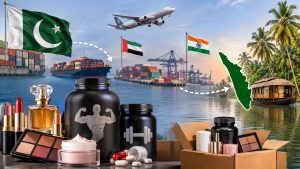
Products from Pakistan are suspected to be routed to India through third-country hubs.
According to him, some of the instant whitening creams popular in the Malabar region originate in Pakistan.
He alleged that products are sometimes brought into India via the UAE, with their brand names and labels changed before being sold in the domestic market.
“At first glance, the labelling and the name may look different, but the ingredients remain the same,” he told South First. This makes it difficult for ordinary consumers to identify the original manufacturer and verify the product’s regulatory status.
Krishnan said consumers should not assume a product is safe merely because its packaging looks professional or carries an unfamiliar brand name.
He also emphasised the importance of checking batch codes.
“When you buy a product, note its batch code and ingredients. Different batches can have minor differences in their formulations, so the batch number is important,” he said.
A batch number helps establish traceability, particularly when a product is recalled, or an adverse reaction is reported. The lack of purchase invoices, manufacturer details, and importer information, as found during some recent inspections, further complicates efforts to trace the supply chain.
Also Read: Cosmetics from Pakistan, vloggers and ailing kidneys in Keralam
Excessive heavy metals are among the most serious concerns associated with certain skin-whitening products. Mercury has historically been used in some skin-lightening preparations because it can interfere with melanin production.
However, mercury exposure can cause serious health complications, particularly affecting the kidneys and nervous system.
Krishnan pointed out that India’s cosmetics regulations prescribe strict limits for mercury in cosmetics.
“In India, the permitted percentage of mercury is 1 ppm. Cosmetics are a highly regulated industry. Ingredients can be used only within the permitted limits and according to the prescribed guidelines,” he said.
He also referred to the case involving the 17-year-old girl who developed a serious kidney ailment. Tests detected 12,500 ppm of mercury in the cream she had used, he said.
Such a concentration would be far beyond the permissible limit. The product has been sent to a laboratory for further tests.
Krishnan also cautioned against expecting pharmaceutical-like results from cosmetics. “Cosmetics are not medicines. People should not expect quick results from cosmetic products the way they might expect results from pharmaceutical treatments,” he said.
He noted that India’s regulatory framework governs the ingredients and concentrations that can be used in cosmetic formulations. The problem arises when products enter the market without complying with these requirements.
Also Read: How social media ‘quackery’ is harming dermatology and trust
Jithin James Mundupalam, Co-founder of SafeLabel AI, which analyses skincare and baby-care ingredients to help consumers make safer choices, told South First that incomplete ingredient disclosure is one of the important warning signs.
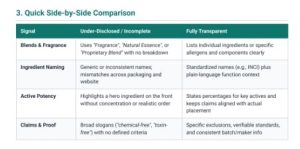
Quick comparison
He said consumers should look beyond attractive packaging and marketing claims and examine four aspects: ingredient order, vague ingredient descriptions, consistency across different platforms and traceability.
For instance, cosmetic ingredients are generally listed in descending order of concentration by weight, with ingredients present at concentrations of 1% or less allowed to be listed in any order.
“In a water-based cream or serum, water is usually one of the main ingredients. If water appears at the bottom of the ingredient list while several botanical extracts and active ingredients appear at the top, consumers should examine the formulation more carefully,” he cautioned.
He also warned against ingredient lists that use vague expressions such as ‘herbal extract’, ‘vitamin blend’, ‘natural essence’, ‘proprietary blend’ or simply ‘fragrance’ without providing adequate details.
A product may prominently advertise niacinamide, vitamin C, turmeric or sandalwood, but that does not necessarily mean these ingredients constitute a significant proportion of the formulation.
Similarly, an ingredient list should account for functional components such as preservatives, emulsifiers, stabilisers and pH adjusters, in addition to the ingredients promoted for their skincare benefits.
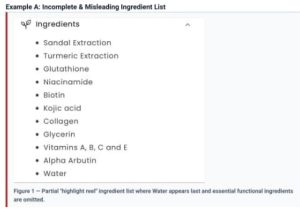
Incomplete Ingredient list
Mundupalam said consumers should also check whether the ingredients listed on the physical packaging match those on the brand’s official website and online retail listings.
Missing manufacturer details, batch numbers, manufacturing and expiry dates and other traceability information are additional warning signs.
“At SafeLabel AI, we examine ingredients against regulatory restrictions across India, Europe, the US, Australia and Japan. If an ingredient is banned in any of these regulatory regions, the app flags it for users,” he said.
The platform also generates personalised compatibility reports for users who provide information about their skin type, sensitivities and skincare requirements.
However, he emphasised the importance of distinguishing between an incomplete ingredient list and a genuinely unsafe formulation. A label that lacks transparency warrants caution, but it does not, by itself, establish that a product contains a toxic substance.
Also Read: India’s obsession with fairness and quick fixes is fuelling a steroid crisis
Krishnan said serums have become increasingly popular partly because their packaging and presentation resemble pharmaceutical products, giving consumers an impression of scientific credibility. Their predominantly water-based formulations can also offer a lighter texture and quicker absorption, depending on the ingredients used.
He pointed to brands such as Minimalist and Cetaphil, which use relatively understated packaging and product presentations rather than relying entirely on elaborate cosmetic designs.
Krishnan also highlighted the importance of how cosmetic products are marketed. Under the regulatory framework, cosmetics cannot make claims that amount to treating or preventing medical conditions.
For instance, product claims such as ‘helps reduce acne‘ or ‘helps reduce dandruff‘ are different from claiming to cure acne or dandruff. Manufacturers must ensure that their packaging, advertisements and product descriptions comply with the applicable rules.
He also cautioned against misinformation circulating after the recent reports.
One such claim is that mercury is deliberately added to lipsticks.
”Mercury is not a required ingredient in lipstick formulations. However, mineral-based pigments can become contaminated with heavy metals during sourcing or purification, making quality control important,” he said.
He advised consumers to be careful about the products used during cosmetic procedures such as keratin treatments and de-tanning.
Meanwhile, Keralam Drugs Control Department is planning to expand its ‘Sahajam Sundaram’ awareness campaign to schools, covering students from the upper primary level onwards.
The department intends to coordinate with the General Education Department to train students and teachers as volunteers who can spread awareness about the risks associated with counterfeit and unauthorised cosmetics, including fairness creams and lipsticks.
Keralam is also conducting Operation Soundarya to crack down on counterfeit, unlicensed and toxic cosmetics.
Meanwhile, the Kerala State Human Rights Commission (KSHRC) has ordered a detailed probe and monitoring of skincare products and dietary supplements advertised on social media over concerns about potential health risks. The move follows a complaint by human rights activist Noushad Thekkayil, who alleged that misleading promotions were endangering public health.
(With inputs from Sumit Jha in Hyderabad. Edited by Majnu Babu. *Name changed).



