

Published Oct 06, 2026 | 9:00 PM ⚊ Updated Oct 06, 2026 | 9:48 PM

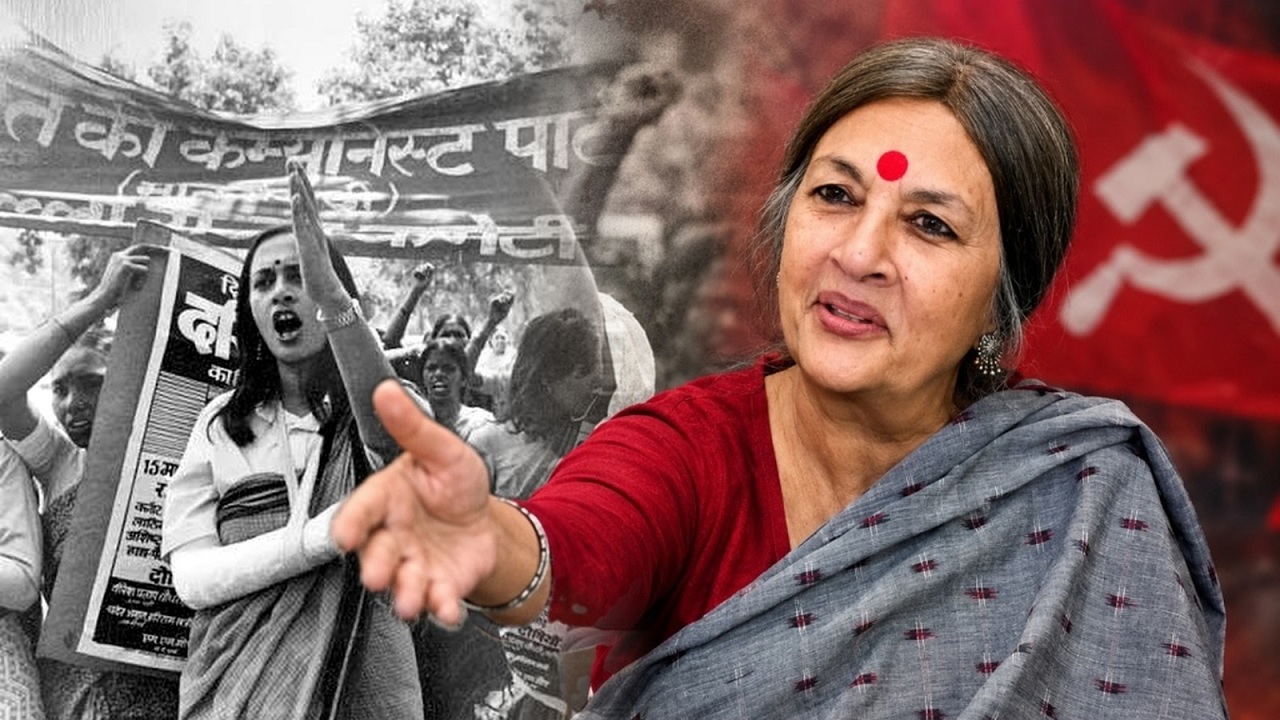
Brinda Karat

Synopsis: As a young woman working for Air India in London, Karat challenged the airline’s mandatory skirt uniform and campaigned for women’s right to wear a saree. She later stood with war victims, workers and women fighting for their rights. Decades later, she remains on the streets alongside a new generation. In conversation with South First, Karat speaks about the ongoing agitation against the Chief Election Commissioner Gyanesh Kumar in Delhi, the young women leading it and the larger political moment unfolding in the capital.
Since the night of 4 October, BJP cyber handles, particularly in Keralam have launched a hate campaign against CPI(M) veteran Brinda Karat.
Karat, 79, was the only senior political leader to walk alongside a group of young activists to Delhi’s Parliament Street Police Station, questioning why an FIR had not been registered against Assistant Commissioner of Police Vivek Bhagat, who has been accused of sexually assaulting a young woman journalist covering the Jantar Mantar protests.
”Why can’t she sit at home at the age of 79?” Right wing handles mocked Karat. But for the young women gathered in Delhi, her presence meant something else. It was reassurance- a veteran who had spent decades standing with women, workers and those without a voice was standing with them again.
As a young woman working for Air India in London, Karat challenged the airline’s mandatory skirt uniform and campaigned for women’s right to wear a saree. She later stood with war victims, workers and women fighting for their rights.
Decades later, she remains on the streets alongside a new generation.
In a conversation with South First, Karat speaks about the ongoing agitation against the Chief Election Commissioner Gyanesh Kumar in Delhi, the young women leading it and the larger political moment unfolding in the capital.
Edited excerpts follow.
Q: You personally went to the Parliament Street police station with the woman journalist to demand an FIR against ACP Vivek Bhagat. How do you view this kind of harassment of women protesters?
A: When I contacted the journalist, she told me that she had been sexually harassed. She works with a digital media organisation. I told her I would meet her there and I went to the police station.
I sat there for a few hours, and it was an absolutely extraordinary experience in the sense that it was completely unusual.
Normally, when we go to a police station with a complaint, we are able to speak to the police. But how can a police station in the centre of the capital close its doors without hearing the complainant? This was the first violation of duty.
There were no senior officers. The officer who was present expressed his helplessness and said that the complaint would be given to the Crime Branch. But when I asked about the timeframe and the procedure for filing the complaint, he could not address those questions.
If a girl comes to a police station with a complaint seeking an FIR, the police are duty-bound to register it. That is the protocol. Then a senior officer said over the phone, ”If you have video evidence, then give it.”
I was infuriated. Now, according to the Delhi Police, they are saying that women subjected to sexual assault have to carry a device with them and record it. It’s ridiculous. This is taking us back decades. We have protocols and we have laws.
The woman journalist was shooting and filming the protests in the capital. The ACP approached her, apparently to remove her from there and squeezed her hard on the breast. It was extremely painful for her. When she asked, ”Why did you do that?” the ACP ran away.
There were three crimes involved. First, The Delhi Police attacked a journalist who was on duty. Second, they used sexual harassment as a weapon to stop them from protesting. Third, the Delhi Police is not only protecting the accused but has also promoted him in the job.
A senior woman activist also told me that, during the protest, her buttocks was pinched by Delhi Police personnel and many of them did not have nameplates on their uniforms. So, it is evident that these are not unique cases, there is a repetition of a pattern.
They seem to have got a licence from somewhere to sexually harass women protesters.
In front of my own eyes, I have seen police personnel without nameplates lifting women around the breasts, putting their hands in inappropriate ways and touching private parts. As activists, we have dealt with cases of sexual harassment and fought against them, but I have never seen this kind of pattern during protests.
Also Read: ‘Finally UNBLOCKED’: Cartoonist Satish Acharya’s Instagram page restored
Q: What do you see as the role of the Left, particularly SFI and DYFI in the ongoing protests against CEC?
A: The role of the Left is important. SFI and DYFI have been the first to get involved in issues such as the NEET examinations and the re-examination, especially in Bihar.
When CJP started the protest and took a positive approach, we felt that any young people mobilising for the right cause should be supported and protected.
MA Baby and I were the first political leaders to go on stage at the CJP protest at Jantar Mantar, demanding Dharmendra Pradhan’s resignation. We also appealed to other political parties to join the movement.
The Left has a role. The Left will support any and every platform and independent activity for the right cause. And SFI-DYFI are actively doing their part.
Q: Congress and Rahul Gandhi have now become the spotlight of the protest against the CEC. Is there a concern that Congress could take over the movement?
A: Nobody has a monopoly. Everybody has a role in such protests. The main purpose is to unite against undemocratic practices. Congress is also the major opposition party in the country, and they have to lead the opposition protest march.
Today, the BJD has joined the protest, and I am happy about that.
But it is unfortunate that Congress has not been able to bring different fronts together. Due to this, the DMK and AAP have reached a situation where they did not join the protest. That is unfortunate.
In the future, I hope the DMK and AAP will join and we will make efforts to make that happen.
Also Read: ‘Gyanesh, it’s done, bro’: INDIA bloc heads to EC demanding CEC’s resignation; MPs detained
Q: Do you see the current protests in India as a sign of a generational shift in politics and activism?
A: It is a wonderful development. There is an attack on democracy and an attack on minorities. Democracy is under attack, and of course, unity and getting into the fight are important, especially because young people have that awareness.
Young people have come together against Modi’s Hindu-Muslim divide strategy, and they feel it has to be opposed. CJP has played a very important role in that mobilisation.
Only together can this be done. This time, the goal should be to prevent dictatorship and the Right Wing’s dream of a Modi-led Hindu Rashtra. Democracy is the main victim. The right to vote is for everyone, and everyone has to raise their voice.
It is wonderful to see SFI, AISA and other movements in it. More than a generational shift, it is people moving in the same direction to save democracy.
Q: We got reports that during the LPU protests in Punjab, only SFI was present with the students, while CJP was not seen. What do you say about this?
A: SFI is a student organisation, so it can enter campuses and stand with students. In private universities, even forming student unions has been restricted, and SFI is trying to change that.
It is inappropriate to discuss CJP’s reported absence at this point. They are not bound to be physically present everywhere. They have extended their support to the LPU protests.
(Edited by Dese Gowda)



