

Published Oct 02, 2026 | 11:45 AM ⚊ Updated Oct 02, 2026 | 11:45 AM

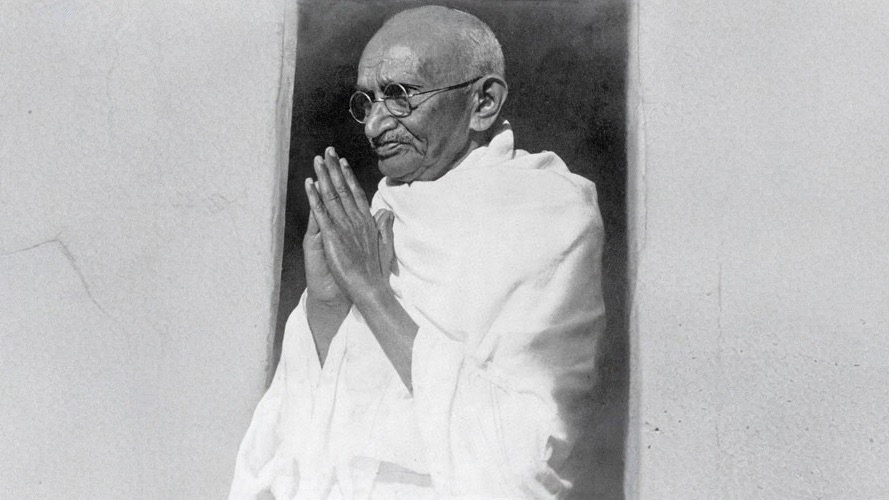
MK Gandhi.

Synopsis: In October 1947, the erstwhile Cochin Legislative Council accepted a portrait of Mahatma Gandhi by artist K V Vaidyanathan Ayyar, making the Council perhaps the first government institution in independent India to display Gandhi’s portrait, long before his image became commonplace in public institutions. During the motion to accept it, members hailed Gandhi’s commitment to peace and non-violence, hoping his ideals would guide the young legislature and the country.
In October 1947, the erstwhile Cochin Legislative Council received an unexpected gift from artist K V Vaidyanathan Ayyar: a portrait of MK Gandhi.
Titled The Father of the Nation, the portrait was intended for installation in the Council hall on 15 August, the day India “shook off the colonial shackles”, the then Prime Minister of Cochin, P Govinda Menon, told the House. Vaidyanathan brought it to Menon’s residence around midnight on 14 August, but there was too little time to secure permission and make the necessary arrangements.
The seat of the erstwhile Cochin Legislative Council.
Moving a resolution to accept the gift, Menon said the portrait would “sanctify” the legislature. He also recorded the Council’s gratitude to Vaidyanathan for presenting a portrait of “such a great living soul”.
On 18 October 1947, the Council stood in unison to honour Gandhi and, in accepting his portrait, wished the “Father of the Nation” a long and healthy life.
The House formally accepted the portrait on 18 October 1947, making the Council perhaps the first government institution in independent India to display Gandhi’s portrait, long before his image became commonplace in public institutions.
Council President L M Pylee called the portrait an “excellent and inspiring gift” to the House.
He recalled that Vaidyanathan had presented Gandhi at Haripura in 1938 with a painting of the Mahatma blessing a Harijan boy. The artist had subsequently produced several paintings on similar themes, Pylee said, earning wide public appreciation.
Pylee said the Council was proud to receive a portrait of the “great national leader” and noted that the artist had aptly titled it The Father of the Nation.
He then asked members to rise in “great veneration, profound respect and affection” for Gandhi and accept the resolution. The Council then stood in unison to honour Gandhi and, in accepting his portrait, wished the “Father of the Nation” a long and healthy life.
The proposal drew an immediate response from members. Parambi Lonappen, member for Irinjalakuda, said he was pleasantly surprised by the proposal and had received no prior notice of it. He welcomed the gift and asked the Prime Minister to ensure that the portrait was given a prominent place in the Council Hall.
Lonappen then spoke at length about Gandhi’s commitment to non-violence, which he hoped would spread throughout India. Gandhi’s presence and his “softening influence”, he said, had prevented the tensions of Partition from producing even greater bloodshed.
“If Mahatma Gandhi is not alive today,” Lonappen said, referring to the situation in British India, “I can assure you India would be in a pool of blood and nothing else.” He credited Gandhi’s wisdom and words with helping to avert massacres, devastation and other acts of destruction.
Also Read: Tools that enslave: Ivan Illich’s questions for India
P Kumaran Ezhuthassan, member for Vadakkancheri, described the installation as a significant moment in the Council’s history. It was, he said, the privilege of the 23-year-old House to have on its walls the portrait of the “Father of the independence” and an embodiment of Gandhi’s ideals. He hoped it would remind members of those ideals and encourage the Council to move beyond the mistakes and shortcomings of its past.
K H Sulaiman likewise said the occasion should remind legislators of Gandhi’s commitment to peace and non-violence. He regretted that the Assembly had at times had to rely on the police, its guns and lathis, to contain violence.
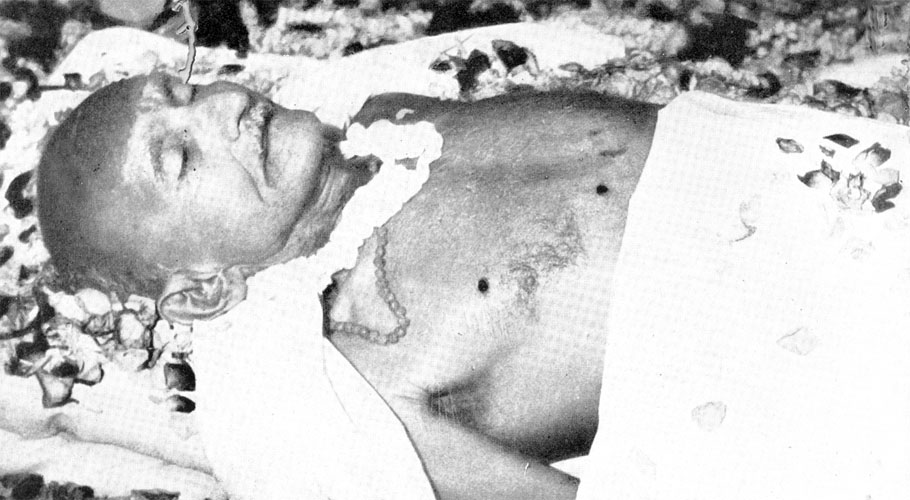
The mortal remains of MK Gandhi.
That, he observed, was a particularly painful contrast on an occasion honouring a leader who had devoted his life to non-violence.
Sulaiman thanked the artist, adding that Gandhi’s serene and dignified face itself conveyed a profound message. Gandhi had worked tirelessly to rid the country of communal conflict, he said, and hoped the portrait would inspire people of all communities to uphold non-violence and shun aggression in public life.
Those hopes would be shattered just 104 days later. On 30 January 1948, Nathuram Godse, a Hindu extremist, assassinated Gandhi, accusing him of “constant and consistent pandering of Muslims”.
(Edited by Dese Gowda)



