

Published Jul 25, 2026 | 8:00 AM ⚊ Updated Jul 25, 2026 | 8:00 AM

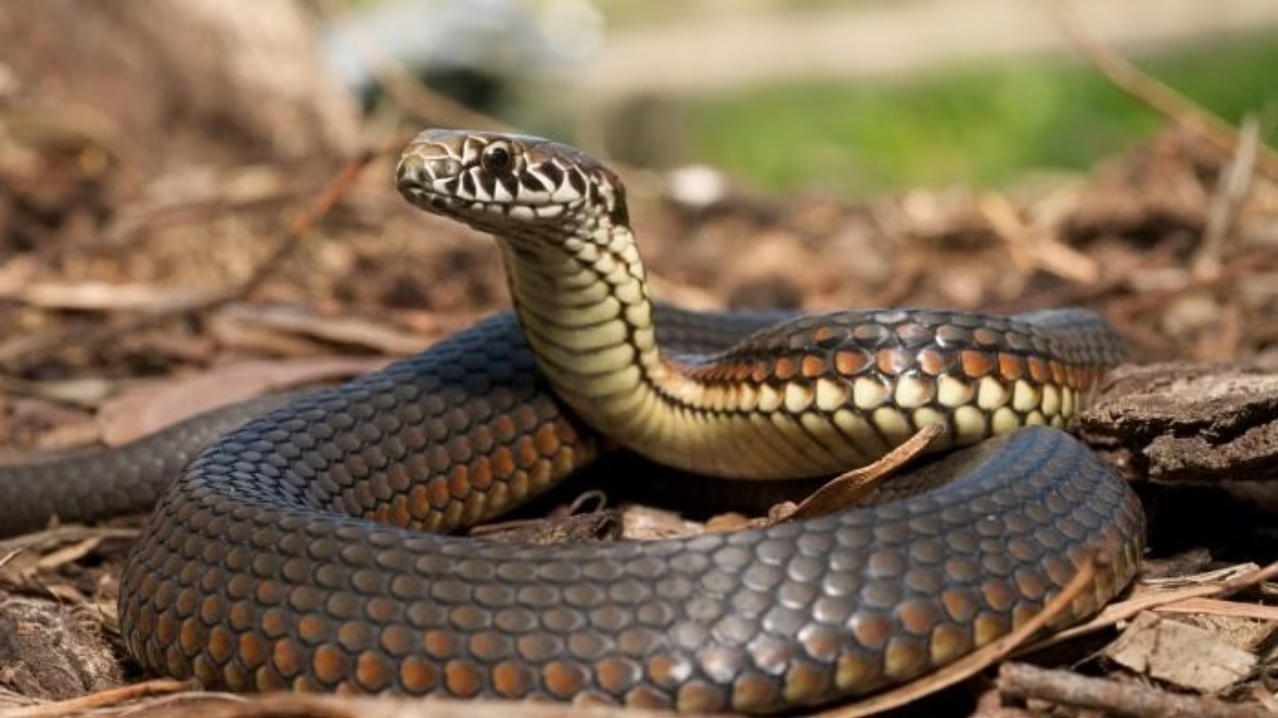
Kerala has recorded around 600 snakebite deaths in the past decade.

Synopsis: Kerala has drawn up a first-of-its-kind roadmap to eliminate snakebite deaths and disabilities by 2030 through better treatment, public awareness, research and coordinated action across departments. The roadmap also acknowledges the state’s unique snakebite challenge beyond the traditional ‘Big Four’. But the ambitious plan also lays bare the hurdles ahead, including underreported cases, gaps in research and species-specific treatment, and the need for stronger rural healthcare to turn the goal into reality.
Kerala has set itself an ambitious public health target to eliminate snakebite deaths and related disabilities by 2030.
With snakebite cases continuing to threaten farmers, plantation workers, tribal communities and other rural populations, the state has unveiled the Kerala State Action Plan for Prevention and Control of Snakebite Envenoming (KSAPSE).
The first-of-its-kind roadmap brings together healthcare, wildlife management, agriculture, local self-governments and scientific research under a single strategy.
Prepared by the Department of Health and Family Welfare in collaboration with the Centre for One Health–Kerala, the action plan moves beyond emergency treatment to tackle the problem at every stage—from prevention and public awareness to rapid medical response and long-term research.
Alongside ensuring the availability of Anti-Snake Venom (ASV) and critical care facilities across the health system, the plan places equal emphasis on community education, school safety measures, improved access to treatment in remote areas and developing species-specific venom research suited to Kerala’s rich biodiversity.
Aligned with the World Health Organisation’s global target and the National Action Plan for Prevention and Control of Snakebite Envenoming (NAPSE), the initiative seeks to build a system in which timely care, informed communities, and coordinated government action make snakebite deaths a thing of the past.
The state had formally declared snakebite as a notifiable public health disease in 2025.
Also Read: Karnataka is India’s snakebite fatality hotspot
According to KSAPSE, snakebites in Kerala are—in most cases—accidents.
The Kerala State Action Plan for Snakebite Envenoming
Nearly 90 per cent of victims are bitten after unknowingly stepping on or disturbing a snake.
Yet, experts said there are also incidents where people deliberately try to handle snakes, sometimes mistaking highly venomous species for harmless ones, with tragic consequences.
Kerala is home to more than 130 snake species across 12 families, making it one of the country’s richest regions for snake diversity. While a few species are found only in specific pockets, most are widely distributed across the state.
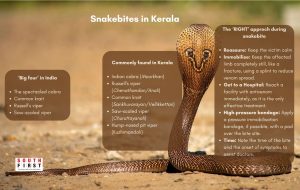
The action plan noted that for decades, India’s snakebite treatment largely focused on the “Big Four” venomous snakes — the Indian cobra (Naja naja), common krait (Bungarus caeruleus), Russell’s viper (Daboia russelii) and saw-scaled viper (Echis carinatus).
In Kerala, the cobra, krait and Russell’s viper are found across much of the state. In contrast, the saw-scaled viper (Echis carinatusis) is largely restricted to parts of Kasaragod, Kannur and Palakkad districts.
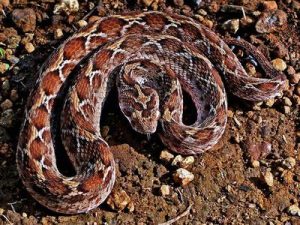
The saw-scaled viper is largely restricted to parts of Kasaragod, Kannur and Palakkad districts.
These four species continue to account for a large share of serious snakebite cases. However, doctors and researchers say they no longer tell the complete story.
One snake that has increasingly drawn attention is the hump-nosed pit viper (Hypnale hypnale), now recognised as a major cause of snakebite in Kerala and parts of neighbouring Karnataka.
The species is common along the foothills of the Western Ghats, forest fringes, plantations and dense wooded areas. It is endemic to the South-Western Ghats.
Unlike the long-held belief that its bite causes only pain and swelling around the wound, recent studies have shown that the hump-nosed pit viper can trigger life-threatening complications.
Victims can develop serious blood-clotting disorders, acute kidney injury and thrombotic microangiopathy, a condition that damages small blood vessels and can affect multiple organs.
The challenge does not end there. The polyvalent anti-snake venom currently available in India is designed to treat bites from the Big Four species and has not been found to reduce illness or prevent deaths caused by hump-nosed pit viper envenomation.
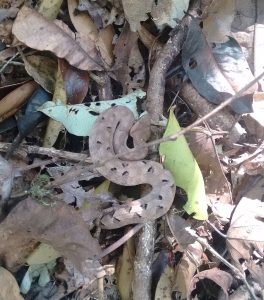
Hump-nosed pit viper (Bangal Priti/Wikimedia Commons)
Administering the antivenom in such cases may instead expose patients to unnecessary risks, including adverse reactions associated with the treatment.
As a result, the action plan said, the hospitals in Kerala, Tamil Nadu and Karnataka generally avoid administering the standard polyvalent antivenom for confirmed hump-nosed pit viper bites.
Health experts said the changing understanding of snakebite in Kerala underscores the need for better species identification, greater public awareness, and treatment protocols that reflect the state’s unique snake population rather than relying solely on the traditional focus on the Big Four.
Also Read: Kerala fast-tracks antivenom for deadly hump-nosed vipers
A key highlight of the action plan is to strengthen the state’s snakebite response by establishing a regional venom research ecosystem focused on the state’s unique snake species, while also improving treatment, antivenom development, and training for frontline healthcare workers.
The proposal, officials said, is in line with the Centre’s plan to establish Regional Venom Centres across the country.
“In Kerala, the focus will be on strengthening institutions that already have expertise in snakebite treatment, toxicology and antivenom research,” a Health Department official said.
“A major component is research on the venoms of Kerala’s medically important snakes. Studies will examine differences in venom between species and within the same species, seasonal variations, and how these influence the pattern of snakebite cases seen in the state,” he added.
The proposal also called for the setting up of advanced laboratory facilities for venom and toxicology research. Institutions will be equipped to carry out biochemical, genomic, proteomic, taxonomic and toxicological studies, while working with universities, biotechnology centres, forensic laboratories and the wildlife department.
Another priority is the development of region-specific antivenoms.
State-accredited venom collection centres are proposed to ethically collect and authenticate venom from Kerala’s medically important snakes.
The plan also sought closer collaboration with antivenom manufacturers to improve the quality and effectiveness of ASV and include venoms from medically significant species found in Kerala but not covered under the existing ‘Big Four’ antivenom.
Separate efforts are also proposed to develop a polyvalent ASV for pit vipers, particularly the hump-nosed pit viper and Malabar pit viper, both of which are responsible for a significant number of snakebite cases in the state.
The proposal also gives importance to strengthening treatment at the primary healthcare level.
Medical officers in Primary Health Centres (PHCs) and Community Health Centres (CHCs) will undergo a six-module training programme covering snake identification, prevention, recognition of envenoming, treatment protocols, management of complications, referral systems, documentation, community awareness and government compensation schemes for snakebite victims and livestock losses.
Special training is also planned for pharmacists and nurses on the safe preparation and administration of ASV. The programme will focus on correct infusion techniques, monitoring patients for adverse reactions and stabilising victims before they are referred to higher centres.
Also Read: Snakebites kill more than wild elephants in Kerala
As per the action plan, the state is set to broaden its snakebite management strategy by focusing on practical, low-cost measures that go beyond the availability of anti-snake venom, with greater emphasis on early intervention, timely referrals and improved emergency care.
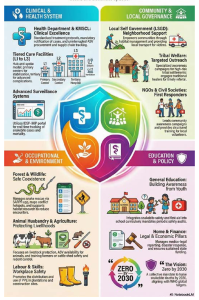
‘Zero by 2030’: Kerala’s ambition plan to check snakebite deaths.
The recommendations, based on the PROMISE (Practical Routes for Managing Indigenous Snakebite Envenoming) approach, call for trained traditional healers to be brought into the formal referral system. Their involvement is expected to help identify serious cases early, encourage faster referral to hospitals and reduce under-reporting of snakebite incidents.
The proposal also stresses the need to strengthen communication and transport networks to ensure patients reach appropriate healthcare facilities without delay.
Establishing poison information centres is another key recommendation aimed at providing expert guidance and avoiding unnecessary movement of patients between hospitals.
A major recommendation is the launch of a 24×7 snakebite helpline, which would provide immediate advice on snakes and snakebite, connect the commoner with experts and direct them to emergency medical services when required.
Recognising that respiratory failure remains the leading cause of death in neurotoxic snakebite, the recommendations say every peripheral and secondary-level health facility should be equipped to provide early airway management and respiratory support. Strengthening these facilities is expected to improve survival rates, particularly during the critical hours after envenoming.
The recommendations also called for the formal inclusion of Kerala’s private healthcare sector in the state’s snakebite prevention and control programme.
Private hospitals already play a significant role in emergency treatment, intensive care, research, training and public awareness. Bringing them into the state framework through standard treatment protocols, data sharing, outcome reporting and joint capacity-building programmes is expected to strengthen the overall response to snakebite across the state.
Also Read: Kerala’s doctors in a high-stakes snakebite gamble
Despite the action plan being welcomed as a long-awaited initiative, experts and stakeholders caution that significant gaps could hamper its implementation.
Traditional and faith-based treatment practices continue to influence care-seeking behaviour—often with fatal consequences.
Officials familiar with the issue point out that the state still lacks reliable data in several critical areas.
Snakebite cases and deaths are believed to be underreported, while district- and block-level estimates remain limited.
There is also inadequate documentation of disabilities and long-term health complications among survivors.
Concerns extend to clinical and ecological data as well.
Documentation on snake species involved in bites and the clinical syndromes they cause is limited, and gaps persist in the management of complications.
Experts also noted that traditional and faith-based treatment practices continue to influence care-seeking behaviour. At the same time, there is little evidence to assess the effectiveness of Information, Education and Communication (IEC) and Behaviour Change Communication (BCC) campaigns.
Another major challenge is the absence of state-specific research on snake ecology and human-snake conflict.
Weak coordination among the health, forest, and wildlife departments has further limited the sharing and use of crucial data.
Speaking to South First, Advocate Kulathur Jaisingh, who had approached the Kerala High Court seeking guidelines on school safety and security, including measures to prevent and manage snakebites, welcomed the government’s move.
He said the action plan was a much-needed step and expressed hope that it would lead to meaningful changes in snakebite prevention, treatment and public safety across Kerala.
(Edited by Majnu Babu).



