

Published Jun 03, 2026 | 11:48 AM ⚊ Updated Jun 03, 2026 | 11:48 AM

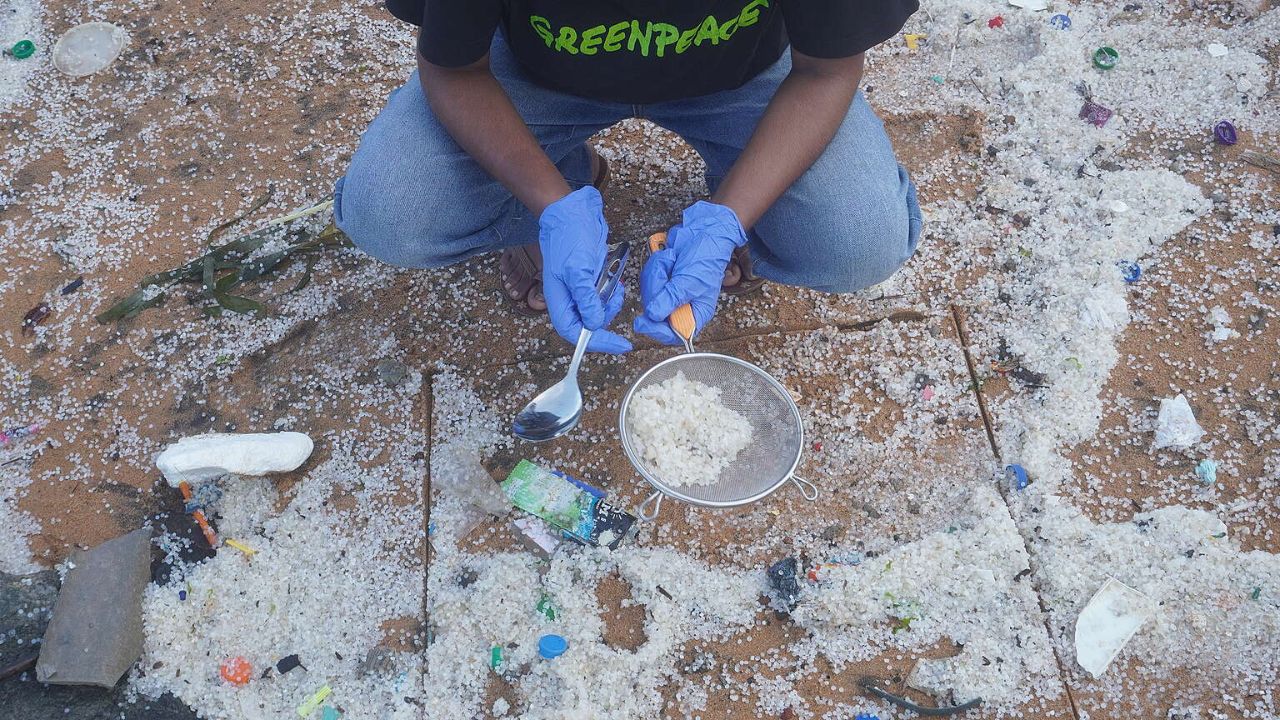
Plastic nurdles on the shore following MSC Elsa 3 wreck. (Greenpeace)

Synopsis: As Kerala’s fishing communities brace for another difficult monsoon season, fresh fears have emerged that plastic nurdles from the MSC Elsa 3 shipwreck could be swept back into the sea, deepening an environmental crisis that remains far from resolved. With hundreds of tonnes of spilled plastic and oil still unaccounted for and key scientific assessments pending, fishers worry that rough seas may reignite a disaster that continues to threaten marine ecosystems and coastal livelihoods.
For Kerala’s fisherfolk, the arrival of the southwest monsoon has never been a season of abundance. Every year, the rough seas and a 52-day ban on mechanised trawling push thousands of fishing families into weeks of uncertainty and financial distress.
Though traditional country boats are exempt from the ban, the turbulent Arabian Sea during June, July and August often makes venturing out impossible even for small-scale fishers. This year, another shadow looms over the coast.
As the monsoon is expected to make landfall in Kerala on 4 June, the fishing community is grappling with fears linked to the plastic nurdle pollution caused by the sinking of the MSC Elsa 3.
The cargo vessel capsized and went down in the Arabian Sea off the Kerala coast on 24 May 2025, spilling containers carrying millions of tiny plastic pellets.
A year later, large quantities of nurdles remain scattered along the coastline and in the marine environment.
Fishers fear that the powerful monsoon waves and undercurrents could wash the pellets back into the sea, spreading the contamination further.
There is also growing anxiety over the containers that still lie on the seabed, with concerns that strong underwater currents during the monsoon could dislodge them and worsen the ecological crisis at a time when livelihoods are already hanging by a thread.
Also Read: Toxic bloom, oxygen crash, 357 tonnes nurdles
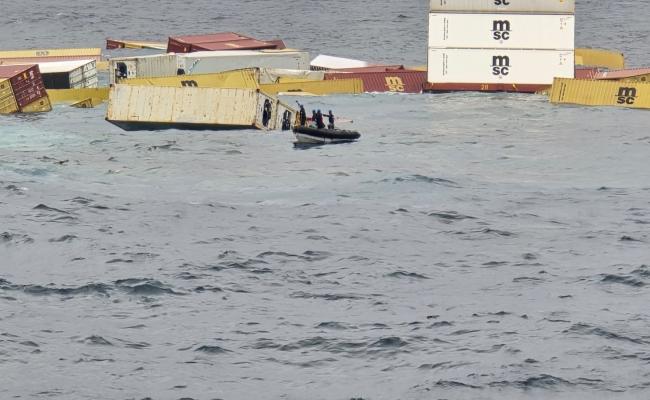
Containers from MSC Elsa 3 were found afloat after the incident.
A year after the shipwreck, major questions surrounding the long-term environmental impact remain unanswered, with critical assessment reports still awaited from scientific agencies.
Official records show that the vessel was carrying 1,836.1 metric tonnes of plastic nurdles, according to the cargo manifest.
Between 24 June, 2025 and 17 March, 2026, a total of 398.187 metric tonnes of plastic nurdles were collected from the shores of Thiruvananthapuram and Kollam districts and transported to Kollam Port for storage.
This means a substantial quantity of the plastic pellets remains unaccounted for.
The first-phase field survey conducted by the Council of Scientific and Industrial Research – National Institute of Oceanography (CSIR-NIO) estimated that the ship was carrying 367 metric tonnes of Heavy Fuel Oil, 84 metric tonnes of Diesel Oil and 55 metric tonnes of Lubricant Oil, amounting to a total of 506 metric tonnes of oil products.
Data furnished by the Directorate General of Shipping, Mumbai, to the Department of Environment and Climate Change (DoECC) indicates that 371.86 metric tonnes of oil were recovered during salvage operations.
The fate of the remaining quantity continues to be a matter of concern for environmental observers and fishers.
Despite a year since the incident, Kerala is yet to finalise a dedicated Oil Spill Contingency Plan (OSCP) for shoreline cleanup.
The Kerala State Pollution Control Board (KSPCB) issued a work order to Environ Software Private Ltd on 27 June 2025 and signed an agreement on 14 July 2025 for preparing the plan.
The consultant has already submitted a draft Oil Spill Contingency Plan incorporating hydrodynamic studies, oil spill modelling, Marine Sensitivity Index mapping and Net Environmental Benefit Analysis (NEBA).
The report is currently under expert scrutiny and requires approval from the Indian Coast Guard before it can be formally adopted and published.
In an affidavit filed before the National Green Tribunal’s Principal Bench in April, Senior Environmental Engineer of the Kerala State Pollution Control Board, Eby Varghese, stated that environmental monitoring is continuing across 13 locations in three coastal districts.
Sampling is being carried out once every two weeks at five locations in Thiruvananthapuram district — Varkala Papanasam, Muthalapozhy river mouth, Perumathura, Poovar and Pallithura.
In Kollam district, monitoring is underway at Valiyazheekal, Neendakara, Thanni and Paravur Pozhikkara, while four locations in Alappuzha district — Valiyazheekal, Thrikunnapuzha, Ambalapuzha and Alappuzha — are also being regularly sampled.
The data collected from these sites is being shared with CSIR-NIO to scientifically determine whether environmental damage attributable to the shipwreck can be established.
A separate agreement was signed between the Pollution Control Board and CSIR-NIO on 16 July 2025 for carrying out a comprehensive Environmental Damage Assessment and Long-Term Study on the impact of the MSC ELSA-3 disaster.
CSIR-NIO later submitted a timeline for the study through a communication dated 25 October 2025.
The institute submitted its first-phase field survey report on 7 January 2026.
A State Level Committee meeting convened by the Director of the Department of Environment and Climate Change on 13 January sought additional clarifications from the scientific agency. Another meeting was held on 25 March to discuss the issues raised.
The Pollution Control Board is still awaiting the finalised first-phase report from CSIR-NIO.
The scientific assessment process remains incomplete.
CSIR-NIO is expected to submit the detailed report covering the findings of the first and second phases of the field survey, along with the third-phase field survey report.
Also Read: The journey of Tahsin Mohammed Jamshid
The plastic nurdles that washed ashore along the state’s coastline after the MSC ELSA 3 incident may not remain confined to beaches and coastal pockets once the southwest monsoon gathers strength, according to fisherfolk representatives and scientific studies that have examined the spill’s aftermath.
Jackson Pollayil of the Kerala Swathanthra Matsya Thozhilali Federation said a significant quantity of nurdles that initially floated in the sea has now settled at different locations along the coast.
Some have accumulated in fissures between groynes while others remain buried or trapped on the shoreline.
With rough seas expected during the monsoon, Pollayil fears that strong waves could dislodge these pellets and carry them back into the marine environment.
“The nurdles are lying in different pockets along the coast. Once the sea becomes rough, the waves can disturb them and push them back into the sea,” he told South First.
Pollayil pointed out that collection efforts, which were visible in the initial days following the spill, have largely disappeared.
“Such exercises were there in the beginning. Now we can’t find such collection drives,” he said.
Nurdles scattered along the coast.
He also raised concerns about debris and containers that remain submerged in the sea following the accident. According to him, stronger currents during the monsoon could shift the debris, damage containers or trigger leakages, creating fresh environmental risks.
Scientific studies conducted after the incident echo many of these concerns.
A study published in the journal Marine Pollution Bulletin in January, titled ‘Environmental Impact of Nurdle Spill from MSC ELSA 3 on the Kanyakumari Coast, Southern India‘, noted that plastic nurdles are persistent marine pollutants with a high dispersal potential because of their buoyancy and small size.
The researchers described the MSC ELSA 3 spill as the largest reported nurdle spill in Indian waters.
The study recorded the continued arrival of nurdles along the Thiruvananthapuram coast, particularly at Kochuveli, Thumba and Vettukad. Ocean currents subsequently transported the pellets further north and into Tamil Nadu’s Kanniyakumari district.
It warned that nurdles present a compound threat to marine ecosystems. Their size and shape make them easily ingestible for a wide range of marine organisms, potentially causing feeding problems, physical blockages and reduced fitness.
Researchers also noted that the pellets can absorb persistent organic pollutants and heavy metals from seawater, allowing contaminants to move through marine food webs.
The paper concluded that preliminary ecological assessments indicated potential risks to benthic communities, including meiofauna and intertidal invertebrates, which are vital to the marine ecosystem.
Another study, published in February in the journal Water, Air & Soil Pollution, documented the early stages of contamination after the sinking.
The paper, titled Nurdles on the Shore: Investigating Plastic Pellet Contamination after the MSC ELSA 3 Sinking in Kerala, off Southwest India, highlighted the vulnerability of Kerala’s coastline to such incidents because of its extensive coastal stretch and heavy maritime traffic.
The study said such maritime accidents pose a substantial risk of localised coastal contamination and underlined the importance of documenting the spread of nurdles before redistribution by waves, currents or cleanup operations alters the evidence.
With the monsoon approaching and large sections of the affected coastline yet to be fully assessed, concerns persist over whether the next phase of the crisis will unfold beneath the waves rather than on the shore.
(Edited by Muhammed Fazil.)



