

Published May 28, 2026 | 7:00 AM ⚊ Updated May 28, 2026 | 7:00 AM

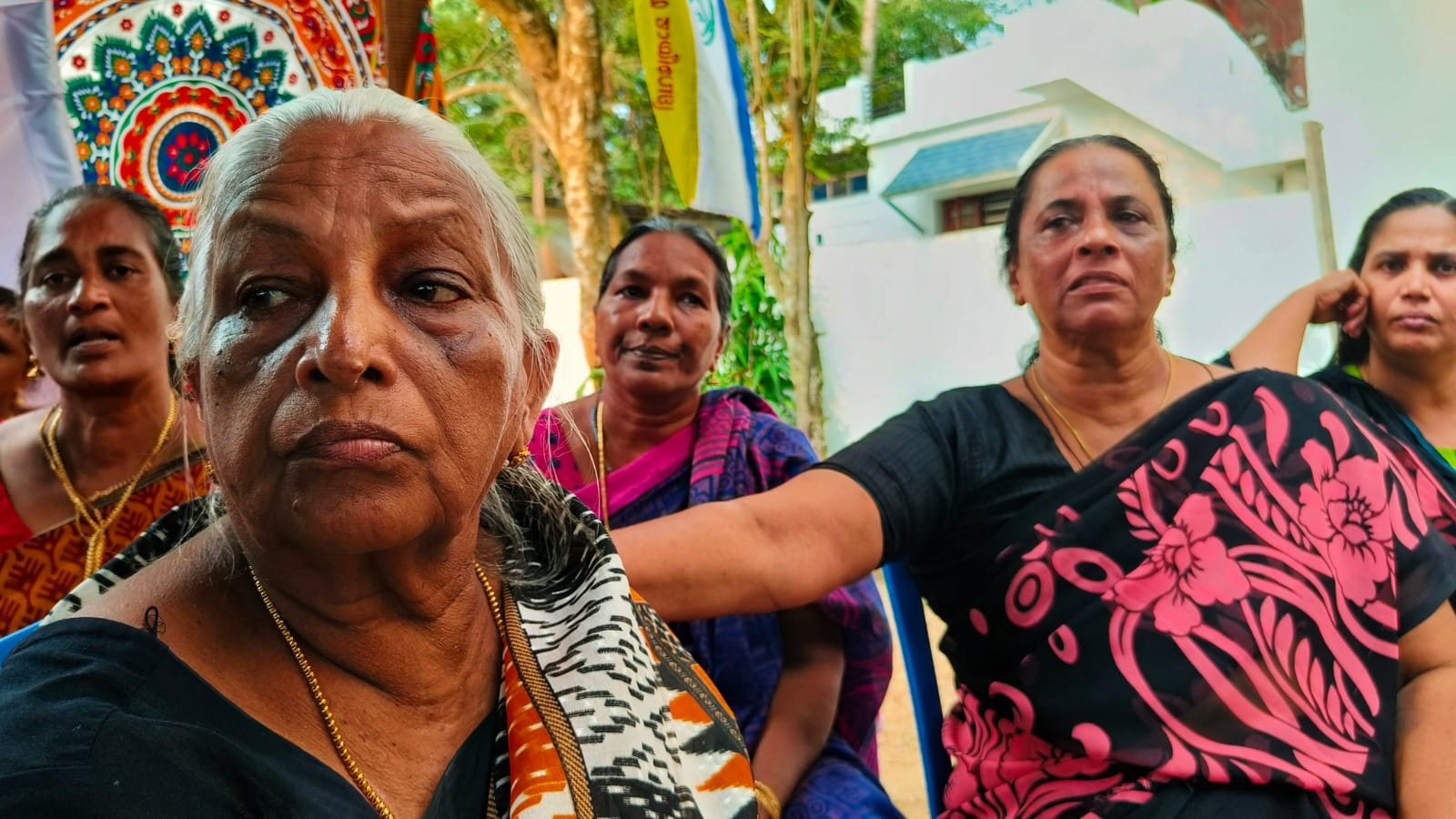
Women leading a protest over the Waqf land dispute in front of the Velankanni Church at Kadappuram in Munambam.

Synopsis: The dispute regarding the land ownership in Munambam near Kochi has reached another flashpoint after the Kerala Waqf Board registered it as Waqf land in the UMEED portal. What began as a complicated property dispute has now transformed into one of Kerala’s most explosive controversies, with both sides locked in a bitter battle.
Until three years ago, John Mathew and his friends measured their lives by the tides and winds, hoping for a good catch as fishing was the main livelihood for most families in Munambam — a coastal village in Kerala’s Kochi.
However, now, their days start and end with court hearing dates and legal notices.
At Munambam, more than 600 Latin Christian fishing families live in fear over their properties, which are now under claims of being Waqf land. After the Waqf Board’s claims surfaced, residents can no longer sell their property, mortgage it for loans or even confidently invest in maintaining their houses.
Land prices have sharply dipped there.
Banks hesitate to process documents because the land has been tagged as disputed Waqf property. Young people planning marriages or migration find themselves trapped by the uncertainty attached to addresses their families have occupied for generations.
At the centre of the crisis lies 404.76 acres of land claimed by the Kerala State Waqf Board as Waqf property — a claim residents fiercely reject. What began as a complicated property dispute has now transformed into one of Kerala’s most explosive controversies, with both sides locked in a bitter battle.
Also Read: Munambam’s Waqf land protest takes a new turn
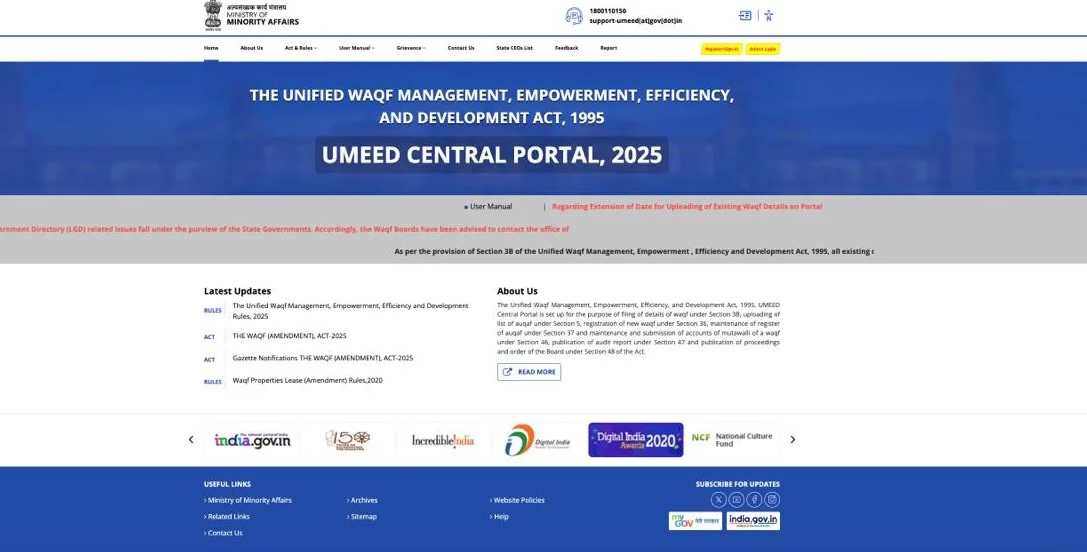
UMEED Portal.
The recent controversy in Munambam began when the Kerala State Waqf Board uploaded the land details onto the Union government’s UMEED portal.
UMEED (Unified Waqf Management, Empowerment, Efficiency and Development) is a centralised digital database intended to create a nationwide record of Waqf properties. The portal is part of the Union government’s effort to digitalise Waqf records and monitor properties across states.
According to the Waqf Board, the upload was part of a broader exercise to digitalise all properties already present in the Waqf register before the Union government’s documentation deadline.
However, the upload triggered immediate backlash.
Residents of Munambam and church groups argued that uploading disputed land onto a national Waqf database while court proceedings remain unresolved could strengthen the perception of final ownership and further complicate the residents’ legal position.
The technical dispute revolves around one crucial legal question- who has the authority to upload Waqf property details onto the UMEED system?
Speaking to South First advocate George Poonthottam, the lawyer representing the residents of Munambam in the Kerala High Court said, “Under Waqf administration procedures, the Mutawalli, the legally recognised manager or custodian of a Waqf property, is generally responsible for maintaining and submitting records relating to that property. In the Munambam case, the Kerala State Waqf Board itself uploaded the details although the recognised custodianship is associated with Farook College in Kozhikode.”

Rajeev Chandrasekhar with Union Minister for Minority Affairs Kiren Rijiju.
On Tuesday, 26 May, BJP Kerala chief and Nemom MLA Rajeev Chandrasekhar met Union Minority Affairs Minister Kiren Rijiju seeking intervention, alleging that the upload violated provisions governing the UMEED framework and the Waqf Act.
“The Waqf Board exceeded its authority by unilaterally registering the land digitally without proper procedural compliance. The immediate dissolution of the present Kerala Waqf Board is our demand, as it is misusing administrative powers,” Joseph Benny, convenor of the Munambam Protest Forum, told South First.
Meanwhile, George Poonthottam maintained that the registration on the UMEED portal will not create a legal hurdle.
“But the dishonesty towards the people of Munambam has been exposed. People feel they have been cheated. The current Kerala Waqf Board is managed by CPI(M)-affiliated members, and they secretly supported the move. This could create rivalry between Christian and Muslim communities. The fact that the Left party facilitated it is unfortunate,” he said.
Also Read: Police teams formed to probe Hyderabad advocate’s murder; Waqf dispute under lens
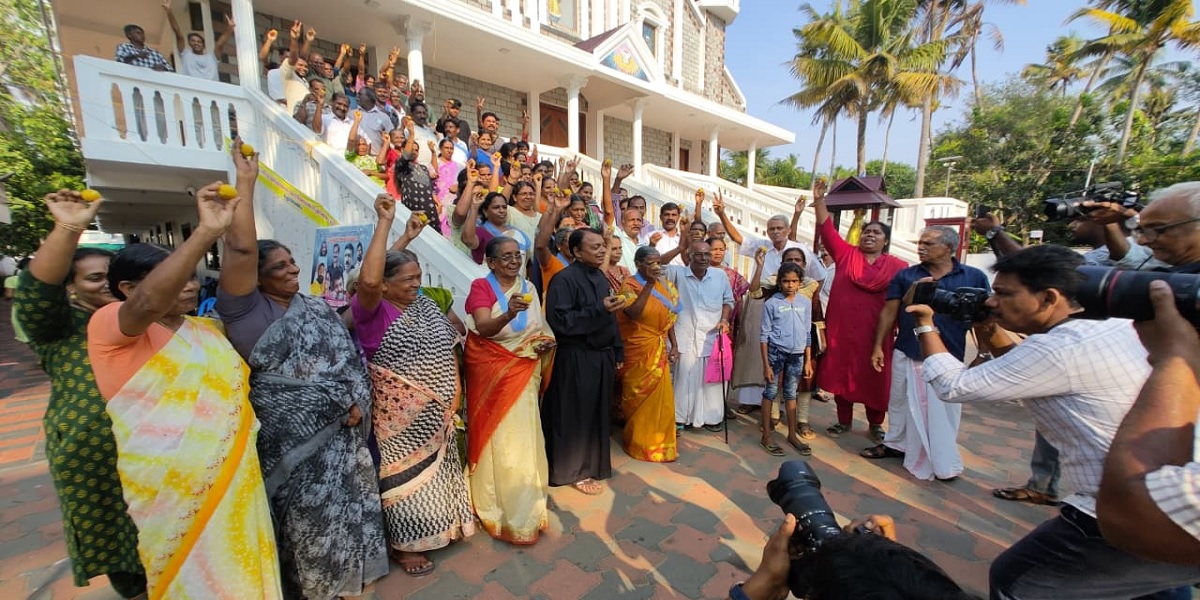
Residents of Munambam gathered in front of Velankanni Church.
The roots of the Munambam land dispute trace back to 1967, when a civil suit (O.S. No. 53/1967) was filed before the Paravur Sub Court in the Ernakulam district regarding the ownership and Waqf status of portions of the land linked to Farook College.
The dispute centred on whether the property was a valid Waqf dedication or a private transfer.
In 1975, the Kerala High Court upheld earlier findings recognising the Waqf status connected to portions of the land. Over time, however, the area became densely inhabited by Christian families who purchased plots through registered deeds, paid land tax, constructed homes and transferred ownership across generations.
The crisis re-emerged dramatically in 2019 when the Kerala State Waqf Board initiated suo motu proceedings and entered the 404.76 acres into the Waqf register as Waqf property.
“This action transformed our legally occupied residential land into disputed territory overnight,” Joseph Benny told South First.
That entry triggered a wave of litigation.
Multiple residents approached courts and the Waqf Tribunal, challenging the Board’s powers, arguing that the land has historically been treated as transferable private property, not as an operational religious endowment.
However, there is still a lack of clarity whether the original transaction itself legally satisfied the conditions required for a permanent Waqf dedication under Islamic law and the Waqf Act.
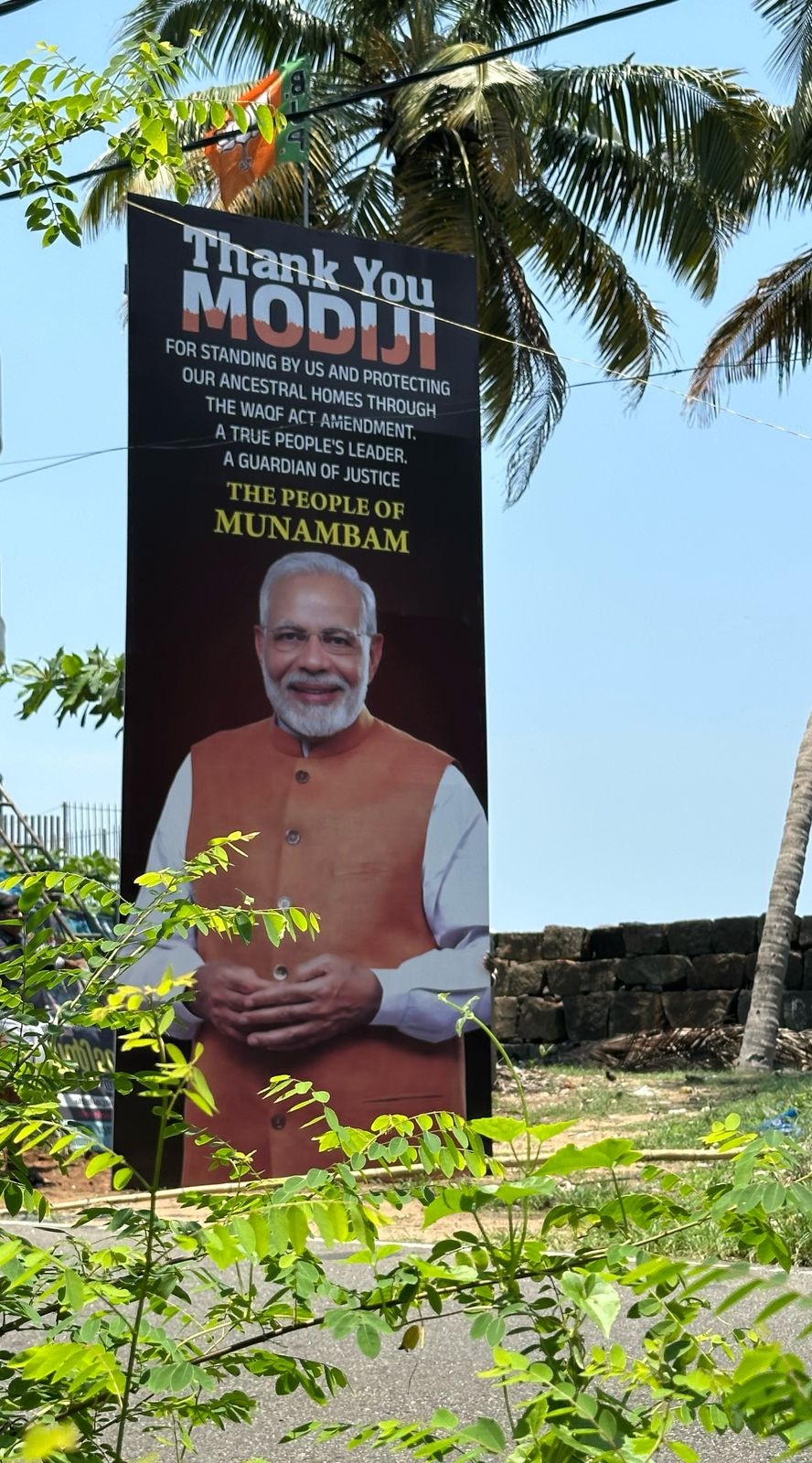
Munambam displays pro-Modi posters amid Waqf dispute.
In 2019, the Division Bench of the Kerala High Court described aspects of the Waqf Board’s actions as legally unsustainable and questioned whether the disputed land could validly qualify as Waqf property.
The court also criticised attempts that appeared to interfere with the ordinary property rights of residents and permitted interim reliefs, including the payment of taxes.
However, the Supreme Court of India later stayed portions of the High Court’s findings and ordered the status quo.
As a result, the final ownership issue remains unresolved and is still active before judicial forums.
Several parallel proceedings are also continuing:
• Cases before the Waqf Tribunal;
• Challenges to Waqf registration;
• Petitions linked to eviction and mutation rights; and
• Questions surrounding the government-formed commission and administrative authority.
This legal uncertainty became politically explosive after VD Satheesan promised before the Assembly elections that the issue could be resolved within “10 minutes” if the UDF came to power.
However, after assuming office as the chief minister, Satheesan shifted his position, arguing that the matter had become deeply complicated due to the UMEED registration process, for which he blamed the outgoing LDF government.
He alleged that the issue had been made more complicated to put the newly elected government in trouble.
Meanwhile, the CPI(M) accused Satheesan of misleading the public and politicising the portal upload. Leaders of the BJP argued that both the LDF and UDF failed to act decisively when the Waqf registration process intensified in 2019.
However, the communal dimension surrounding Munambam continues to grow.
As right-wing groups attempted to frame it as a dispute between Kerala’s minority communities, the families of Munambam maintained that their struggle is never about politics or religion, but about securing the legal right to the homes and coastline they have lived on for generations.
And while the goats kept fighting, many in Munambam, like John Mathew, feel the fox had already begun to feast. Their livelihood still lies out at sea, yet even the sea no longer brings peace, as they never know when they will be called again to fight their case.
(Edited by Muhammed Fazil.)



