

Published May 23, 2026 | 9:00 AM ⚊ Updated May 23, 2026 | 9:00 AM

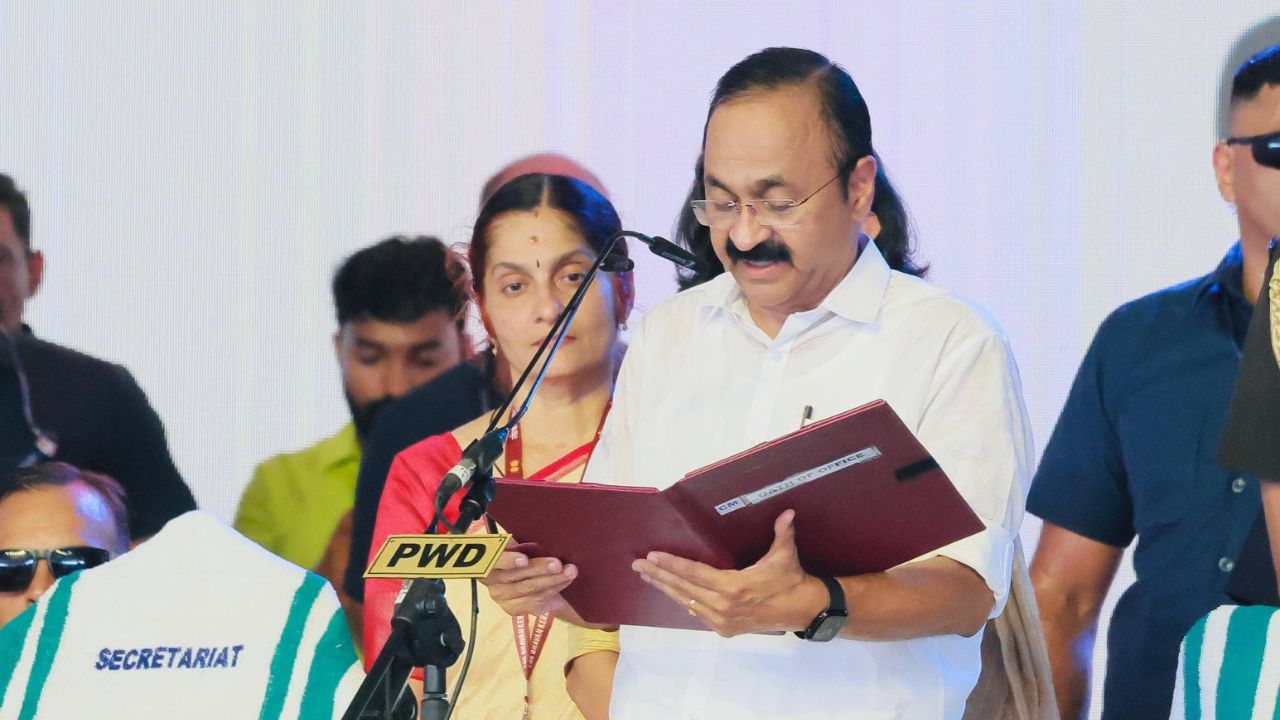
VD Satheesan taking oath as the chief minister of Kerala.

Synopsis: Kerala’s new UDF government is preparing a white paper that could become the first major political and financial audit of the state after 10 years of LDF rule, with the report expected to expose the strain created by rising debt, off-budget liabilities and widening gaps between revenue and welfare commitments. At the heart of the exercise lies a larger battle over narrative — whether Kerala’s finances reflect fiscal recovery, as claimed by the previous government, or a treasury pushed to its limits beneath years of aggressive borrowing and expanding expenditure.
With the new government settling into office, Kerala’s finances have moved to the centre of a political and administrative reckoning.
A white paper on the state’s fiscal condition — now in its draft stage and likely to be tabled in the very first session of the 16th Kerala Legislative Assembly — is expected to lay bare the real condition of the exchequer inherited by the UDF government from the LDF government after a decade.
The decision came on 18 May, soon after the first Cabinet meeting of the new administration, where the government resolved to appoint a panel of experts to prepare a detailed assessment of the state’s finances within 10 days.
A day later, the special committee headed by retired civil servant and former Kerala State Planning Board Vice-Chairperson KM Chandrasekhar held its first meeting, setting in motion an exercise that could shape the political narrative of the new regime’s opening months.
The proposed white paper is expected to spell out, in plain terms, the fiscal space actually available to the government at a time when public expectations are unusually high and the promised “Indira guarantees” are under close scrutiny.
The move also reopens a sharply contested debate over Kerala’s financial health.
In the 2026-27 State Budget, the then-finance minister KN Balagopal had declared that the state had emerged from a prolonged fiscal crisis and was preparing to enter a higher phase of economic growth. The UDF, throughout the election campaign, countered that the state treasury had been drained over the past decade, leaving behind severe financial strain masked by political claims.
With the white paper now on the horizon, those competing narratives are headed for their first formal test.
Also Read: Kerala IAS officer to stand trial nearly 7 years after journalist’s death in car crash
The white paper is expected to paint a stark picture of the state’s fiscal position after a decade of LDF rule, while also preparing the ground for difficult policy choices in the months ahead.
Senior Finance Department officials indicated that the document, now under preparation, will go beyond a routine accounting exercise and attempt to establish the “true fiscal baseline” inherited by the new administration.
The paper is expected to cover the period from 2016 to 2026 and examine the trajectory of debt, deficits, off-budget borrowings and expenditure commitments accumulated during the two consecutive LDF terms.
“The idea is not merely to list liabilities, but to clearly spell out the government’s fiscal capacity and the limits within which new commitments can realistically be implemented,” a senior Finance Department official told South First.
Another official pointed out that the white paper would seek to explain why several development projects and welfare promises may need phased implementation despite the government’s ambitious electoral commitments.
“There is an enormous public expectation after the election. But the fiscal space available to the state is extremely tight. The paper will try to place the numbers before the public in a transparent manner,” the official said.
Chief Minister VD Satheesan had earlier signalled that the document would focus on fiscal transparency and expenditure realism, especially at a time when the Congress-led front has promised an expanded welfare architecture, including enhanced pensions, free bus travel for women and wider health coverage.
Officials said the white paper is likely to underline the widening mismatch between revenue receipts and committed expenditure.
Recent Budget assessments had already flagged persistent stress in the state’s finances, with the revenue deficit for 2026-27 estimated at ₹34,587 crore and the fiscal deficit projected at 3.40 percent of the Gross State Domestic Product (GSDP).
The document is expected to devote considerable attention to debt servicing obligations, pension liabilities, salary expenditure and subsidy commitments, all of which continue to consume a major share of the state’s revenue receipts.
Off-budget borrowings, particularly through the Kerala Infrastructure Investment Fund Board (KIIFB), are also expected to come under scrutiny.
Though South First reached out to Chandrasekhar to understand the methodology being adopted for the white paper, he declined to disclose details, maintaining that the exercise remains confidential until the document is formally tabled by the Chief Minister in the Assembly.
Meanwhile, Finance Department sources said the paper would likely attempt a consolidated picture of “hidden and contingent liabilities” that may not always be reflected fully in annual Budget estimates.
The analytical approach is expected to rely largely on official audited data drawn from State Budgets, Finance Accounts, Comptroller and Auditor General (CAG) reports, RBI studies on State finances, Economic Reviews and Medium-Term Fiscal Policy statements.
Rather than employing complex economic modelling, the exercise is likely to focus on comparative trend analysis — examining how Kerala’s fiscal indicators evolved between 2016 and 2026, including changes in tax buoyancy, capital expenditure, borrowing patterns and deficit ratios relative to GSDP.
Comparisons with national averages and fiscally better-performing states may also feature in the report.
Finance officials said the government wants the document to retain a “professional and data-driven tone” despite its obvious political significance.
“It cannot read like a political chargesheet. The credibility of the paper will depend on the quality of evidence and the seriousness of the analysis,” a senior official said to South First.
The white paper is expected to eventually serve as the foundation for the government’s first full Budget, helping determine the sequencing of welfare schemes, revenue mobilisation measures and expenditure priorities.
Within government circles, there is also an acknowledgement that the exercise may become the basis for renewed demands for greater financial support from the Centre.
Kerala has witnessed similar exercises in the past.
The 2016 assessment by the incoming LDF government had accused its predecessor of leaving behind strained finances, unpaid liabilities and what was then described as “living on a financial lie”.
The forthcoming report appears set to reopen that debate — this time with the roles reversed.
The LDF government, from 2016 to 2026, has projected Kerala’s finances as a story of stronger revenue mobilisation, controlled deficit levels and improved fiscal discipline despite mounting debt and repeated disputes with the Centre over borrowing restrictions.
Presenting the State Budget 2026-27, the government claimed Kerala generated an additional ₹1,27,747 crore in own tax revenue during the tenure of the second Pinarayi Vijayan government.
The figure refers to additional collections and not the total tax revenue.
Average annual own tax revenue rose from ₹47,453 crore during the first LDF government between 2016-17 and 2020-21 to ₹73,002 crore in the current term. The budget estimated own tax revenue for 2025-26 at ₹83,731 crore.
Non-tax revenue also registered an increase, the budget stated.
The government said it mobilised an additional ₹24,898 crore under the head, with average annual non-tax revenue rising from ₹10,455 crore in the first LDF term to ₹15,435 crore during the second term. Combined together, the government said more than ₹1,52,645 crore in additional own revenue had been generated.
Expenditure figures reflected a sharp expansion in state spending.
Average annual expenditure during the Oommen Chandy government (2011-16) stood at ₹68,028 crore.
It increased to ₹1,17,191 crore during the first Pinarayi Vijayan administration and further to ₹1,69,547 crore in the second term.
Expenditure for 2025-26 is estimated at ₹1,92,456 crore. The government also pointed out that developmental spending through the Kerala Infrastructure Investment Fund Board (KIIFB) comes in addition to this.
Debt, though, remains a major concern.
Kerala’s total debt rose from ₹1,57,370 crore at the start of the first LDF government to ₹4,88,910 crore projected for 2025-26.
The government argued the debt had not doubled during the second term, saying it would have crossed ₹5.93 lakh crore if that were the case.
It also highlighted that the debt-to-GSDP ratio fell from 38.47 percent in 2021 to 33.44 percent now.
The Budget and Economic Review blamed the Union government for worsening fiscal pressure.
The state alleged that ₹5,944 crore was cut from its approved borrowing limit and that nearly ₹17,000 crore was excluded from eligible receipts this year. GST rate revisions by the Union government were projected to cause an annual loss of ₹8,000 crore.
The Economic Review maintained that Kerala was pursuing fiscal consolidation through higher revenue mobilisation and expenditure rationalisation.
Fiscal deficit stood at 3.02 percent of GSDP in 2023-24, rose to 3.86 percent in 2024-25 and is estimated at 3.16 percent in 2025-26.
Revenue deficit is projected at 1.9 percent of GSDP in 2025-26.
Even as transfers from the Union government declined by 6.15 percent in 2024-25, the state’s own revenue receipts continued to register growth, the LDF government had claimed.
To give weight to this claim, the Left government, in its last phase, cited the report of the Comptroller and Auditor General of India to argue that Kerala’s debt levels remain within manageable limits compared to many other states.
According to the assessment, Kerala figures among the states with a debt-to-GSDP ratio below 25 percent.
The government maintained that, if the conventional pattern of state debt doubling every five years had continued unchecked, Kerala’s liabilities would have crossed ₹6 lakh crore by now.
Instead, the debt burden has remained below ₹4.7 lakh crore, which the administration presented as evidence of relative fiscal restraint despite sustained spending pressures and borrowing constraints.
Also Read: Free bus travel for women becomes acid test for UDF in Kerala
Even as the Left continues to argue that the state has emerged from a prolonged financial crunch, the UDF has sharpened its attack on the alleged dire straits that the state’s economy finds itself in.
In 2023, while in Opposition, the UDF came out with a detailed white paper on public finances. It was released ahead of the Budget session.
The document painted a grim picture of the state’s finances, accusing the government of pushing Kerala into a deep debt trap through unchecked expenditure, weak revenue mobilisation and excessive dependence on borrowings.
It described the situation as one marked by “toxic debt”, warning that the financial stress had reached alarming levels.
Drawing from Budget records and audit data, the paper pointed to a steep rise in key fiscal indicators over the years. Revenue deficit, which stood at ₹9,657 crore in 2015-16, was estimated to have climbed to more than ₹23,000 crore by 2021-22.
Fiscal deficit, too, nearly doubled during the same period, crossing ₹37,000 crore.
The state’s total debt burden emerged as the centrepiece of the criticism.
According to the document, liabilities that were around ₹1.57 lakh crore in 2015-16 had surged past ₹3.33 lakh crore within six years. Per capita debt, it noted, had crossed the ₹1 lakh mark.
Budget estimates for 2022-23 projected overall debt at nearly ₹3.72 lakh crore. The white paper argued that once liabilities linked to infrastructure financing agencies and social security pension borrowings were added, the effective debt exposure would inch close to ₹4 lakh crore.
The UDF also flagged the debt-to-GSDP ratio, claiming it had breached 39 percent, significantly above the benchmark maintained during earlier administrations.
It cited Reserve Bank data to argue that the state had already crossed levels that were projected only for later years.
Another major allegation centred on tax collection.
The paper claimed that the government had failed to mobilise close to ₹70,000 crore in potential tax revenue over five years. It accused the administration of poor enforcement, ineffective amnesty schemes and an inability to curb evasion.
The report further revisited earlier warnings against large-scale extra-budgetary borrowings, arguing that financing mechanisms created outside the Budget framework had ultimately become direct liabilities of the state.
To stabilise the situation, the white paper called for tighter expenditure control, stronger tax administration and identification of new revenue streams. It also recommended a review and rationalisation of major infrastructure projects and a restructuring of debt management practices to ease the mounting financial pressure.
It’s learnt that these recommendations may also find a place in the white paper being drafted now.
(Edited by Muhammed Fazil.)



