


Published Dec 13, 2025 | 9:43 PM ⚊ Updated Dec 13, 2025 | 9:43 PM

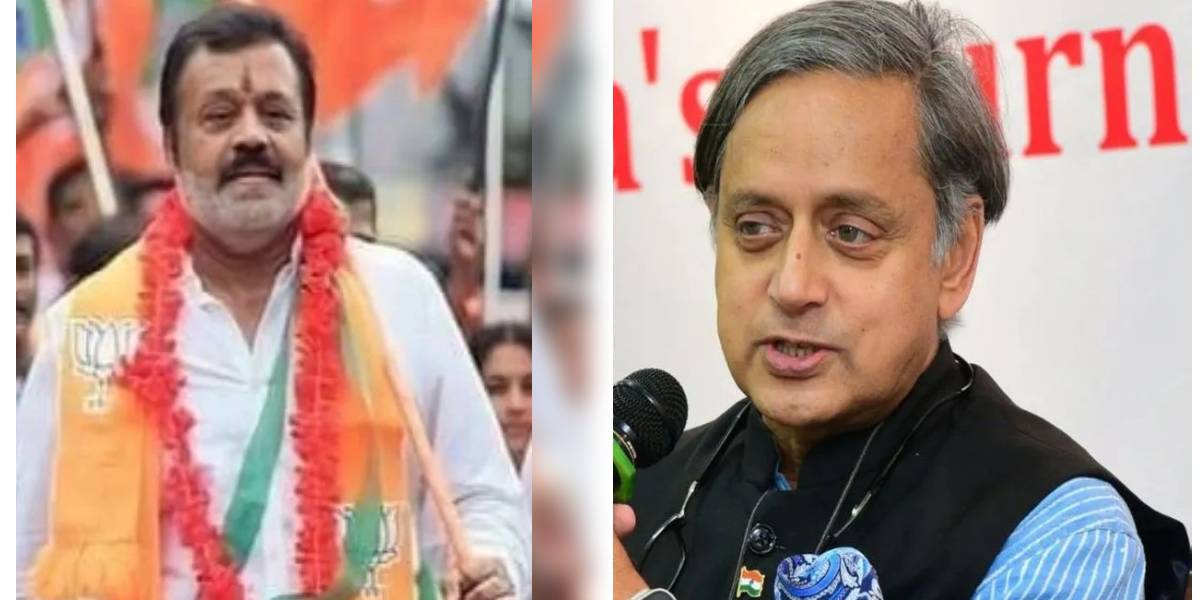
Suresh Gopi and Shashi Tharoor.
Synopsis: The results of Kerala’s local self-government elections have delivered a telling political contrast. In Thiruvananthapuram, the BJP-led NDA broke a 45-year LDF stranglehold over the city corporation, signalling a major shift in the capital’s political landscape. In Thrissur, however, the BJP’s expectations — buoyed by Union Minister Suresh Gopi’s 2024 Lok Sabha victory — failed to translate into a civic-level breakthrough.
Two Kerala municipal corporations, two high-profile MPs, and two sharply divergent verdicts.
While the BJP scripted a historic takeover of the Thiruvananthapuram Corporation after 45 uninterrupted years of Left rule, the much-hyped BJP surge in Thrissur fell flat.
The contrasting outcomes have reopened questions about leadership, campaign strategy, credibility, and the limits of personality-driven politics in Kerala’s local body elections.
The results of Kerala’s local self-government elections have delivered a telling political contrast. In Thiruvananthapuram, the BJP-led NDA broke a 45-year Left Democratic Front (LDF) stranglehold over the city corporation, signalling a major shift in the capital’s political landscape.
In Thrissur, however, the BJP’s expectations — buoyed by Union Minister Suresh Gopi’s 2024 Lok Sabha victory — failed to translate into a civic-level breakthrough.
At the heart of these outcomes lie two MPs, two styles of politics, and two very different electoral stories — one of opportunity lost for the Congress and another of overreach for the BJP.
For the LDF, the writing had long been on the wall in Thiruvananthapuram.
Widespread anti-incumbency feeling against the outgoing council, led by Mayor Arya Rajendran, created fertile ground for a regime change.
Garbage management failures, potholed roads, erratic water supply, and broader civic decay had become defining issues.
Yet, while the BJP capitalised on this discontent, the United Democratic Front (UDF) failed to convert the moment into a comeback.
On paper, the Congress-led front appeared to improve, increasing its seat tally to 19 from 10 in 2020.
But the broader trajectory tells a different story: from 40 seats in 2015 to 21 in 2020 and then to 10, the party had already suffered a steep decline.
Against that backdrop, the 2025 result represents not a revival but a missed opportunity.
The UDF campaign, in fact, showed signs of promise. The decision to field former Aruvikkara MLA KS Sabarinathan — unofficially projected as the mayoral face — came as a surprise and generated early buzz.
Candidate selection was relatively smooth compared to previous elections, with fewer public dissensions and a blend of young and experienced faces.
Still, it was not enough to stop the BJP’s march to power.
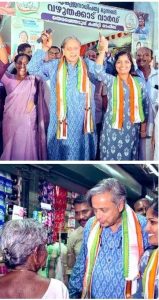
Shashi Tharoor MP during campaigning
The election outcome has also reignited debate within the Congress about the role of Thiruvananthapuram MP Tharoor.
Party workers acknowledge that Tharoor did campaign — joining candidates in wards such as Kowdiar, Vazhuthacaud, Jagathy and Palayam — but argue that his involvement lacked intensity and leadership.
“Everyone knew the BJP was going for an all-out battle to capture the Corporation. We were also fighting hard. But our MP could have spearheaded the campaign. Campaigning for a few days and then leaving for tours does not help,” said a local Congress worker.
There is also unease within the party about a lingering perception among voters that Tharoor is ideologically drifting towards the BJP.
“One question we constantly had to counter was whether Tharoor would remain in the Congress or eventually move to the BJP. That doubt exists among voters, and it hurts,” another worker said.
Ironically, Tharoor’s campaign rhetoric left little ambiguity. He openly described the LDF’s 45-year rule as “misrule,” accusing it of pushing the city into ruin through civic neglect and poor governance.
He projected Congress candidates as young, energetic, and capable of delivering change.
But BJP’s sharper focus, organisational aggression, and access to central resources ultimately tilted the scales — even amid controversies, including allegations linked to the suicides of party workers.
The BJP, meanwhile, wasted no time in nationalising its Thiruvananthapuram victory.
Prime Minister Narendra Modi described the NDA mandate in the Corporation as a “watershed moment” in Kerala politics, claiming it reflected a popular belief that development aspirations could only be fulfilled under BJP leadership.
In another statement, he asserted that Kerala was “fed up” with both the LDF and UDF, projecting the NDA as the sole alternative for a “Vikasita Keralam.”
Party leaders are already signalling their intent to consolidate gains, with plans underway to bring the Prime Minister to Thiruvananthapuram to unveil an ambitious development roadmap for the Corporation.
This, however, also puts Tharoor in a politically delicate position.
Since 2009, he has consistently articulated a vision of transforming Thiruvananthapuram into a world-class urban hub — centred on connectivity, smart city initiatives, sustainability, IT growth, startups, and coastal development. Many of these proposals, he has argued, stalled due to Centre–state frictions.
After the results, Tharoor struck a statesmanlike tone, congratulating both the UDF for its statewide performance and the BJP for its historic win in his constituency.
“I campaigned for a change from 45 years of LDF misrule, but the voters have rewarded another party that also sought change in governance. That is the beauty of democracy,” he said.
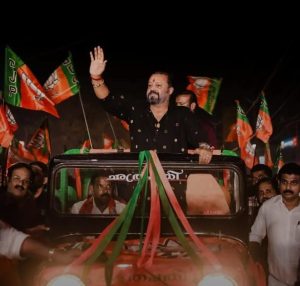
Suresh Gopi MP during campaigning
If Thiruvananthapuram marked a BJP breakthrough, Thrissur exposed the limits of parliamentary momentum.
The party entered the civic polls riding high on Union Minister Gopi’s emphatic Lok Sabha victory in 2024.
Leaders openly spoke of “capturing Thrissur,” confident that the so-called ‘Suresh Gopi effect’ would seamlessly translate to the Corporation.
It did not.
The NDA improved only marginally — from six seats in 2020 to eight leads — falling far short of its own projections.
The promised civic sweep never materialised.
Thrissur Corporation, traditionally a battleground between the LDF and UDF, has already made history once again by returning the Left to power.
This time, the LDF pushed for an unprecedented third term, leaning on its welfare credentials and development claims.
Ironically, internal discomfort weakened the Left’s campaign too, particularly over the Mayor’s absence from the field and perceptions of his proximity to Gopi.
Gopi has aggressively projected Thrissur as a showcase for his ‘Vikasit Thrissur’ vision — a blend of infrastructure expansion, cultural preservation, entrepreneurship, and social welfare. The NDA’s ‘Panch Ratna’ civic manifesto and subsequent efforts to secure central commitments reinforced this narrative.
Yet, on the ground, little of it translated into electoral traction.
Local feedback suggests that political theatrics, combined with dissatisfaction over the central minister’s personal style of engagement, may have worked against the BJP’s ambitions.
Unlike parliamentary elections, civic polls demand sustained grassroots presence and credibility in addressing everyday urban issues — an arena where star power alone appears insufficient.
In the capital, the BJP seized a rare opening created by LDF fatigue and Congress hesitation, converting discontent into a historic takeover.
In Thrissur, the same party discovered that a parliamentary wave and a charismatic MP cannot substitute for sustained grassroots engagement and local confidence.
In short, voters knew how to separate hype from delivery.
(Edited by Majnu Babu).


