

Published Jul 08, 2026 | 9:00 AM ⚊ Updated Jul 08, 2026 | 9:00 AM


Road construction. (Creative Commons)

Synopsis: A global geopolitical crisis has unexpectedly become a major factor behind Kerala’s worsening road conditions, as soaring bitumen prices have forced contractors to halt hundreds of public works. The government’s relief package may restart stalled projects, but industry leaders say lasting solutions require reforms that go well beyond temporary compensation.
Every monsoon, battered roads and crater-like potholes become a familiar sight across Kerala.
This year, however, the story behind the worsening condition of roads stretches far beyond delayed maintenance or bureaucratic inertia. It begins thousands of kilometres away in the conflict-ridden waters of West Asia.
The disruption of shipping routes around the Strait of Hormuz, coupled with the prolonged geopolitical crisis in the region, has triggered an unprecedented shortage of bitumen — the single most important material used for road construction.
The result has been a dramatic escalation in prices, suspension of road works across Kerala and elsewhere in the country, and mounting concerns over the fate of thousands of public infrastructure projects.
While the state government stepped in with a special relief package for contractors affected by the abnormal rise in bitumen prices, paving the way for stalled works to resume, the effects are yet to be felt on the ground.
Also Read: Kerala man arrested under UAPA for FB post on Pahalgam massacre
Bitumen, also known as asphalt, is the petroleum-based binding material that holds together aggregates used in road construction. It is estimated that India consumes nearly nine million tonnes annually, but domestic production meets only about 60 percent of the requirement. The remaining demand is largely met through imports from West Asian countries, including Iraq, the UAE, Iran, Oman and Bahrain.
The conflict in the region severely disrupted supplies.
While India managed to diversify crude oil imports to some extent, the same flexibility was not available for bitumen. Industry experts pointed out that high-grade VG-40 bitumen — widely used for highways and roads in tropical conditions — is largely produced from specific Middle Eastern crude varieties.
Alternative crude sources, including Russian crude, yield lower-grade bitumen, not suitable for many Indian road projects without additional processing.
As supplies tightened, prices spiralled.
VG-40 bitumen, which was available for around ₹40,000–58,000 per tonne before the crisis, crossed the ₹1 lakh mark in several markets.
In Kerala, contractors say the price of a barrel nearly doubled from about ₹8,000 to ₹16,000, while the cost per kilogram has risen from the government-approved rate of ₹48 to nearly ₹105.
The shortage was equally severe. India’s bitumen imports fell sharply in April 2026, while national consumption registered a steep decline during April and May, reflecting a slowdown in road construction.
For Kerala, the timing could hardly have been worse.
Road maintenance and resurfacing are usually taken up before the onset of the southwest monsoon.
However, this year, local bodies found themselves unable to proceed with projects as contractors withdrew from works that had suddenly become financially unviable.
Road works undertaken by grama panchayats, block panchayats, municipalities and corporations gradually came to a standstill by the second and third week of May.
According to the Kerala Government Contractors Federation (KGCF), the existing government schedule of rates had become completely unrealistic after the sudden increase in bitumen prices.
“The government has been giving ₹48 for one kilogram of bitumen. The market price has climbed to around ₹105 per kilogram and continues to increase. It is impossible to execute the works under these conditions, and therefore contractors have suspended projects,” a federation office-bearer said.
Similar concerns were raised by KGCF district leaders, who warned that continuing works under existing contract conditions would result in huge financial losses.
The slowdown affected not only new projects but also ongoing maintenance works, rural road connectivity, tourism routes and flood mitigation infrastructure. In districts such as Alappuzha, several tarring and repair works came to a complete halt due to shortages of bitumen and bitumen emulsion.
Local self-government institutions, which spend nearly half of their annual plan allocations on road works, faced an additional challenge. Without revised financial support, many projects would have to be scaled down by reducing road lengths or modifying estimates, requiring fresh approvals from District Planning Committees and causing further delays.
Also Read: Priyadarshini scheme pushes Kerala’s private bus sector into financial distress
Acknowledging that the situation arose from extraordinary international developments rather than normal market fluctuations, the State Cabinet, at its meeting on 30 June, approved a proposal to compensate contractors for the abnormal increase in bitumen prices.
The decision allows payment of the additional cost of bitumen used in road works for the period between 1 April and 30 June 2026, for contracts in which the last date for submission of tenders was before 1 April, 2026.
For calculating the compensation every month, a formula has also been developed. According to it, the additional amount payable is linked to the quantity of bitumen used and the difference between the prevailing market price and the original contract price.
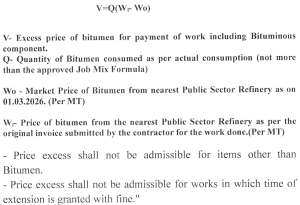
Government formula for monthly bitumen cost compensation.
The Cabinet, however, imposed clear conditions.
The additional payment will be restricted exclusively to the bitumen component of the work. No compensation will be allowed for increases in the cost of other construction materials. Contractors who received extensions of time with a penalty will also not be eligible for the benefit.
Government records placed before the Cabinet noted that the global conflict had caused acute shortages of bitumen, resulting in an abnormal increase in prices that made it extremely difficult for contractors to complete road works within the agreed contract rates.
Several contractor organisations had submitted representations requesting government intervention, arguing that the unprecedented rise in costs had made ongoing projects economically unsustainable.
The proposal was prepared following recommendations of the Chief Engineers’ Committee, which met on 23 May after examining the situation in detail.
The committee recommended extending to state government works a mechanism similar to the price adjustment allowed by the Union Ministry of Road Transport and Highways (MoRTH) through circulars issued on 1 April and 17 April this year.
The Finance Department, after examining the proposal, recommended that the matter be placed before the Council of Ministers.
Meanwhile, the latest decision also marks a departure from the state’s policy adopted in recent years.
Kerala had earlier allowed compensation for abnormal increases in bitumen prices following the 2018 price spike through a series of government orders.
However, those provisions were subsequently withdrawn after audit objections by the Comptroller and Auditor General (CAG), which observed that contractors were expected to factor market fluctuations into their quoted rates. Later clarifications restricted those benefits only to projects that were already in progress during the earlier period.
The present crisis, Public Works Department officials pointed out, has been treated as an exceptional situation arising out of global geopolitical developments rather than ordinary market volatility.
“At the national level, too, the Union Ministry of Road Transport and Highways has acknowledged the impact of the crisis. It has permitted extensions of project deadlines under force majeure provisions and introduced price adjustment mechanisms for projects affected by the steep escalation in the cost of bitumen, fuel and logistics,” said a PWD official.
Officials believe the state’s latest decision will provide immediate relief to contractors and help restart hundreds of stalled road projects. However, they point out that India will have to reduce its overwhelming dependence on West Asian bitumen by expanding domestic refining capacity, diversifying import sources, encouraging recycling of asphalt and investing in alternative road construction technologies.
While welcoming the state government’s decision to compensate contractors for the abnormal rise in bitumen prices, contractor organisations say the measure addresses only a small part of a much larger crisis engulfing Kerala’s construction sector.
Speaking to South First, Varghese Kannampally, state leader of the Kerala Government Contractors Association, said the current system of fixing contract rates itself needs a thorough overhaul.
“The rates adopted in government tenders are based on the Delhi Schedule of Rates 2021. Even several Union government works follow the same pattern. But these rates often do not reflect the actual market situation. The extraordinary circumstances created by the West Asian war have exposed this weakness even further,” he said.
According to Kannampally, the problem extends far beyond bitumen.
“It is not only bitumen that has become expensive. The prices of steel, pipes, electrical materials, and quarry products have all gone up sharply. Fuel prices have also increased, pushing up transportation costs. Contractors have had to bear all these additional expenses. This is one of the reasons why the construction sector is no longer attracting people as it once did,” he said.
He pointed out that although the conflict escalated in February and material prices started rising from March, the government’s compensation package covers only the period from 1 April 1 to 30 June.
“The price escalation actually began in March. The relief should have covered that period as well,” Kannampally said.
He argued that instead of announcing special packages each time prices shoot up, the government should permanently incorporate a price variation clause in all construction contracts.
“Price fluctuations are a reality. If there is a price variation clause in the tender itself, extraordinary increases can be addressed automatically. Likewise, if prices come down, the benefit will go to the government. It is a fair system that protects both sides,” he explained.
Kannampally also noted that the disruption was not confined to road projects.
“Irrigation works and several other infrastructure projects were also affected. The focus has largely been on roads because bitumen is involved, but the entire construction sector has been under pressure due to the steep rise in input costs,” he said.
He added that rising material prices are only one side of the problem.
“Another reality is the shortage of government works available to ordinary contractors. A large share of projects is being entrusted to the Uralungal Labour Contract Cooperative Society and around 46 accredited agencies without inviting open tenders. These agencies undertake even relatively small works. Many of the eligibility conditions applicable to regular contractors do not apply to them. As a result, there is no level playing field,” Kannampally alleged.
According to him, unless the government addresses both issues — volatile construction costs and equitable access to public works — the difficulties faced by contractors are unlikely to ease despite the latest relief package.
(Edited by Muhammed Fazil.)



