

Published Dec 10, 2024 | 4:10 PM ⚊ Updated Dec 10, 2024 | 4:10 PM

UDF urges 16th Finance Commission to address Kerala’s fiscal challenges

The United Democratic Front (UDF) in Kerala has called on the 16th Finance Commission to address what it sees as significant inequities in the allocation of central resources, which have deeply affected the state’s finances.
In a memorandum submitted to the Commission, the UDF highlighted a sharp decline in Kerala’s share of central taxes, which dropped from 2.5 percent during the 14th Finance Commission to 1.92 percent in the 15th.
The party attributed Kerala’s financial difficulties to an unfair distribution of funds, pointing to both vertical and horizontal devolution issues.
#Kerala: The United Democratic Front (UDF) has urged the 16th #FinanceCommission to rectify the perceived inequities in resource allocation that have hit Kerala hard.
Highlighting a steep drop in the state’s share of central taxes — from 2.5% during the 14th Finance Commission… pic.twitter.com/1ZqsinHWk4
— South First (@TheSouthfirst) December 10, 2024
As part of its recommendations, the UDF has proposed increasing the states’ share of central taxes from 41 percent to 50 percent, and reducing the weightage of per capita income in the devolution formula from 45 percent to 25 percent. The party argues that GDP-based calculations disadvantage Kerala, a state with a unique socio-economic structure.
Additionally, the UDF has called for a more equitable distribution of cess and surcharge revenues, which currently do not contribute to the divisible pool, but instead bypass states altogether.
On demographic criteria, the UDF has expressed concern over the penalty imposed on states with successful population control measures. The party has recommended reducing the weightage of the 2011 Census to 10 percent and increasing the emphasis on demographic performance to 25 percent.
The UDF also urged the Finance Commission to consider Kerala’s vulnerability to natural disasters and climate change. The party proposed a revision of the “Forest and Ecology” criterion, with an increased weightage of 20 percent to account for the state’s environmental fragility and disaster risks.
Furthermore, it suggested incorporating the slope of the terrain into area calculations and introducing a decentralised devolution index.
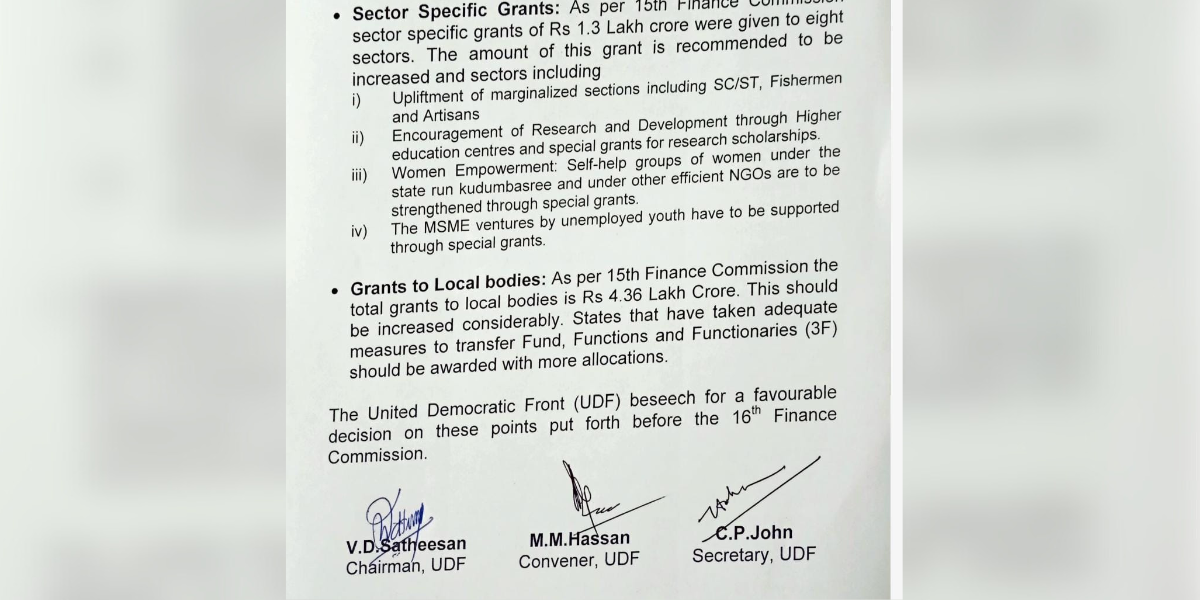
On grants, the UDF sought continued revenue deficit support and increased funding for sector-specific initiatives, including programs for marginalised communities, women empowerment, and MSMEs.
The party also called for a significant boost in local body grants, recognising Kerala’s advances in decentralisation.
These demands were presented to the 16th Finance Commission during its three-day visit to Kerala, led by Chairman Dr. Arvind Panagariya, former Vice Chairman of NITI Aayog.
The Finance Commission’s mandate is to determine the revenue-sharing formula between the Centre and states for the next five years, and its upcoming report is expected to play a pivotal role in shaping Kerala’s financial planning, particularly in areas requiring substantial central support.
The UDF hopes that these recommendations will address Kerala’s ongoing fiscal challenges and lead to a fairer distribution of resources, enabling the state to meet its developmental needs more effectively.
(Edited by Ananya Rao with inputs from Dileep V Kumar)



