

Published Apr 13, 2026 | 7:00 AM ⚊ Updated Apr 13, 2026 | 7:00 AM

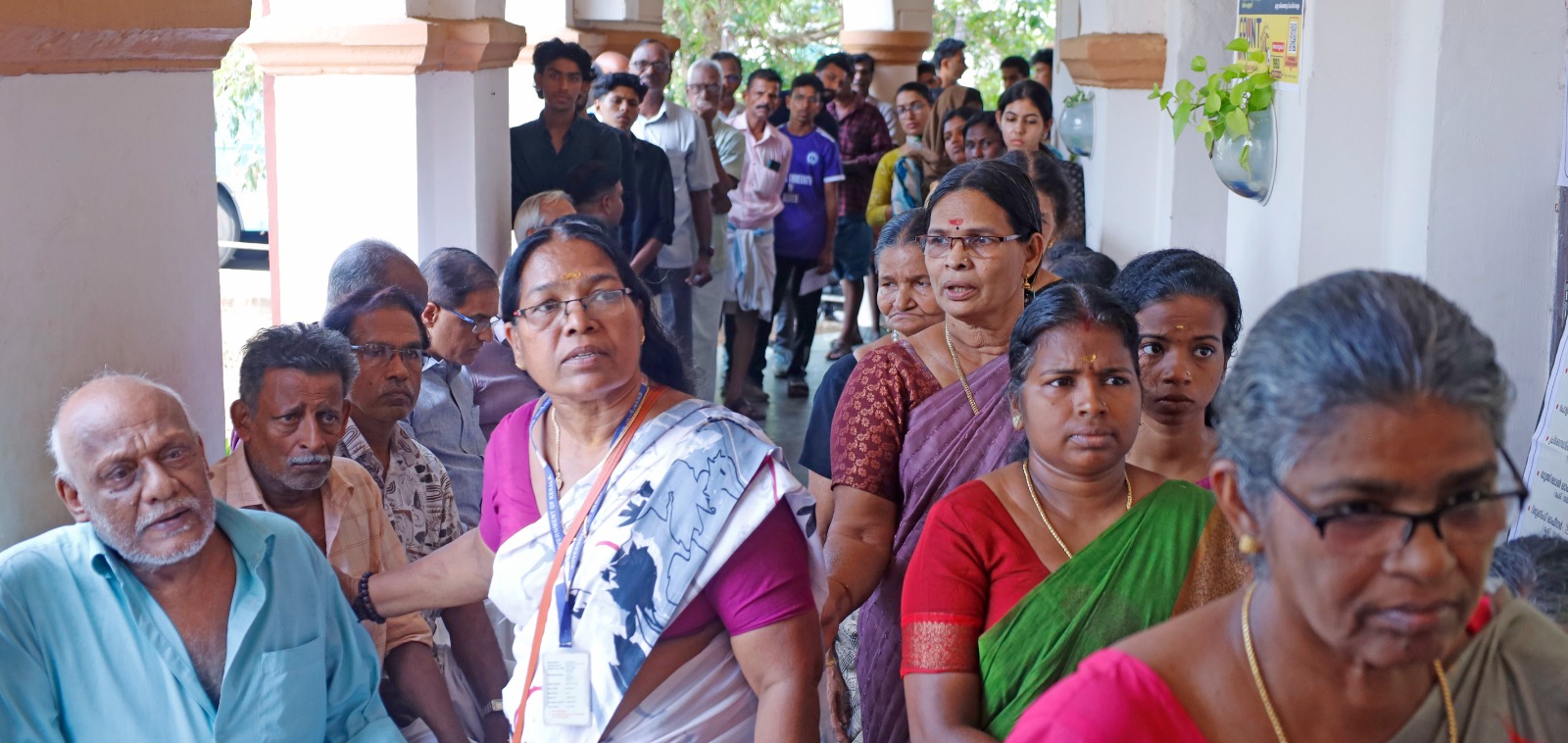
Kerala recorded one of its highest voter turnouts in decades in the 2026 Assembly polls.
Synopsis: Kerala’s unusually high voter turnout has upended easy political readings, with each front interpreting the surge as backing its own narrative. But Rather than signalling a clear wave, the numbers point to an intense and unsettled electorate, leaving the real story to be decided only when votes are counted.
With voter turnout in the 2026 Assembly elections at 78.27 percent (provisional, as it excludes service voters and postal ballots), brushing past recent highs, observers are reading more into the queues across Kerala than civic enthusiasm.
At the same time, Kerala’s political class reads the same numbers in three very different ways. Each front has rushed to claim the mood behind the queues.
The ruling CPI(M)-led LDF frames this as a clear endorsement of governance and continuity under Pinarayi Vijayan, casting the surge as confidence in its decade-long record.
The Congress-led UDF, led on the campaign front by VD Satheesan, reads the same enthusiasm as a vote for change but points to undercurrents of anti-incumbency.
Meanwhile, the BJP-led NDA, under Rajeev Chandrasekhar, casts the high participation as evidence of a politically awakened electorate, one that could disrupt the state’s traditional two-front rhythm.
If there is one thing this election has unsettled, it is the comfort of neat arithmetic.
Every front walked in with confident seat projections—LDF stretching its ambition to 110, UDF speaking easily of crossing the century, NDA quietly circling a few dozen hopeful pockets.
But the turnout figures do not behave like obedient data points. They complicate the story. Across districts, the rise is unmistakable.
Thiruvananthapuram jumps from 70.02 percent to 77.04 percent. Kollam edges up, Ernakulam surges close to 80 percent, Palakkad crosses that line, Malappuram records one of the sharpest spikes.
Even in places where turnout was already high—Kannur, Kozhikode—it holds firm or inches up. Forty-four constituencies crossing 80 percent is not routine; it signals something restless beneath the surface.
Yet the meaning does not settle. Both the LDF and UDF claim this enthusiasm.
For the Left, it is continuity—people stepping out to endorse governance, despite an expected dip of up to 20 seats from the current 98.
For the UDF, the same queues translate into fatigue with incumbency, a quiet consolidation visible earlier in local body numbers where it led in 81 segments.
Each side finds its reflection in the same mirror. Look closer, and the patterns grow uneven.
High-stakes triangular contests—Nemom, Manjeswaram, Palakkad—push turnout beyond 80 percent, showing mobilisation driven as much by fear of the third player as by loyalty.
But in Kazhakoottam and Vattiyoorkavu, where the contest sharpened late into triangular fights, the numbers stay below that mark.
In central Kerala, constituencies like Kaduthuruthy, Thiruvalla and Ranni dip below 70 percent, cutting against the statewide surge. There are other distortions.
Voter rolls have shrunk in several districts after revision—lakhs fewer in Thiruvananthapuram alone—but polling percentages climb. This changes the weight of each vote. In places like Alappuzha, fewer voters but higher participation leave both fronts uneasy about margins.
In Kasaragod, an influx of new voters and higher female turnout adds another layer of uncertainty.
Geography also shapes the pattern.
Malabar’s heavy polling feeds UDF optimism of a breakthrough, especially in Malappuram and Kozhikode.
But the Left points to its entrenched pockets holding steady under pressure.
In the south, where margins tend to be thinner, the jump in turnout—especially in urban and semi-urban seats—could tilt close contests either way.
So what does the turnout mean? Not a wave. Not yet. It points instead to intensity—of competition, of polarisation, of voters less willing to sit this one out.
When intensity rises without a clear directional swing, predictions stop being projections. They become guesses dressed up as confidence.
With Kerala recording one of its highest voter turnouts in decades, the numbers have triggered a familiar round of speculation—but the signals are more layered this time.
For G Gopakumar, psephologist and former vice chancellor of the Central University of Kerala, the surge in polling percentage is not a standalone statistic.
It points to a convergence of structural corrections and political churn.
He notes that turnout this year edges close to some of the state’s highest benchmarks—85.7 percent in 1960, 80.53 percent in 1987, and 79.2 percent in 1977—placing the current election in that league of high-engagement contests.
What stands out is the gender gap.
He told South First that women voters turned out in larger numbers, touching 80.86 percent, while men lagged at 75.01 percent. That difference, subtle on paper, could carry weight in close contests.
Gopakumar attributes the rise first to a cleaner electoral roll following the Special Intensive Revision (SIR).
The removal of duplicate entries, deceased voters and those who had migrated has, in his view, made the turnout more “real” than inflated. But beyond administrative corrections, he says politics is doing the heavier lifting.
He says there is little ambiguity about anti-government sentiment. Price rise, unemployment, financial strain, allegations of corruption, stress in public health and higher education, and controversies surrounding Sabarimala all feed voter motivation. The effect, he says, appears to tilt towards the United Democratic Front, with the NDA also drawing some of that dissatisfaction.
Yet the bigger shift may lie elsewhere. Kerala’s long-standing bipolar contest is loosening. The BJP-led NDA’s expanding footprint introduces a third variable that cannot be brushed aside.
If the NDA significantly raises its vote share across a few dozen constituencies, even without sweeping victories, it could disrupt traditional equations. The rise of three-cornered fights, Gopakumar says, has its own logic—sharper competition pulls more voters to the booths.
He also flags the consolidation of minority votes alongside sections of the UDF base, while pointing to the BJP’s growing traction among backward Hindu communities. Both trends, he says, complicate the LDF’s path.
A similar caution against easy conclusions comes from D Dhanuraj, founder chairman of the Centre for Public Policy Research, who views the turnout through a more granular lens.
High voting, he told South First, no longer translates automatically into an advantage for any single front, especially in a state where triangular contests are no longer exceptions.
His reading of constituency-level patterns offers a different texture.
Areas witnessing intense contests recorded unusually high participation.
In contrast, traditional LDF bastions like Kannur and Kasaragod saw relatively lower turnout. That contrast, he says, lends some weight to the idea that opposition voters may have been more energised.
He also observed temporal shifts on polling day itself.
Early hours saw brisk voting across regions, but momentum tapered in many constituencies as the day progressed. That slowdown, D Dhanuraj says, points to a possible gap in last-mile mobilisation—an area where Kerala’s cadre-based politics has historically excelled.
Central Kerala emerges as a crucial zone in his assessment. Higher turnout here aligns with the UDF’s expectations of a comeback. Add the consolidation of minority votes in key districts, and the region becomes more central to the outcome.
In the south, particularly Thiruvananthapuram, the numbers may carry a different message. Strong turnout there may bolster the BJP’s prospects, especially when set against softer participation in parts of north Kerala. Urban centres, many of which lean towards the UDF, also reported higher polling, adding another layer to the arithmetic.
Dhanuraj says a routine increase in turnout would hover around two to two-and-a-half percentage points. This election has gone beyond that margin, even in harsh weather. That, he says, is rarely accidental.
The unanswered question, across both analyses, is conversion.
High turnout signals intent—but intent fragments in a three-way contest.
How much of this heightened participation translates into votes for the BJP, how effectively the UDF channels anti-incumbency, and whether the LDF’s organisational strength compensates for visible gaps—these variables will decide the final picture.
The turnout has set off a familiar political chorus—every front hears what it wants in the numbers.
For the ruling LDF, led by Pinarayi Vijayan, the surge signals trust, not turbulence.
Pinarayi Vijayan has framed the participation as a clear nod to continuity, saying voters have rallied behind a decade of governance and are unwilling to disrupt what he calls a steady development trajectory. His remarks, measured yet confident, cast the turnout as a quiet endorsement rather than a restless pushback.
Across the aisle, the Congress-led UDF reads the same enthusiasm very differently.
VD Satheesan has gone so far as to predict a three-digit tally, sensing a shift in public mood. Shashi Tharoor, pointing to long queues and brisk urban polling, has read the numbers as voters asserting agency—choosing change after ten years of LDF rule.
There is a sense, in their telling, of accumulated discontent finding expression at the ballot. Then comes the BJP’s pitch, less about immediate victory and more about long-term churn.
Rajeev Chandrasekhar has cast the turnout as evidence of a politically awakening electorate, pointing to a future where Kerala’s triangular contest gives way to a sharper, bipolar fight.
For now, the numbers speak loudly. Results are due on 4 May. The numbers are fixed, but their meaning is still up for grabs.


