

Published Jun 04, 2026 | 3:42 PM ⚊ Updated Jun 04, 2026 | 3:42 PM

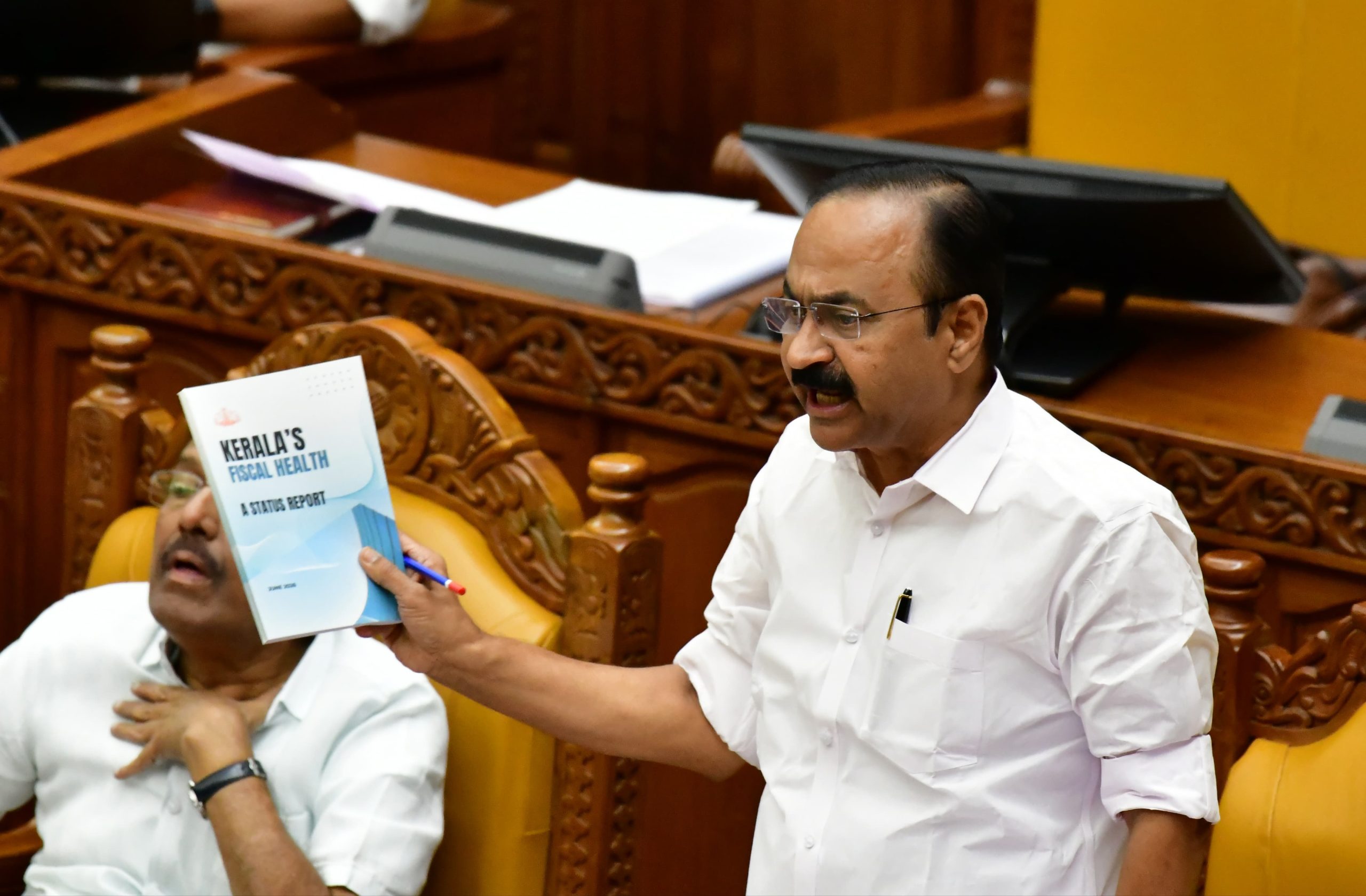
Chief Minister V D Satheesan tabling 'Kerala’s Fiscal Health: A Status Report' in the Assembly on Thursday.

Synopsis: Kerala’s latest fiscal review has triggered a sharp political and economic reckoning, with questions being raised on the long-term sustainability of the KIIFB-led infrastructure model. The review also warned that rising debt, shrinking fiscal space and mounting PSU losses could push the state into deeper financial strain. As stricter borrowing norms and reduced central grants tighten the screws, the report signalled that Kerala may soon face hard choices between welfare commitments, public investment and structural reforms.
A sweeping ‘Kerala’s Fiscal Health: A Status Report‘ released by the UDF government on Thursday, 4 June, that analysed a decade of Left governance, has redrawn the contours of Kerala’s fiscal debate.
The review has raised serious questions over the future of the KIIFB model, the sustainability of its public sector enterprises and the shrinking room available for public spending in the years ahead.
At the centre of the document is a stark warning that Kerala’s finances have entered a phase of structural stress, with mounting liabilities, tighter borrowing restrictions and declining central support converging at a time when the state is already carrying one of the country’s heaviest debt burdens.
It’s learnt that the State Budget on 19 June will take into account these findings and recommendations and make policy interventions accordingly.
Also Read: KIIFB dilemma: Will CPI(M)’s brainchild sink or soar?
The Kerala Infrastructure Investment Fund Board (KIIFB), once projected as the state’s flagship vehicle for financing large-scale infrastructure outside the constraints of conventional budgetary limits, now finds itself facing fundamental questions about its future.
The white paper acknowledged KIIFB’s contribution in building organisational capacity, financing critical infrastructure projects and introducing quality, sustainability and digital management practices. However, it argued that the circumstances under which KIIFB was created have changed significantly, raising doubts about the viability of its existing model.
Over the years, KIIFB emerged as a major financier of roads, hospitals, industrial projects and other infrastructure initiatives. The LDF government also projected it as a model that could boost the state’s infrastructural development.
The white paper, however, noted that the institution’s foundational premise has been weakened following findings by the Comptroller and Auditor General (C&AG) that KIIFB’s debt was effectively the state’s debt.
As a result, the borrowings undertaken by KIIFB now directly affect the state’s own borrowing capacity, undermining its role as an independent fund-raising agency.
The state is currently facing a combined liability of nearly ₹56,000 crore linked to KIIFB.
This includes around ₹21,000 crore in outstanding loan obligations that will ultimately have to be repaid by the government, as well as project commitments worth approximately ₹35,000 crore that are yet to be financed.
The white paper pointed out that KIIFB’s cost of raising funds consistently remained higher than the state government’s own borrowing costs, by roughly one to one-and-a-half percentage points.
In such a scenario, continuing with an independent borrowing mechanism may no longer be financially prudent.
The report also raised concerns about the geographical distribution of KIIFB-funded projects.
Kannur alone accounted for more than one-fifth of the total project approvals and nearly a fifth of all disbursements.
Along with Thiruvananthapuram and Ernakulam, the three districts account for almost half of KIIFB’s approved spending.
The white paper noted that neither economic indicators nor human development parameters offer a clear justification for such concentration.
Questions have also been raised about sectoral priorities.
Nearly 68 percent of approved allocations were concentrated in three departments: Public Works, Industry, and Health and Family Welfare. The rationale for prioritising these sectors over areas such as education, water supply, sanitation and local infrastructure was not clearly articulated, the report observed.
With the C&AG’s observations fundamentally altering the financial and legal landscape, the white paper said the debate was no longer about whether KIIFB should continue in its current form.
Instead, the focus must shift to managing the transition while honouring existing commitments and preserving the institution’s technical and organisational strengths.
Among its key recommendations, the white paper proposed ending the practice of diverting state revenues into an escrow account for KIIFB. Future liabilities should be met through budgetary borrowings, while KIIFB should no longer be permitted to raise funds independently from external sources.
The white paper called for a forensic audit of KIIFB’s finances, including scrutiny of expenses related to the Masala Bond issue, consultancy payments routed through the Centre for Management Development (CMD), and instances where borrowed funds were reportedly redeposited with banks.
Pending a long-term restructuring, it recommended KIIFB to prepare a comprehensive account of all liabilities, including loan repayments, interest obligations, project funding commitments and completion schedules.
Such an exercise, it said, became necessary to provide the Legislature and the public with a transparent picture of the financial obligations that Kerala will have to shoulder in the years ahead.
The Kerala government constituted KIIFB in 2009 as a Body Corporate financial institution, to mobilise funds for infrastructure development from outside the state revenue.
The white paper also called for difficult but unavoidable decisions to tackle the mounting burden posed by loss-making public sector enterprises (PSEs), warning that continued inaction could further strain the state exchequer.
The document painted a grim picture of Kerala’s public sector landscape.
Of the 132 active public enterprises in the state — comprising 126 government companies and six statutory bodies — a majority have remained in the red over the past decade.
The paper said that while government companies registered a combined profit only in the first year of the review period, they have since recorded aggregate losses year after year. Statutory corporations, though fewer in number, have consistently posted even higher losses.
Public utility enterprises have emerged as the principal source of concern. The accumulated losses of PSEs more than doubled from ₹31,517.1 crore in 2021 to ₹72,851.2 crore in 2024-25.
The white paper identified the Kerala State Road Transport Corporation (KSRTC), Kerala Water Authority (KWA) and Kerala State Electricity Board Limited (KSEBL) as the biggest contributors to the losses.
In 2021-22, KSRTC and KWA together accounted for nearly 80 percent of the total net loss of state PSEs, with KSRTC alone contributing more than half. In subsequent years, these entities continued to dominate the loss figures, alongside Kerala Social Security Pension Limited (KSSPL).
The report noted that the poor financial health of these utilities extends beyond annual losses.
KSRTC, KWA and KSEBL together accounted for nearly 69 percent of the total arrears owed to the state government by public enterprises, municipal corporations and cooperative societies.
“The poor performance of these utilities not only imposes a direct fiscal burden through budgetary support and financial assistance but also generates broader economic costs,” the document observed.
Against this backdrop, the white paper proposed a broad restructuring framework for public sector enterprises, stressing that the three major utilities must be reformed in a manner that prevents them from remaining a recurring burden on public finances.
The document also underlined the need for Kerala to significantly expand its electricity generation capacity, signalling that power sector reforms should form a key component of the restructuring exercise.
Among the notable recommendations was the merger of the Kerala State Beverages (Manufacturing and Marketing) Corporation (Bevco) and the Kerala Civil Supplies Corporation.
While Bevco has contributed substantial tax revenues — paying ₹48.41 crore in 2022-23, ₹84.66 crore in 2023-24 and ₹47.33 crore in 2024-25 — the Civil Supplies Corporation continued to incur heavy losses owing to subsidised sales of essential commodities.
The report suggested bringing both entities under a single corporation with separate divisions for liquor distribution and civil supplies operations.
It also advocated a hard-nosed approach towards non-strategic enterprises.
Public sector units considered non-viable may be taken up for disinvestment, privatisation or closure, while fully protecting workers’ interests and livelihoods.
The recommendations signalled a shift towards a more pragmatic approach to public sector management, with the government acknowledging that long-delayed structural reforms can no longer be postponed if Kerala’s fiscal position is to be stabilised.
Also Read: KIIFB question: Scrap, reform, or depend on LDF’s pride?
The white paper noted that though the state may have secured a modest increase in its share of central tax devolution under the 16th Finance Commission, the larger fiscal picture confronting the state remained deeply challenging.
It highlighted that the Commission raised Kerala’s share in the inter se distribution of central taxes from 1.925 percent under the 15th Finance Commission to 2.382 percent for the 2026-31 award period.
The increase of 0.457 percentage points was among the highest absolute gains recorded by any state, second only to Haryana.
Yet, the apparent gain masked a far more difficult reality.
The new award period came with the withdrawal of several crucial grants that had previously cushioned Kerala’s finances.
Under the 15th Finance Commission, Kerala received ₹37,814 crore as post-devolution revenue deficit grants over five years. In addition, the state obtained ₹2,412 crore through sector-specific and state-specific grants. All three categories have now been discontinued.
As a result, the higher devolution share was unlikely to compensate for the loss of these transfers.
The state’s outstanding liabilities were estimated at ₹5.07 lakh crore in 2025-26, equivalent to 35.5 percent of the Gross State Domestic Product (GSDP), significantly above the national and major state averages.
At the same time, the 16th Finance Commission has tightened the fiscal discipline framework for states.
It reiterated the fiscal deficit ceiling of 3 percent of GSDP, called for an end to off-budget borrowings, and recommended that all such liabilities be transparently incorporated into state budgets.
For Kerala, this leaves limited room for adjustment.
The report noted that the state’s expenditure structure has been heavily burdened by committed spending on salaries, pensions, and interest payments. In such circumstances, capital expenditure often becomes the easiest target for compression when revenues weaken.
The broader trend in Centre-State fiscal relations also worked against Kerala over the years.
Kerala’s own share in tax devolution has declined across most Finance Commissions over the past three decades, interrupted only briefly during the 14th Finance Commission period. The partial recovery under the 16th Finance Commission, the white paper pointed out, did not offset the removal of revenue deficit support.
The paradox is stark.
Kerala remains one of India’s largest state economies and among the highest in per capita income, but its fiscal space is narrowing rapidly.
With stricter borrowing rules, declining grant support, and mounting debt obligations, the state now faces difficult choices between raising revenues, cutting expenditure, or slowing development spending.
(Edited by Majnu Babu).



