

Published Apr 09, 2026 | 7:02 PM ⚊ Updated Apr 09, 2026 | 8:09 PM

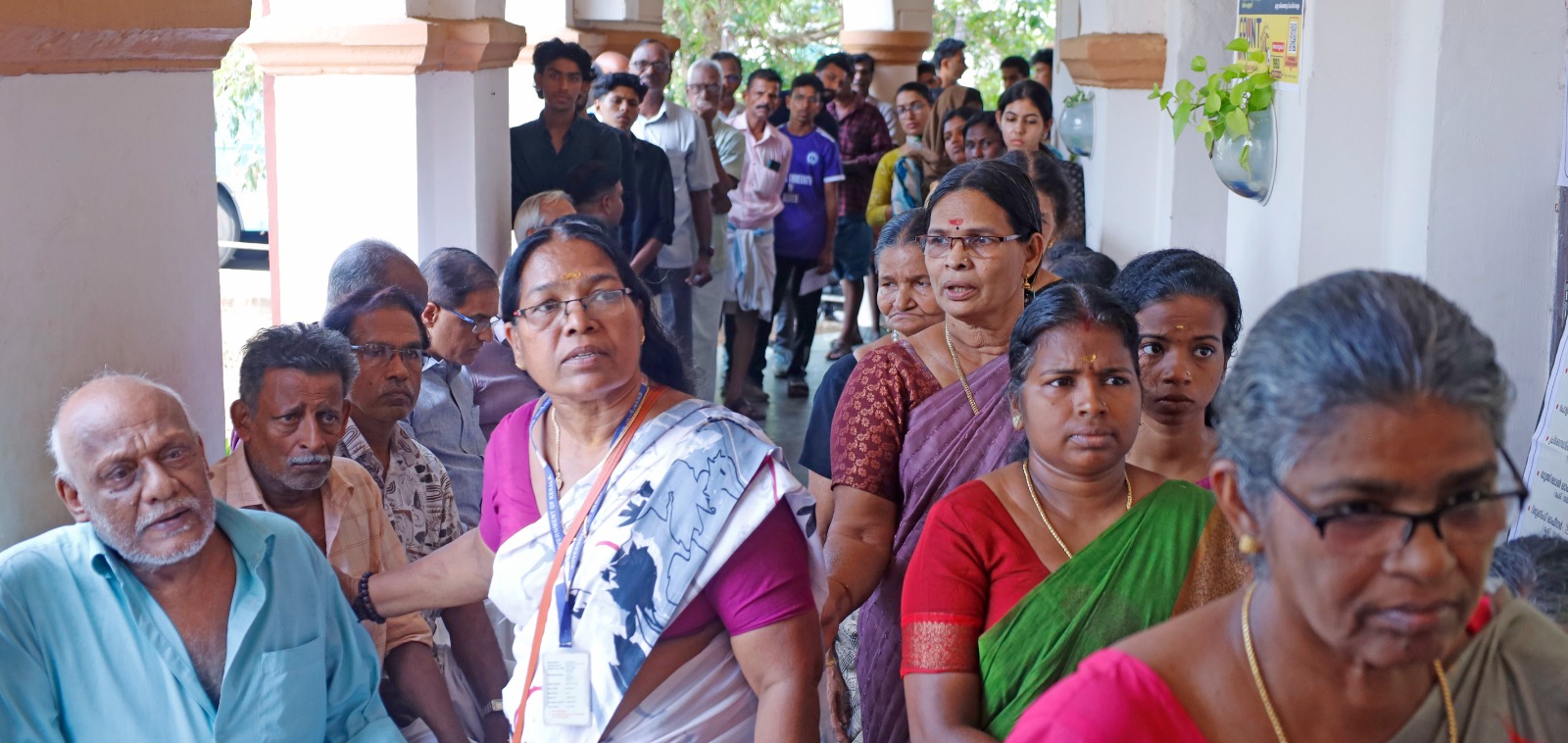
Voters braved the summer sun to cast their votes. A scene from St Joseph Higher Secondary School at Pavaratti in Thrissur..
Synopsis: Barring a few incidents, polling was largely smooth across Kerala. Votes will be counted only on 4 May, after the completion of polling in Tamil Nadu and West Bengal. While polling will be completed in a single phase in Tamil Nadu on 23 April, West Bengal’s two-phase process will be over only on 29 April. The first phase of polling in West Bengal is also on 23 April.
The fate of 883 candidates in 140 Assembly constituencies in Kerala was sealed on Thursday, 9 April.
Voter turnout stood at 77.93 percent, higher than the 74.06 percent recorded in 2021. Kerala’s all 14 districts saw voter turnout exceeding 75 percent. The final figure is likely to change.
For the candidates and political parties, the long hours of campaigning under the scorching sun ended with the polling, but the conclusion marked the beginning of almost a month-long wait to know the mandate of the state’s 2.71 crore voters.
According to the poll schedule, the votes will be counted only on 4 May, after the completion of polling in Tamil Nadu and West Bengal. While polling will be completed in a single phase in Tamil Nadu on 23 April, West Bengal’s two-phase process will be over only on 29 April. The first phase of polling in West Bengal is also on 23 April.
Polling across several booths remained incomplete even as the scheduled voting time drew to a close at 6 pm, prompting election authorities to extend the process in affected locations.
Officials confirmed that the final update on voter turnout and polling status will be released only after returning officers formally close proceedings at all booths.
District collectors have been directed to ensure that voting is concluded at the earliest in stations where delays have been reported.
To facilitate this, sectoral officers have been deployed to visit these booths, assess on-ground conditions, and arrange necessary support to expedite the process.
Authorities emphasised that every voter present within the polling premises before the deadline will be allowed to cast their vote, in line with election guidelines.
Polling began at 7 am and by 9 am, over 16 percent of the voters exercised their franchise. By 11.30 am, the turnout touched 33.28 percent.
As the polling progressed, the Kerala State Disaster Management Authority issued a special advisory urging voters, officials, and political workers to take precautions against the intense summer heat.
However, the harsh April sun failed to deter the voters, as the turnout climbed to 75.01 percent by 5 pm, surpassing the total 74.06 percent recorded in 2021. At 7 pm, the tentative figure stood at 77.45 percent.
The surge in numbers has left the three main fronts — the LDF, UDF and NDA — searching for meaning. The ruling LDF read it as a sign of continuity in power, the UDF saw the possibility of a return after a decade, and the NDA felt the higher turnout signalled a wider acceptance on the ground.
Polling was largely peaceful, though scattered incidents were reported.
The day itself had its share of twists.
In one case, a polling officer was replaced after complaints of canvassing for a party. In another, a BJP candidate’s social media account briefly carried a post urging voters to back a rival LDF candidate, setting off confusion before it was taken down.
Together with the strong turnout, these moments lent an unexpected edge to an otherwise orderly celebration of a democracy’s topmost festival.
As polling gathered pace, the state’s top political figures stepped out to vote, each projecting a distinct vision of the mandate they expect from the electorate.
Chief Minister Pinarayi Vijayan, after casting his vote at a school in his home constituency of Pinarayi, struck a confident note about the Left Democratic Front’s prospects. He described the election as a defining moment for Kerala’s future, arguing that the state is firmly on course toward becoming more developed and that the momentum must not be interrupted.
Pointing to what he called achievements across sectors, Vijayan maintained that governance under the LDF had remained steady even through difficult periods. Several long-pending projects were revived over the past decade despite crises that put the state under strain. He also claimed that Kerala’s administrative culture under the LDF has kept corruption to a minimum, describing it as the “least corrupt” in the country.
The chief minister suggested that public trust in the LDF has deepened over time, saying people’s lived experience over the past ten years has strengthened confidence in the Front. Recalling an increase in seat share in the previous election, he expressed certainty that the tally would rise further this time. He dismissed predictions of a sweeping victory for the Opposition, saying such claims would not stand once the votes are counted.
Leader of the Opposition VD Satheesan projected an emphatic return to power for the United Democratic Front. He said his party was on track to cross the 100-seat mark, citing both national surveys and his own extensive travels across the State in recent months.
Satheesan pointed to the steady turnout and long queues at polling stations as a sign of voter engagement. Kerala’s electorate, he said, were wont to keeping a close watch on both the ruling front and the Opposition to make choices with a high degree of political awareness.
Kerala Pradesh Congress Committee president Sunny Joseph echoed similar optimism, suggesting that the mood seen in recent local body elections would carry over into the Assembly polls. He also spoke of a strong lead expected in his constituency, Peravoor, and raised concerns over remarks made by MV Nikesh Kumar regarding the Wayanad fund issue, indicating that legal action could follow.
For the BJP, state president Rajeev Chandrasekhar framed the election as a call for change. After voting in Thiruvananthapuram, where he is contesting from Nemom, Chandrasekhar said his campaign had centred on a forward-looking development agenda under the banner of “Viksit (developed) Keralam.”
He emphasised that the party had steered clear of personal attacks, focusing instead on policy and progress. Urging people to turn out in large numbers, he described the election as significant not just for representation but for shaping the state’s direction. Chandrasekhar also argued that the BJP’s presence has altered political conversations in Kerala, compelling rivals to engage more seriously with development issues and governance.
With each camp reading the mood in its own favour, the day of voting reflected both high participation and sharply competing narratives—setting the stage for a closely watched verdict.
Polling unfolded largely without disruption, though the day was punctuated by scattered incidents that stirred political reactions and brief moments of tension in several constituencies.
In Kasaragod’s Manjeshwaram constituency, allegations of impersonation at booth number 128 in Kayyar set off a political storm. The BJP claimed that a man had cast a vote in the name of a voter currently in the Middle East. Police detained the suspect for questioning, while election authorities began a preliminary inquiry. The party reiterated its earlier concerns about possible attempts at bogus voting in the constituency, adding to an already charged atmosphere.
At Uduma, authorities intervened after a senior election agent affiliated with the UDF candidate was found inside a polling booth wearing spy camera goggles. Acting swiftly, officials removed him from the premises and seized the device, citing strict rules that prohibit any form of recording within polling stations.
Another tense moment played out in Thrikaripur, where a dispute over a suspected bogus vote escalated into a heated exchange inside a booth. The situation intensified after the arrival of a candidate, against whom a complaint has now been filed alleging that he threatened the presiding officer. The episode led to protests outside the booth, with rival workers accusing each other of disrupting the polling process.
In Wayanad’s Mananthavady constituency, a polling officer was taken off duty following complaints that he had attempted to influence voters. Party workers alleged that he openly urged people to vote for a particular symbol. Authorities, after a quick assessment, removed him and replaced him to ensure that polling continued without further concern. A departmental inquiry is likely.
Thrissur district witnessed both tension and tragedy.
A minor clash broke out between political workers in Manalur, while in Wadakkanchery, protests erupted after a voter was told his vote had already been recorded as a postal ballot. Similar complaints surfaced in Kuttiady in Kozhikode, where a woman was denied her vote for the same reason, triggering agitation at the booth.
In a separate incident in Thrissur, a 65-year-old man collapsed shortly after casting his vote and later died despite being rushed to the hospital. Polling officials had attempted to assist him immediately when he fell ill on the premises.
Concerns over bogus voting were not confined to one area.
Complaints of votes being cast in the names of absent voters emerged from multiple constituencies, including Malampuzha, Shoranur, Thrikkaripur, and Vattiyoorkavu, leading to protests and demands for verification.
In Kalpetta, an irregularity involving polling personnel came to light when a polling agent was found to be simultaneously serving as an ASHA, prompting her removal.
Meanwhile, in Chittoor, a brief but sharp political controversy erupted after a social media post appeared on a candidate’s official page, seemingly urging voters to support a rival front. Though the post was quickly deleted, screenshots spread rapidly, drawing allegations of political collusion.
The candidate denied involvement and called for an investigation into whether the page had been compromised.
The Facebook post allegedly appeared on the official page of BJP candidate Pranesh Rajendran, seeking votes for LDF candidate Adv. V. Murugadoss.
The post, which was removed within minutes, urged voters to support Murugadoss by voting for the ‘ring’ symbol and backing the Left Front for the continuation of development. It also contained criticism of the UDF, accusing it of indulging in “low-level politics” and claiming that Chittoor would respond to what it described as “Congress drama that mocks democracy.”
Adding to the day’s events, a technical anomaly was reported at a polling booth in Manjeshwaram’s Badaje area, where a voting machine was found to have recorded more votes than the number of voters who had cast their ballots.
In another incident from Thrissur, a young woman was initially denied her franchise due to an injured finger.
Akshara of Kurkanchery had arrived at her polling station around 1 pm. However, officials refused to allow her to vote, citing the inability to apply indelible ink on her left index finger, which had been stitched and bandaged following an accident involving a mixer-grinder on 6 April.
Despite Akshara producing medical records to substantiate her condition, the presiding officer reportedly insisted that voting would be permitted only if the bandage was removed.
The decision triggered protests, drawing the attention of political leaders, including LDF candidate VS Sunil Kumar, and intervention from district authorities.
Even as pressure mounted, the polling officer initially stood firm. The situation was eventually escalated to higher authorities, with Ratan U Kelkar, Chief Electoral Officer of Kerala, stepping in to resolve the issue.
After hours of delay and sustained protests, Akshara was finally allowed to vote in the last hour of polling, reportedly after submitting a written affidavit. Having reached the booth in the early afternoon, she cast her vote close to 6 pm.
Amid these developments, Congress candidate Chandy Oommen drew attention with a symbolic gesture, arriving to vote dressed in black as a mark of protest. Speaking to reporters, he invoked the legacy of his father and framed the election as a moment of reckoning, expressing confidence that the electorate would deliver a decisive verdict.
Despite these scattered incidents, polling progressed steadily across the state, with authorities maintaining control and ensuring that voting continued in most places without prolonged disruption.
(Edited by Majnu Babu).


