

Published May 05, 2026 | 12:53 PM ⚊ Updated May 05, 2026 | 12:53 PM

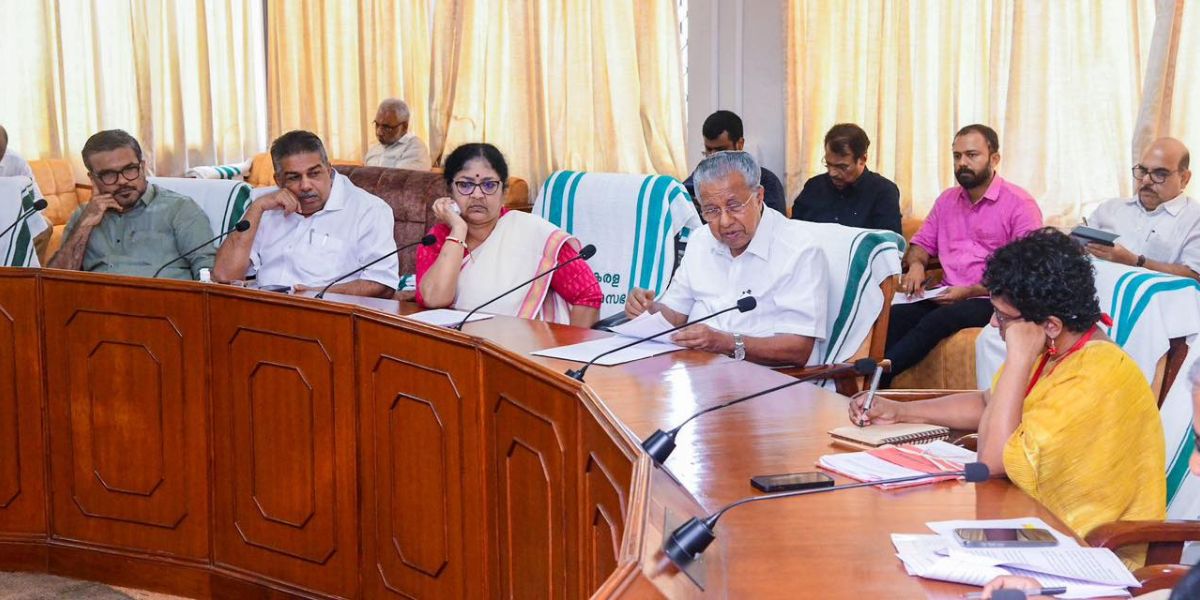
Kerala Chief Minister Pinarayi Vijayan and other ministers during a meeting with the Chief Secretary.

Synopsis: The Kerala Assembly elections result exposed a striking collapse within the ruling LDF, with most ministers losing their seats and even those who survived seeing their margins shrink sharply. What stands out isn’t just defeat, but how deeply it cut into the Cabinet’s core, suggesting that the government had lost touch with its own ground.
The scale of the setback for the Left in Kerala after the Assembly elections has stunned even hardcore supporters.
After a decade in power, the LDF has been pushed to the margins in an election that many expected it to lose — but not like this.
Of the 20 ministers who went to the polls, only seven returned; the rest fell, a roll call of defeats that included senior faces and even the LDF convener.
One minister, K Krishnankutty, had stayed out of the fray.
The numbers tell their own story: From a high of 99 seats in 2021, with the CPI(M) accounting for 62, the front has now slumped to well below half that strength — worse than its previous low of 40 seats in 2001.
The UDF’s victory was anticipated, yet the depth of the Left’s collapse was not.
It’s an outcome loaded with irony: The Left now finds itself without power anywhere in India, and the final blow has come from Kerala — the very state that once made history by electing the country’s first communist government.
For a movement that once stood as the third-largest force in Parliament, this verdict lands heavily — and raises difficult questions about how it has been functioning, and where it goes from here.
Also Read: Decoding the UDF tsunami! The forces behind the wave
The verdict has cut deep into the heart of Kerala’s ruling establishment. What once looked like a tightly held political machine now shows visible cracks, with the Council of Ministers taking a severe hit at the hustings.
At the top, Pinarayi Vijayan remains the captain, securing a third consecutive term from Dharmadam.
Yet, the numbers tell a quieter, more troubling story. His victory margin has shrunk sharply — from 50,123 in 2021 and 36,905 in 2016, to 19,247 this time. The win stands, but the cushion has thinned.
The strain is even more evident among key lieutenants.
Finance Minister KN Balagopal scraped through in Kottarakkara with a margin of just 1,012 votes, a steep fall from 10,814 in 2021. The contrast becomes sharper when placed against 2016, when Aisha Potty — then with the CPI(M), now contesting from the UDF camp — had won the same seat by 42,632 votes.
PWD and Tourism Minister PA Mohammed Riyas retained Beypore, though his margin slid to 7,487, from 28,747 five years ago. In Chengannur, Fisheries Minister Saji Cheriyan held on with 10,292 votes, down from 32,093.
Among the few bright spots, Agriculture Minister P Prasad improved his standing in Cherthala, increasing his margin from 6,148 to 14,489. Civil Supplies Minister GR Anil also managed a steady performance in Nedumangad, though with a slight dip.
Revenue Minister K Rajan saw his margin fall sharply in Ollur — from 21,506 to 8,884.
That is where the list of comforts ends.
Out of the 21-member Council of Ministers, only seven returned — four from CPI(M) and three from CPI. The rest faced defeat, many by striking margins.
Health Minister Veena George lost Aranmula to Abin Varkey by 18,985 votes, overturning her earlier lead of 19,003. Industries Minister P Rajeeve fell in Kalamassery to VE Abdul Gafoor by 16,312 votes.
In Thrithala, MB Rajesh lost by 8,385 votes to VT Balram. Education Minister V Sivankutty was defeated in Nemom by BJP State President Rajeev Chandrasekhar, reversing his earlier victory over BJP leader O Rajagopal in 2021.
Higher Education Minister R Bindu lost in Irinjalakuda to Thomas Unniyadan by 10,212 votes. OR Kelu went down in Mananthavady by 10,543 votes, while Devaswom Minister VN Vasavan lost Etumanoor to Nattakom Suresh by 19,752 votes.
Sports and Waqf Minister V Abdurahiman faced one of the heaviest defeats, losing Tirur to Kurukoli Moideen by 24,137 votes after switching constituencies.
From the CPI camp, J Chinchurani lost Chadayamangalam to MM Naseer by 7,486 votes.
Allies fared no better.
Transport Minister KB Ganesh Kumar, a long-time presence since 2001, lost to Jyothikumar Chamakala by 8,310 votes. Ramachandran Kadanapally was defeated in Kannur by 18,551 votes, while Water Resources Minister Roshy Augustine lost Idukki to Roy K Paulose, after representing the constituency for decades, by 23,822 votes.
Forest Minister AK Saseendran was defeated in Elathur by Vidya Balakrishnan by 12,162 votes, a dramatic reversal from his previous 38,502-vote win.
For a government that once prided itself on electoral solidity, the message from the ground is unmistakable — voters have shifted, and the Council of Ministers has borne the brunt.
Also Read: MK Stalin concedes defeat, says DMK will serve as ‘exemplary opposition’
The verdict has landed with unusual force, and there is little room for the Left to soften its meaning.
For a political formation that has shaped Kerala’s electoral rhythm for decades, alternating power with the UDF, this defeat carries a sharper edge. It comes after 10 uninterrupted years in office under Pinarayi Vijayan — a stretch that once seemed to signal a shift in the state’s political grammar.
Back in 2021, the LDF’s sweeping victory had drawn strength from a perception of steady leadership during the pandemic.
Welfare measures reached deep into households, and outreach to minority communities added to a sense of inclusiveness.
For a while, it looked like a model that could defy Kerala’s long-standing pattern of electoral alternation.
That momentum has now broken.
Anti-incumbency alone doesn’t explain the scale of the setback.
Allegations of corruption have lingered in public discourse, but what appears to have cut deeper is something less tangible and more damaging: An impression that power had grown distant, even dismissive.
The charge of arrogance — voiced not just by opponents but increasingly by those within the Left’s own fold — has stuck.
The signals were there, if one cared to read them.
Even in traditional strongholds like Kannur, the cracks had begun to show. This wasn’t just a drift among floating voters; it hinted at unease among committed cadres.
“There was anger, not just disappointment,” a senior party insider said, speaking quietly after the results. “People wanted to be heard.”
The outcomes in several constituencies underline that mood.
Leaders such as TK Govindan, V Kunjikrishnan, and G Sudhakaran — once associated with the Left — walked away and found emphatic victories under the UDF banner. These weren’t marginal wins; they were statements.
Then there is Perambra — a Left bastion since 1982 — where LDF convener TP Ramakrishnan went down to IUML’s Fathima Thahiliya by 5,087 votes, a result that spoke louder than the broader tally.
Even more telling was what unfolded in Dharmadam.
For a leader long seen as electorally unassailable, Pinarayi Vijayan trailing in the early rounds sent a jolt through the party’s ranks.
Though early leads don’t always hold, the symbolism was hard to miss. It pointed to a deeper churn beneath the surface.
The Left has historically prided itself on the primacy of the movement over the individual.
Yet, over the past decade, the lines blurred. Governance and party messaging increasingly revolved around a single figure. There has arguably never been a chief minister in Kerala so singularly projected as the face of a government.
That centralisation brought clarity in moments of crisis, but it has now come at a cost.
When credit gathers around one individual, so does discontent. Across constituencies, the UDF appears to have tapped into a growing “anti-Pinarayi” sentiment, converting it into electoral advantage.
Meanwhile, the party’s mass organisations — once its most reliable shield — struggled to respond. Units of SFI and DYFI, often quick to mobilise, seemed less effective this time. Their reduced visibility on the ground became part of a larger story about organisational fatigue.
Inside the party, there is also introspection about style.
Pinarayi Vijayan served as party secretary for 16 years before becoming chief minister, and his command over the organisation has rarely been questioned. But some within now argue that the same “iron grip” may have narrowed internal debate.
“He didn’t fail as a leader,” another insider said, choosing words carefully. “But he didn’t function as part of a team. In fact, there was no team.”
For the Left, this moment is less about a single electoral loss and more about recalibration. The message from voters is not ambiguous. Authority without accessibility has limits. Control without consultation carries risks.
(Edited by Muhammed Fazil.)



