

Published Apr 30, 2026 | 8:00 AM ⚊ Updated Apr 30, 2026 | 8:00 AM

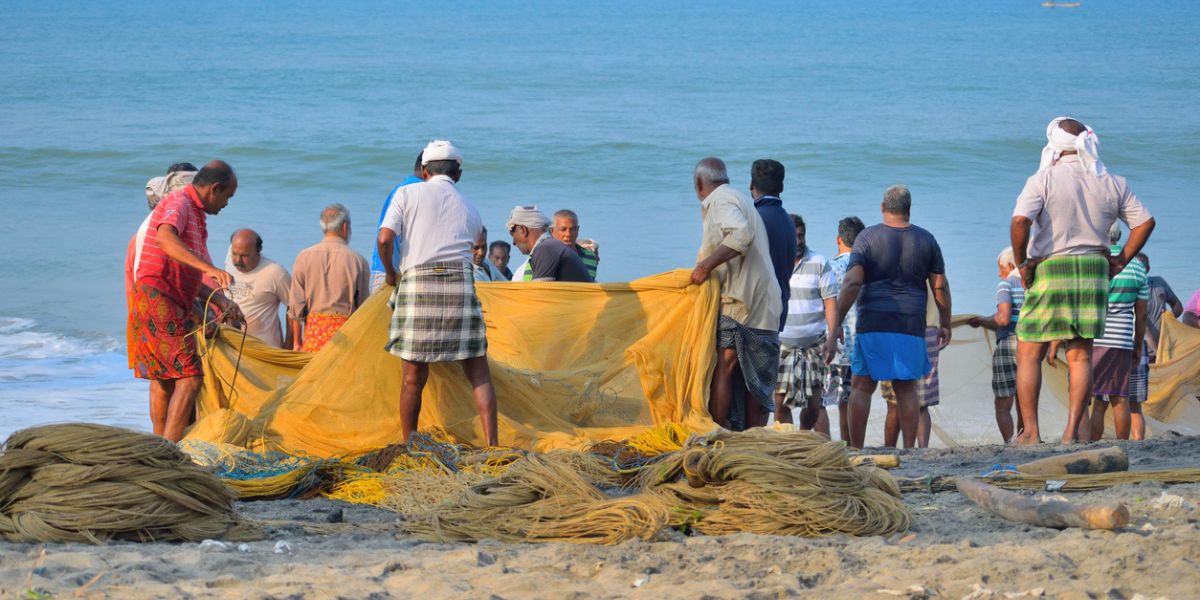
A group of fishermen in Varkala, Kerala. (iStock)

Synopsis: Warmer seas along Kerala’s coast are unsettling long-familiar fishing patterns. Sardines and mackerel are moving away, and daily catches are turning unreliable. Higher fuel costs, erratic labour supply, and even jellyfish crowding the nets are adding to the strain on an already fragile season.
A stretch of unusually warm sea has begun to unsettle Kerala’s fishing coast, and the strain is now visible not just in scientific bulletins but in the daily arithmetic of boats, nets and fuel.
The monsoon is still weeks away, the winds are manageable, and while it is considered a lean phase, fishing communities have long learned how to navigate it. This year feels different. The heat lingers longer into the evenings, the sea behaves unpredictably, and the catch — once modest but reliable — is now uncertain.
Across harbours, from Thiruvananthapuram to Kasaragod, conversations circle back to one thing: The water is warmer, and the fish are no longer where they used to be.
What used to be a predictable lean season has turned uncertain, harsher, and more expensive.
Also Read: Unannounced power cuts amid heatwave spark political clash in Kerala
Jackson Polayil of the Kerala Swathanthra Matsya Thozhilali Federation described the change in practical terms rather than scientific ones.
“This is usually an off-season for us, pre-monsoon,” he said.
“But the heat is increasing year by year. The sea surface temperature is rising. Fish varieties that are usually found in surface waters — like mackerel and sardine, the pelagic types — are migrating to cooler waters. That’s why our catch is dwindling,” he told South First.
The shift he describes is not subtle. Traditional fishers, who rely on nearshore pelagic species such as sardines, anchovies, and mackerel, are finding their nets coming up lighter — or empty.
“Our traditional fisherfolk depend on these fish,” he continued. “Now they are moving away. Even deep-sea varieties are shifting. When there’s no satisfactory catch, a fisherman has to either stay longer at sea or go again another day. That increases cost.”
Fuel, already a major expense, has become a deciding factor in whether a boat even leaves the shore.
“Kerosene price has increased,” Polayil said. “Fishing is now happening only on intermittent days because of the cost involved.”
Scientists have been warning about these patterns for years.
Rising sea surface temperatures (SST) are altering the structure of the upper ocean. Warmer water increases stratification, limiting the vertical mixing that typically brings nutrients from deeper layers to the surface. With fewer nutrients, phytoplankton — the base of the marine food web — declines.
This disruption cascades upward. Zooplankton, small fish, and eventually larger commercial species are all affected.
Even a shift of around 1°C can push sensitive species to move deeper or farther offshore in search of cooler, oxygen-rich waters. Warmer seas also retain less dissolved oxygen, creating stress zones that marine life tends to avoid.
The Indian Ocean has been warming faster than most of the world’s oceans since the mid-20th century. Along India’s western coast, including Kerala, this warming is now visible in both scientific data and daily catch patterns.
The Central Marine Fisheries Research Institute (CMFRI) has documented these changes over decades. Sea surface temperatures along the Indian coast have already risen by about 0.2–0.3°C over the past 45 years and could increase by as much as 2–3.5°C by the end of the century.
Their research shows a clear trend: As SST rises, plankton concentration tends to decline. Since plankton forms the foundation of marine ecosystems, its reduction affects fish growth, reproduction, and survival.
Warmer surface waters disrupt the ocean’s natural mixing process, reducing the upward flow of nutrients that sustain phytoplankton — the base of the marine food chain. When plankton declines or shifts deeper, fish follow.
Even a small temperature rise can trigger this movement.
Pelagic species are particularly sensitive. They either dive deeper or move farther offshore in search of cooler, oxygen-rich waters where food is available.
Fishers are now seeing this science play out in real time.
“In March, the catch of pelagic fish varieties was satisfactory,” Polayil said. “But that changed in April. Take sardine (mathi), the ones we got this time are undergrown. Their biomass has decreased. Usually by now their weight should have increased.”
He links it to a breakdown in the food chain.
“Maybe they couldn’t consume enough phytoplankton or zooplankton, algae, diatoms… something has changed. This is directly connected to sea surface temperature.”
If declining fish stocks were not enough, another challenge has arisen: Jellyfish.
Jackson points to what fishers locally call “kadal chori”. “Jellyfish blooms have increased in our seas,” he said. “Due to their presence, fishermen are finding it difficult. They can cause itching and swelling on contact.”
Experts said rising sea surface temperatures are a primary driver behind these blooms. Warmer waters accelerate jellyfish metabolism and reproduction, allowing populations to grow rapidly.
India is estimated to host around 50 species of jellyfish, with at least 20 identified along the Kerala coast.
“They are usually seen this time of the year,” Jackson said. “But this time their presence is huge because of the increased heat.”
The impact goes beyond discomfort. “During the catch, they get into the fishing nets along with other fish. Sometimes, only jellyfish end up in the net. They damage the nets due to their weight.”
He paused before adding a detail that sounds almost counterintuitive.
“Over 90 percent of a jellyfish’s body is water. But still, it becomes double weight in the net.”
The strain can tear nets, increasing repair costs. In some cases, entire fishing trips yield little else, turning effort into loss.
“The loss in actual numbers is yet to be calculated,” he said.
Also Read: Kerala’s changing heat landscape
For boat operators, the problem extends beyond ecology. Peter Mathias, state president of the All Kerala Boat Operators Association, described the situation as layered and unpredictable.
“The crisis is not limited to temperature,” he said. “There is the US-Iran war and the subsequent crisis in the fuel sector.”
Fuel availability and pricing have become critical constraints. Diesel shortages have forced some harbour-based pumps to shut down temporarily.
“Many pumps operating from the harbour have closed due to scarcity,” he said.
At the same time, labour shortages are affecting operations.
“The traditional fishing sector now majorly relies on a migrant workforce,” Peter explained. “The main manpower comes from Tamil Nadu and West Bengal.”
With elections underway in both states, workforce availability has fluctuated.
“While elections in Tamil Nadu are now over, some are yet to come back. In Bengal, the second phase of elections is on 29 April.”
The absence of workers delays voyages and reduces operational capacity.
“This is an off-season, but we usually use this time to equip ourselves for the 52-day trawling ban period beginning in June,” he said. “This time, the stakes are high, and we didn’t expect this.”
As fish move farther offshore, boats must travel longer distances.
“We have to go that extra mile,” he said. “And that is affecting us badly.”
The cumulative effect — fuel costs, labour shortages, declining catch — has pushed the sector into a fragile state.
“What we demand is a comprehensive package from both the Union and state governments,” he said.
Fishers have also been paying attention to scientific advisories.
A recent bulletin from the Indian National Centre for Ocean Information Services (INCOIS), issued on 20 April, flagged a marine heatwave alert across the Arabian Sea.
A marine heatwave, as defined by scientists, is not just a warm day at sea. It is a prolonged period — at least five days — of unusually high temperatures, exceeding long-term averages. These events alter ecosystems in ways that can take months or even years to reverse.
The bulletin noted a “Watch–Alert–Warning” situation stretching from Gujarat down to Kerala and Lakshadweep, extending towards Oman. The potential impacts listed included coral reef stress, shifts in pelagic fisheries, and reduced productivity.
On 26 April, a moderate marine heatwave event covered nearly 40 percent of the Arabian Sea.
At the same time, the bulletin observed that around 24.86 percent of the Kerala coast fell under a “No Heat Wave” category, indicating no significant marine heatwave directly along the state’s shoreline.
For fishers, the distinction is less reassuring than it sounds.
Fish do not stay confined to administrative boundaries. Changes elsewhere in the Arabian Sea can still influence migration patterns and availability along Kerala’s coast, they point out.
The Indian Ocean, of which the Arabian Sea is part, has been warming faster than many other ocean basins since the mid-20th century. Along India’s coast, sea surface temperatures have already risen by around 0.2 to 0.3 degrees Celsius over the past 45 years. Projections suggest a much steeper rise by the end of the century.
These changes ripple through the marine ecosystem.
Plankton composition shifts. Fish diets adapt. Spawning patterns change. Some species decline while others expand.
Studies indicate that fish eggs and certain larvae show a negative correlation with rising temperatures, while others respond differently. Seasonal cycles are being altered.
For fishers, this translates into unpredictability.
Traditional knowledge — once built on generations of observation — is becoming harder to apply.
Fishing seasons are shifting. Catch composition is changing. The timing of fish availability is no longer reliable.
In some regions, fishers are already moving toward alternative livelihoods during peak heat periods. Others are reducing the number of fishing days, weighing the cost of fuel against uncertain returns.
Women in fish processing and vending, often the invisible backbone of the sector, are also feeling the strain as supply fluctuates.
Meanwhile, rising fish prices affect consumers across Kerala, where fish remains a staple source of protein.
Mariam, a fish vendor at the Karamana market in Thiruvananthapuram, said pricing has become increasingly unpredictable.
“Everything depends on the day’s catch now,” she said. “Take common varieties like mathi and ayala (mackerel). Just last month, mathi was around ₹75 a kilo and ayala about ₹180. Now it’s a different story. Mathi is selling between ₹140 and ₹160, and ayala has gone up to ₹200–₹210.”
She pointed out that the swings are not just about demand, but about what actually reaches the shore.
Traders and exporters are also feeling the strain. The prolonged heat has discouraged many deep-sea vessels from venturing out, reducing the volume of fish available for export markets and adding another layer of pressure on an already unsettled trade.
Back at the harbour, the mood is neither panic nor resignation. It is something quieter, uncertainty mixed with persistence. Fishers continue to go out, adjust routes, repair nets, and watch the water more closely than ever.
Jackson summed it up without drama. “Usually this is a rough season,” he said. “But this time the stakes are high. We didn’t expect this.”
What lies ahead depends on factors far beyond the coastline — global warming trends, ocean dynamics, fuel markets, and policy responses.
(Edited by Muhammed Fazil.)



