

Published Apr 29, 2026 | 6:30 PM ⚊ Updated Apr 29, 2026 | 7:16 PM

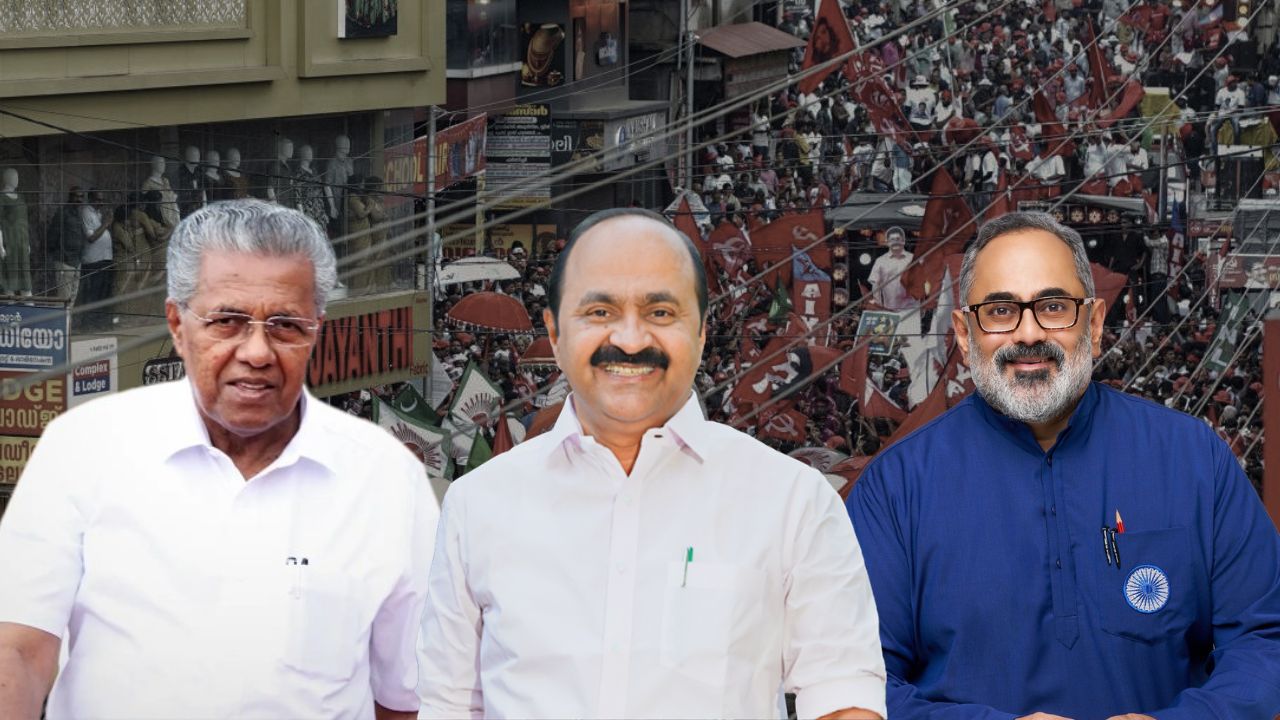
Pinarayi Vijayan, VD Satheesan and Rajev Chandrasekhar.

Synopsis: A post-poll survey by Hyderabad-based People’s Pulse Organisation has predicted a clear majority for the Congress -led UDF in Kerala. The survey findings pointed out that the LDF retains strong governance legitimacy and leadership advantage, yet faces a clear undercurrent of voter fatigue, while the UDF benefits from a moderate but decisive shift in voter sentiment
A post-poll survey by Hyderabad-based People’s Pulse Organisation has predicted a clear majority for the Congress-led UDF in Kerala following the Assembly elections held on 9 April.
According to the survey, the UDF is projected to secure 75–85 seats, comfortably crossing the majority mark in the 140-member Assembly, while the incumbent CPI(M)-led LDF is expected to win 55–65 seats, indicating a decline from its earlier dominance but retaining a resilient base. The BJP-led NDA is projected to secure 0–3 seats, continuing its struggle to convert vote share into seats.
The Kerala Assembly election 2026 marks a significant moment in the state’s political journey, reflecting both continuity in its established electoral patterns and subtle shifts in voter sentiment. The survey pointed out that the election is shaping into a closely contested yet directionally decisive political battle.
The survey findings pointed out that the LDF retains strong governance legitimacy and leadership advantage, yet faces a clear undercurrent of voter fatigue, while the UDF benefits from a moderate but decisive shift in voter sentiment, translating into a stronger seat position.
While the vote share gap remains narrow, the seat projections clearly favour the UDF, pointing toward a likely regime change. At the same time, the presence of silent voters and floating segments ensures that the contest remains competitive.
Also Read: Unknown forces, PR fuel the ‘constant’ as ‘united’ Congress hopes to win Kerala
The election unfolded after a decade of LDF governance with high political awareness, strong voter participation and evolving socio-political dynamics.
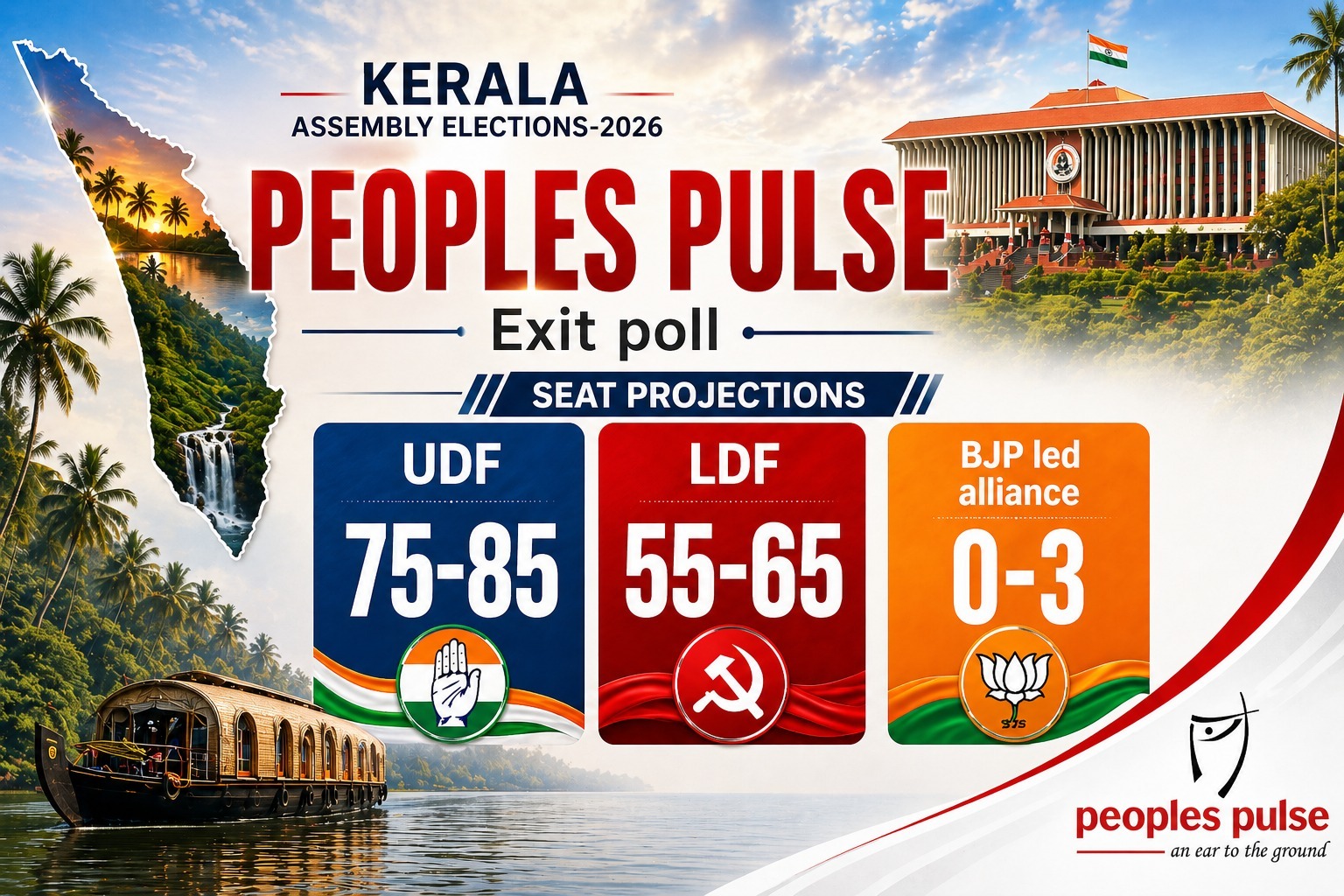
Projected seats.
According to the survey, the contest remains rooted in a tightly competitive bipolar structure, with the UDF at 31.1 percent vote share holding a marginal lead over the LDF at 29.1 percent, while the NDA, at 7.6 percent, remains a distant third.
According to the survey, this narrow vote share gap is translating into a clearer electoral advantage for the UDF.
A striking feature of the survey is the presence of a substantial “silent voter” segment, with 25.7 percent of respondents choosing not to disclose their preference. This high degree of voter secrecy complicates precise electoral predictions and suggests the possibility of hidden vote swings that could influence the final outcome.
“Such patterns reinforce Kerala’s electoral character, where even marginal vote share differences can produce decisive seat outcomes due to efficient vote distribution and constituency-level dynamics,” said the survey report.
“The broader electoral trend indicates a moderate shift toward the UDF, not driven by strong anti-incumbency but by a preference for political alternation. This aligns with Kerala’s historical pattern of cyclical power shifts, suggesting that the electorate is not rejecting the incumbent outright but is inclined toward change within a stable democratic framework,” it added.
The post-poll Survey was conducted by People’s Pulse Research Organisation in collaboration with the VK Sukumaran Nayar Chair for Parliamentary Affairs, Department of Political Science, University of Kerala, Thiruvananthapuram.
The study adopted a multi-stage stratified random sampling methodology, covering 20 Assembly constituencies with four polling stations each, and 50 respondents per station, resulting in a total sample size of 2,057 respondents. Data was collected through face-to-face household interviews between 13 April and 20 April, followed by rigorous analysis and report preparation.
The electoral contest remains deeply rooted in Kerala’s bipolar political system. While the 2021 election broke the cycle with the LDF retaining power, the current election reflects a renewed inclination toward alternation. At the same time, the developmental performance of the LDF government continues to be widely acknowledged.
A majority of respondents (55.1 percent) expressed satisfaction, particularly with infrastructure, public services, electricity supply, government schools, and social security pensions. The LDF is also perceived as the most effective party in delivering governance and welfare, reinforcing its administrative credibility.
However, this positive perception coexists with emerging concerns. Issues related to governance and corruption have influenced voter preferences, contributing to a partial tilt toward the UDF. Allegations linked to governance and leadership, including controversies such as Sabarimala-related issues and perceptions of leadership conduct, are considered credible by a notable section of respondents.
There is also a perceptible decline in the perceived performance of the current LDF government compared to its previous term, indicating emerging anti-incumbency even within its support base. Despite satisfaction with governance, around 42 percent of respondents believe the LDF should not be given another chance, while 35.6 percent express dissatisfaction overall. This reflects a nuanced voter mindset, acknowledging performance while also seeking change.
Also Read: No post announced, yet three Congress leaders line up for Kerala CM chair
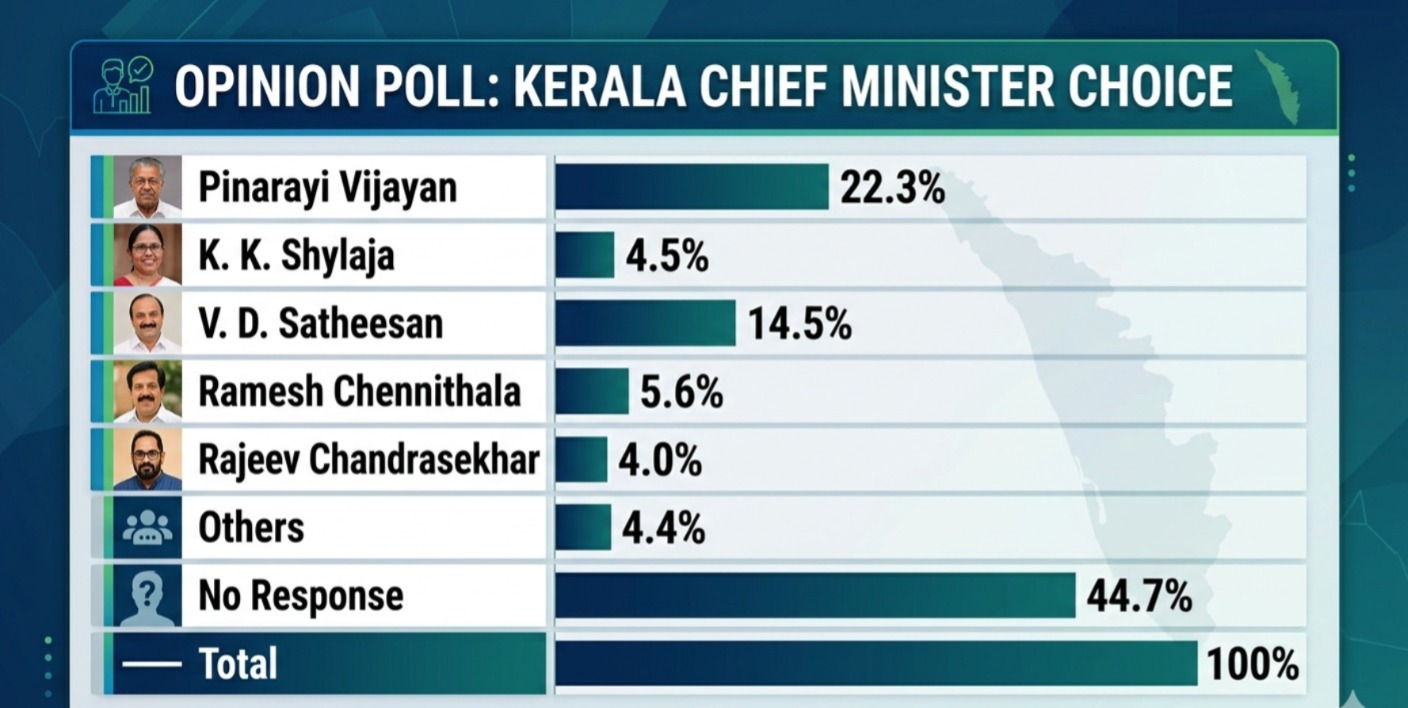
Chief Minister Choice.
Leadership dynamics further reinforce this paradox. Pinarayi Vijayan remains the most preferred Chief Ministerial candidate with 22.3 percent support, indicating strong leadership consolidation within the LDF. In contrast, the opposition leadership remains fragmented, with VD Satheesan at 14.5 percent emerging as the leading alternative but without comparable consolidation. A large proportion of respondents remain undecided, reflecting the absence of a dominant opposition face.
Voting behaviour in Kerala continues to be stable and largely pre-determined, with 57.2 percent deciding their vote before campaigns and 22.3 percent after candidate announcements. Party ideology and development remain the most influential factors, underscoring a politically aware electorate driven by long-term considerations rather than short-term campaign effects.
The presence of a significant floating voter segment (30.1 percent) adds another layer of complexity. While the LDF retains the largest committed base and the UDF follows closely, this floating segment plays a decisive role in shaping electoral outcomes.
The evaluation of the Union government remains largely negative, with 50.9 percent expressing dissatisfaction, highlighting Kerala’s distinct political orientation compared to national trends. This also reflects in the limited acceptance of the “double engine government” model, with 55.4 percent of respondents disagreeing that alignment with the central government is necessary for development.
Despite some incremental growth in NDA support, its broader acceptance remains constrained. A majority of respondents (50.4 percent) do not view it as a viable third alternative, and 59.4 percent reject the need for a third front, reaffirming the dominance of the LDF–UDF bipolar framework. Concerns related to ideological factors, including perceptions around a “Hindu Rashtra” agenda, further limit its expansion.



