

Published Apr 06, 2026 | 3:54 PM ⚊ Updated Apr 06, 2026 | 3:54 PM

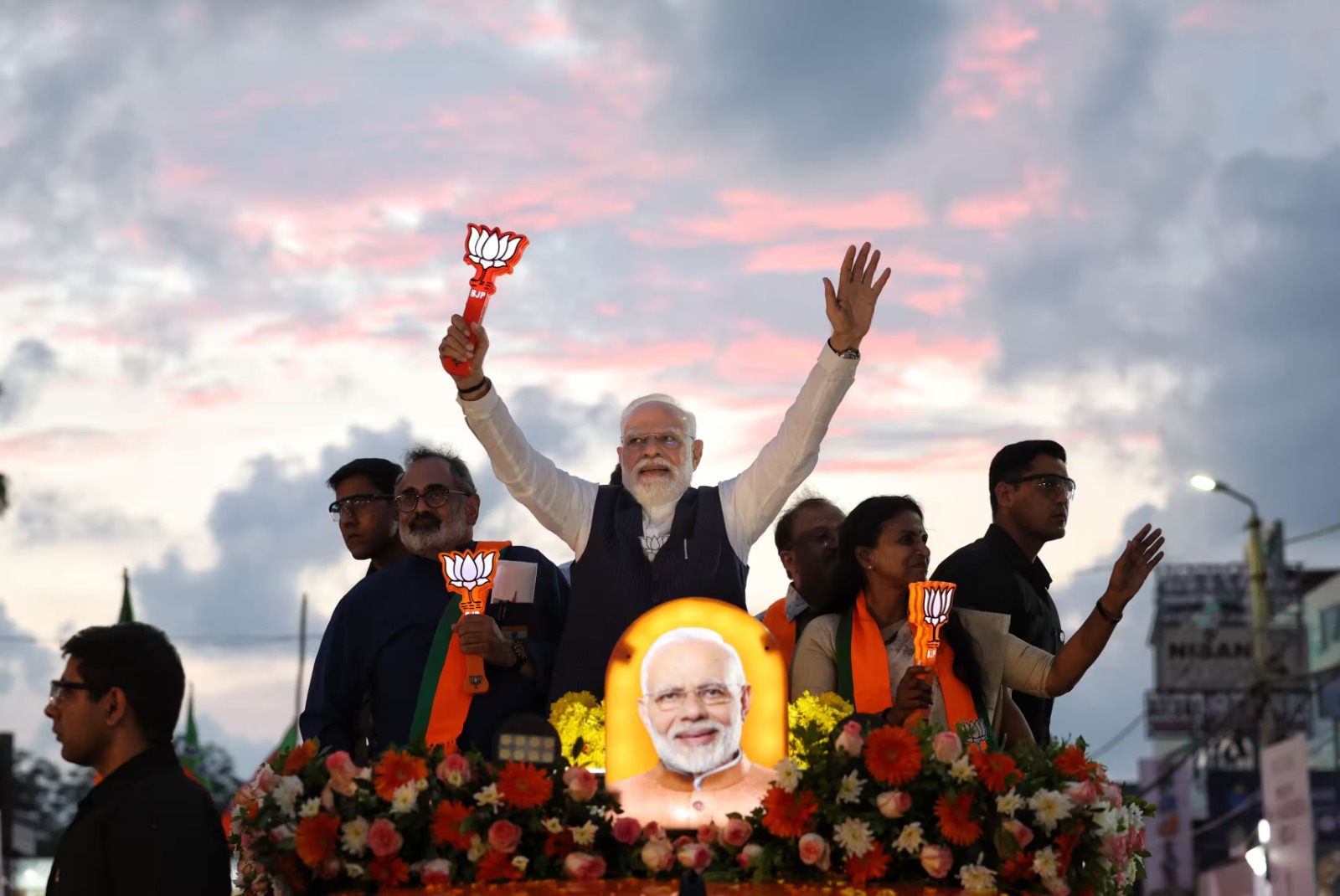
Modi accused both LDF and UDF of spreading misinformation about the FCRA amendments. Pictured, a roadshow in Thiruvananthapuram.
Synopsis: With elections looming and the BJP attempting a careful outreach to Kerala’s Christian community, the controversy over the FCRA Bill threatened to undo months of groundwork. The Centre was forced to put the Bill on hold, which may not be enough to placate the Church.
It arrived with the language of oversight and national security. It stalled under the weight of suspicion and political reality.
Introduced in the Lok Sabha on 25 March, the Centre pitched the proposed amendments to the Foreign Contribution (Regulation) Act (FCRA) as a necessary strengthening of a system vulnerable to misuse. While defending the Bill, Minister of State for Home Nityanand Rai argued that it would strengthen transparency, curb illicit fund flows, and check activities ranging from forced religious conversions to threats against national interest.
But outside Parliament, a different reading took hold.
Across poll-bound Kerala, particularly within influential Church networks, the proposal triggered unease that quickly hardened into resistance.
What the government described as regulation began to look, to its critics, like encroachment — especially on institutions built over decades with foreign contributions.
The pushback was swift, coordinated, and politically sensitive.
By 2 April, the Centre hit pause.
The retreat was not dressed up as one. It came quietly, almost cautiously. Yet the timing told its own story.
With elections looming and the BJP attempting a careful outreach to Kerala’s Christian community, the controversy threatened to undo months of groundwork. The Bill was not withdrawn. But it was set aside — at least for now.
Between intent and perception, the gap had widened too quickly. And in that gap, a piece of legislation meant to tighten oversight ended up testing trust.
At the core of the controversy lies a sensitive question: who controls institutions built on foreign funding once regulatory permissions lapse?
The proposed amendments would make sweeping changes to the 2010 FCRA framework.
The most contentious provision allowed the Union government to appoint a designated authority with powers akin to those of a civil court to take control of assets created through foreign contributions if an organisation’s licence had expired, been cancelled, or not renewed. The institutions could include schools, hospitals, and orphanages that form the backbone of Kerala’s Christian social infrastructure.
There was more. Expanded liability for office-bearers. Tighter timelines to utilise funds. Automatic lapsing of registrations in certain cases. Mandatory approval before investigations. A tweak in penal provisions.
In isolation, each clause might have passed as regulatory tightening. Together, they raised a red flag.
Church groups saw something deeper — a possible shift in control over long-standing institutions. Many of these bodies depend heavily on overseas donations. The idea that assets could be taken over or liquidated, with proceeds flowing into the Consolidated Fund of India, struck at the heart of institutional autonomy.
As congregations gathered for Palm Sunday services across Kerala, the message from the pulpit went beyond scripture.
In parish after parish, bishops and priests of the Syro-Malabar Church chose the occasion to voice unease over the proposed changes to the FCRA, setting the tone for what has now become a wider and more coordinated response from Christian leadership.
What began as expressions of concern has quickly taken shape as a firm and collective objection.
The Kerala Catholic Bishops’ Council (KCBC), one of the most influential Church bodies in the State, described the proposed amendments in stark terms — problematic, a violation of fundamental rights and “deeply unethical.”
The position taken in Kerala mirrors that of the national leadership.
The Catholic Bishops’ Conference of India (CBCI), the apex decision-making body of the Catholic Church in the country, has already flagged what it sees as serious risks embedded in the Bill. In a formal response to the introduction of the FCRA Bill, 2026, in the Lok Sabha, the CBCI warned that the legislation could endanger the very “operational survival” of minority institutions and civil society organisations.
At the heart of the Church’s concern lies a perceived shift in the nature of the law itself.
Church leaders argued that the proposed framework moves away from regulation and edges into control. One provision, in particular, has triggered anxiety—the power granted to the Union government to deny licence renewals and, in such cases, take over the institutions, funds and assets of organisations through a designated authority.
Church authorities pointed out that existing rules already mandate strict compliance. Access to foreign funds, they say, is contingent upon detailed disclosures and adherence to guidelines.
“No organisation receives funds without the Centre’s knowledge,” a senior Church functionary noted, questioning the need for further tightening.
Yet, it is the uncertainty surrounding licence renewals that has struck a deeper chord. Church leaders have asked a pointed question: if renewal decisions lie with the government, what safeguards exist against arbitrary denial? The lack of clarity, they say, has created unease among institutions that depend on such funding to sustain charitable and educational initiatives.
The KCBC has formally written to Prime Minister Narendra Modi, urging that the Bill be referred to the Parliamentary Standing Committee on Home Affairs.
It has also sought a broader consultative process—public hearings, detailed debates, and scrutiny both inside and outside Parliament.
Speaking at a press briefing, KCBC deputy secretary general Fr. Thomas Tharayil argued that the proposed changes could have far-reaching consequences. If an organisation’s FCRA licence is cancelled or not renewed, he said, the provisions would allow for a direct transfer of its assets and funds to a designated authority. That, in effect, could bring decades of work to a halt.
The implications are not abstract.
Church-run schools, orphanages and social service centres—many of which rely partly on foreign contributions supplemented by local funding—could face closure. Fr. Tharayil pointed out that projects built with international support are also sustained by contributions from within the country, making them community investments as much as external ones.
There is also a growing sense of frustration over what Church representatives describe as an already difficult environment.
According to them, several organisations, including those affiliated with the Catholic Church, have experienced delays or refusals in the renewal of FCRA licences, despite operating within the legal framework. The introduction of additional bureaucratic layers, they warn, could deepen the crisis in the voluntary sector.
Beyond procedural concerns, the Church has framed the issue in constitutional terms.
The KCBC has labelled the amendment “unconstitutional” and “draconian,” arguing that it grants sweeping powers to the bureaucracy, potentially enabling it to take control of institutions on minor or technical grounds.
Senior Church figures have added their voices, sharpening the critique. Major Archbishop Baselios Cardinal Cleemis posed a direct challenge, asking whether any section of the Christian community has ever posed a threat to national security—an implicit rejection of the premise that stricter controls are necessary.
From within Kerala, Pala Bishop Joseph Kallarangatt described the Bill as a structural departure from the existing framework. In his view, it transforms the FCRA from a regulatory mechanism into an instrument of control, with the potential to choke the flow of resources that sustain charitable work.
He also warned of broader social consequences. Measures that weaken links between minority communities and their international networks, he said, could disproportionately affect the poor and unsettle the social fabric.
The concern is not confined to a single denomination. Archbishop Thomas Tharayil of the Changanassery Archdiocese and head of the Malankara Orthodox Syrian Church- Baselios Marthoma Mathews III have both expressed reservations, signalling a convergence of opinion across different Christian traditions in the State.
Meanwhile, Syro Malabar Church Major Archbishop Raphael Thattil has endorsed the collective stand taken by Church leaders, urging the government to address the concerns raised before moving forward with the legislation.
As the debate unfolds, the Church’s position remains clear and consistent.
It is not merely opposing a legal amendment; it is questioning the direction in which the law is headed. The demand now is for deliberation—slower, wider, and more transparent.
Whether the government chooses to accommodate these calls or presses ahead will determine not just the fate of the Bill, but also the relationship between the BJP and a vast network of institutions that operate under various Christian factions.
The Centre’s decision to press pause on the proposed amendments to the FCRA Amendment Bill has set off a political churn in Kerala, where the issue has swiftly moved from policy debate to electoral flashpoint.
Union Parliamentary Affairs Minister Kiren Rijiju was the first to signal a retreat of sorts, announcing that the Bill would be postponed.
The move came in the wake of mounting unease among Christian groups, many of whom had voiced apprehension over how the changes might affect their institutions and outreach work.
Yet, the government’s messaging did not stop at postponement.
On Good Friday, Rijiju, who has been campaigning in Kerala, struck a conciliatory note aimed squarely at the Christian community.
He insisted there was no reason for alarm, emphasising that the proposed amendments were not intended to target legitimate organisations or religious groups.
According to him, the Narendra Modi government remains committed to safeguarding minority interests. He framed the amendments as a tightening of safeguards rather than a sweeping overhaul—an effort, he said, to curb the misuse of foreign funds for activities deemed unlawful or detrimental to national interests.
At the same time, Rijiju accused political rivals of fuelling anxiety. He alleged that both the Congress and the Left in Kerala were spreading misinformation, particularly among NGOs and community organisations that rely on foreign contributions. The charge was blunt: that fear was being manufactured for political gain.
His remarks came against the backdrop of vocal resistance from sections of the Church.
Priests and church bodies had raised questions about transparency, regulatory overreach, and the potential chilling effect on humanitarian work. Their concerns appeared to have caught the BJP off guard—especially in a state where the party has been working steadily to expand its footprint among Christian voters.
The response from the BJP’s Kerala leadership was swift.
Rajeev Chandrasekhar, the party’s state president, convened a hurried press meet in Thiruvananthapuram. He sought to reassure stakeholders that the Centre would not rush the legislation without addressing the concerns raised by church leaders.
Chandrasekhar revealed that he had spent several days in consultations with representatives of various Christian denominations. Those discussions, he admitted, showed that apprehensions remained widespread. Acting on that feedback, he said he had advised the Union Home Minister to delay the Bill until there was greater clarity and confidence among affected groups.
He also pushed back against the narrative that the amendments were aimed at any one community. The issue, he argued, had been framed incorrectly in public discourse. According to him, the real concern was the misuse of foreign funds, including instances of money laundering—something he said could not be ignored.
Despite the growing controversy, expectations that the Prime Minister would directly address the matter during his Kerala visit did not quite materialise.
At a rally in Thiruvalla on 4 April, Modi chose a broader political line instead of engaging with specifics.
He accused both the ruling Left Democratic Front (LDF) and the opposition United Democratic Front (UDF) of spreading misinformation about the FCRA amendments. The charge was familiar: that opposition parties were resorting to “vote-bank politics” by stoking fear among minorities.
Drawing parallels with past controversies, Modi referred to the backlash over the Citizenship Amendment Act (CAA), arguing that dire predictions made at the time had not come true. He suggested that a similar pattern was unfolding with the FCRA debate, and even alluded to earlier disputes around the proposed Uniform Civil Code (UCC), portraying them as part of a recurring cycle of political alarmism.
What has emerged, then, is a layered picture. On paper, the Bill is about regulatory tightening—about ensuring that foreign contributions are used for declared, lawful purposes. On the ground, especially in Kerala, it has become something else: a test of political messaging, community trust, and electoral strategy.
The immediate impact of the controversy is clear.
The Centre has hit the brakes, signalling that it is unwilling to risk alienating a key community without further dialogue.
For now, the BJP government at the Centre has stepped back just enough to let the temperature drop—while continuing to insist that its intentions have been misunderstood.
The government has not withdrawn the Bill. It maintains that consultations will continue and that the intent is regulatory, not political.
But the immediate objective appears clear: contain electoral damage.
In the days following the controversy, BJP leaders in Kerala found themselves engaged in what one insider described as “continuous firefighting.”
Clarifications were issued. Assurances were given. Outreach intensified.
Yet, as one district-level leader put it: “In politics, perception often becomes reality before you can correct it. By the time we explained, the narrative had already settled.”
That narrative — of a central law potentially encroaching on minority-run institutions — was precisely what the party had been trying to counter for years in Kerala.
For months, the BJP had been working to soften its image among Kerala’s Christian community. Outreach programmes, quiet engagements with clergy, symbolic gestures — what party insiders half-jokingly called a “cake and flower” approach — were beginning to show modest traction.
The stakes were particularly high in constituencies like Kanjirappally and Pala, where the NDA had fielded prominent faces such as Union Minister George Kurian and Shone George, respectively. These are not just electoral contests; they are social negotiations, where trust matters as much as arithmetic.
Then came the Bill.
“It wasn’t just about the content,” admitted a BJP functionary in Kottayam, speaking on condition of anonymity. “It was about timing. You can explain the policy later. But elections run on first impressions, and that impression turned negative very fast.”
Another local leader was more blunt: “We had spent months telling people we are not hostile to their institutions. Suddenly, this came. It put us on the back foot overnight.”
Christians make up roughly 18–19% of Kerala’s population. But their influence is not evenly spread. In several central districts, they are not just a significant bloc — they are the decisive one.
In seats like Pala, Kanjirappally and Thiruvalla, electoral outcomes often hinge on how different church denominations lean. Historically, this space has oscillated between the UDF and LDF. The BJP’s long-term ambition has been to break into this matrix.
This election cycle was seen as a potential opening.
The FCRA amendments, however, risked collapsing that window.
Political observers point out that the backlash was not merely organic; it was amplified effectively.
The Left framed it as ideological overreach. The Congress positioned it as an attack on minority rights. Church leaders, wary of institutional vulnerability, added moral weight to the criticism.
For now, the pause button has been pressed. But whether the pause is temporary or signals deeper reconsideration will depend on how the political winds shift after polling.
(Edited by Majnu Babu).


