

Published Aug 30, 2026 | 9:00 AM ⚊ Updated Aug 30, 2026 | 9:00 AM

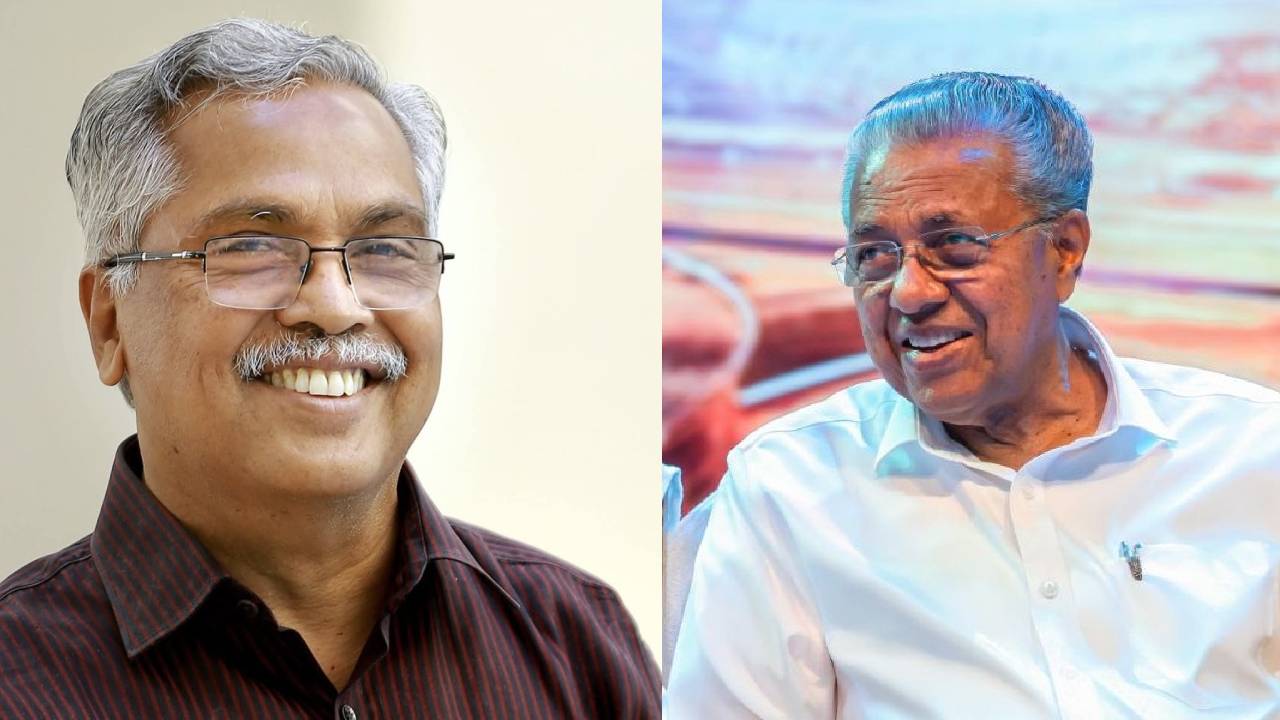
Binoy Viswam and Pinarayi Vijayan.

Synopsis: Amid the CPI(M)-CPI row over the Deputy Leader of the Opposition post, IUML leader KPA Majeed has stirred Kerala politics by recalling the days when the CPI, Congress and Muslim League governed together under C Achutha Menon. His praise for the CPI and sharp criticism of the CPI(M) triggered speculation of an indirect invitation to the CPI, though the League leadership has denied making any such offer.
Amid the continuing public sparring between the CPI(M) and the CPI over the Deputy Leader of the Opposition post in the Keralam Legislative Assembly, the Indian Union Muslim League (IUML) has brought an old chapter of Keralam politics back into the conversation.
In an article published in the IUML mouthpiece Chandrika on Saturday, 29 August, the party’s national vice-president KPA Majeed looked back at the years when the CPI, Congress and Muslim League governed Kerala together under C Achutha Menon.
Menon of the CPI was the chief minister from November 1969 to August 1970, and again from October 1970 to 1977.
While praising the CPI’s political legacy, Majeed also took a sharp swipe at the CPI(M), accusing it of treating its smaller Left ally with a “big brother” attitude.
The intervention immediately fuelled speculation that the IUML was extending an indirect political invitation to the CPI to return to an arrangement with the Congress-led UDF.
Senior League leaders, however, were quick to downplay that interpretation, while Majeed insisted his article was an expression of sympathy, not an invitation.
Also Read: When big brother says ‘no’, younger sibling says ‘not so fast’
Majeed’s article appeared at a particularly delicate moment for the two principal constituents of the LDF.
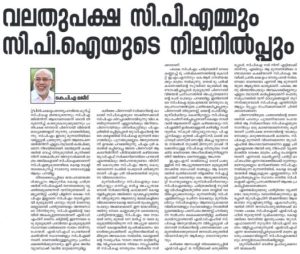
K.P.A. Majeed’s article
The CPI and CPI(M) are locked in a public spat over the Deputy Leader of the Opposition post, with leaders on both sides exchanging unusually sharp remarks through party publications and the media.
Against this backdrop, Majeed revisited the history of the CPI’s partnership with the Congress and the Muslim League.
The political landscape of Keralam was markedly different in the years following the historic split in the Communist movement in 1964.
The CPI and the newly formed CPI(M) initially contested the 1967 Assembly election together as part of a broad seven-party alliance. The coalition came to power with EMS Namboodiripad of the CPI(M) as Chief Minister.
But the ministry did not last.
Differences between the two Communist parties widened, eventually placing them on opposite sides of Keralam politics.
A brief CPI-led ministry under C Achutha Menon followed in 1969, after which the political equations changed decisively.
The 1970 Assembly election saw the emergence of the United Front, comprising the Congress, CPI, Revolutionary Socialist Party, Muslim League and Praja Socialist Party.
The alliance won the election, and Achutha Menon became Chief Minister. The Achutha Menon government became the first ministry in Kerala to complete its full constitutional term. Its tenure was subsequently extended during the Emergency declared by Prime Minister Indira Gandhi in 1975, and the government remained in office until 1977.
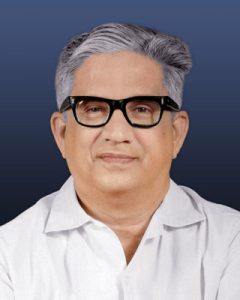
C Achutha Menon
Majeed described this period as a significant chapter in the political history of both the Muslim League and the CPI.
He argued that the Achutha Menon years laid an important foundation for Keralam’s later achievements in education and healthcare, which came to be associated with the much-discussed Keralam development model.
Majeed said the CPI has its own political identity and history and could not be reduced to a subordinate partner within an alliance.
Recalling the period after the Communist Party split, he noted that the CPI had remained in government for years, including as the party leading the ministry, without the CPI(M).
According to him, the CPI had been pushed to the margins after becoming caught in the CPI(M)’s political orbit.
Also Read: CPI vs CPI(M) — same script, new actors
The timing of the article ensured that it did not go unnoticed in the ongoing CPI-CPI(M) confrontation.
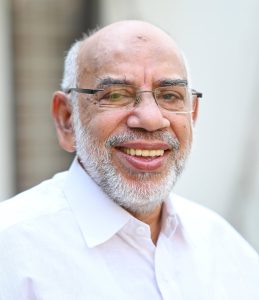
KPA Majeed. (Facebook)
On the same day, the CPI(M) mouthpiece Deshabhimani carried an article by party state secretariat member CN Mohanan, who accused the CPI of attempting to create divisions within the LDF.
Continuing his criticism of the CPI’s political history, Mohanan referred to the party’s association with the Congress during the Emergency period. He argued that the post-Emergency electoral success of the Congress-led alliance in Kerala, contrary to the broader national trend, reflected the state’s distinctive social and political circumstances and the influence of anti-Communist political currents.
Mohanan also accused the CPI of creating a controversy over what he described as a non-issue. The post of Deputy Leader of the Opposition in the Kerala Assembly, he argued, had traditionally been held by the CPI(M).
The dispute began after the CPI raised its claim to the Deputy Leader of the Opposition post.
Leader of the Opposition Pinarayi Vijayan rejected the demand, making it clear the position would go to a CPI(M) legislator.
Vijayan said the appointment only required the Leader of the Opposition to communicate the name to the Speaker and that there was no ambiguity over whom he would recommend.
The remarks drew a strong response from CPI state secretary Binoy Viswam, who said Vijayan’s manner of speaking was unbecoming of his position.
Senior CPI leader Sathyan Mokeri subsequently used an article in the party mouthpiece Janayugam to describe the remarks as a violation of coalition etiquette. The CPI(M), in turn, accused the CPI of taking internal differences to the public domain.
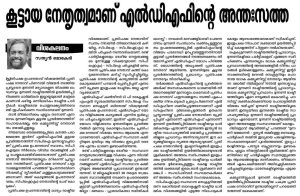
CPI leader Sathyan Mokeri’s article on 25 August
It was into this charged atmosphere that Majeed’s reflections on the CPI’s past relationship with the Congress and Muslim League landed.
Amid rumours that Majeed’s article was an indirect invitation for the CPI to join the UDF, the IUML leadership moved swiftly to distinguish political appreciation from a formal offer.
Senior League leader PMA Salam said Majeed had merely highlighted what he described as the CPI’s neglect within the LDF.
Any discussion about a new political arrangement, he said, would arise only if the CPI itself chose to leave the LDF.
Senior leader and Minister PK Kunhalikutty also dismissed the suggestion that a formal invitation had been issued, describing Majeed’s observations as an academic discussion of an important period in Kerala’s political history.
Majeed later clarified that he had not written the article to demand that the CPI return to the UDF.
He said it was not for him to decide whether the CPI should join another front. That was a matter for the CPI to consider and, if such a situation arose, for the UDF to discuss collectively.
Majeed said his article had been prompted by the allegations and criticism directed at the CPI during the present dispute.
He maintained that he had merely expressed sympathy and solidarity with a party with which the Muslim League had maintained cordial political relations in the past.
The CPI, he said, was capable of assessing its own political situation and taking its own decisions.
For now, the IUML intervention has added another layer to the ongoing dispute between CPI(M) and CPI.
By invoking the Achutha Menon years, Majeed has also reopened memories of a time when the CPI, Congress and Muslim League occupied the same side of Keralam’s political divide—long before the LDF and UDF settled into the rival formations that have dominated the state’s politics for decades.
(Edited by Majnu Babu).



