

Published May 12, 2026 | 11:42 AM ⚊ Updated May 12, 2026 | 11:42 AM

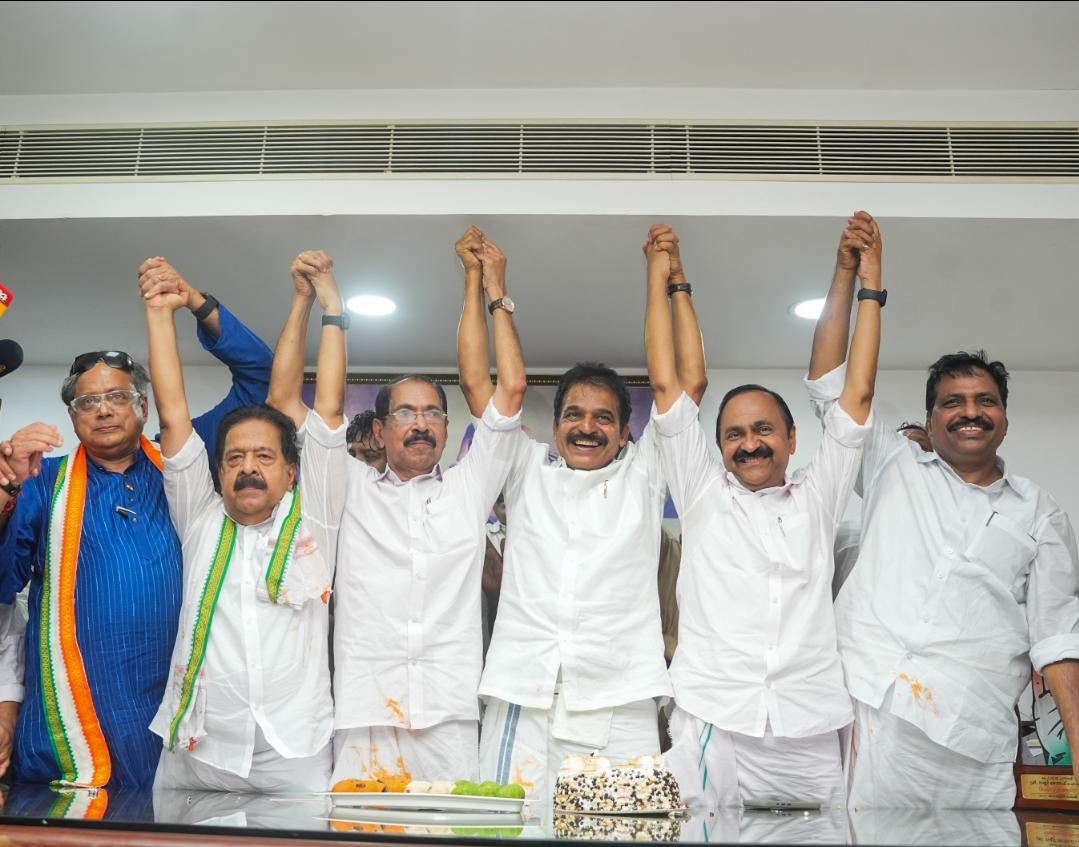
Congress leaders at the KPCC office following the victory in the Assembly elections on 4 May

Synopsis: A week after the UDF’s emphatic victory, the Congress still finds itself trapped in a familiar Kerala ritual — closed-door talks, factional balancing and suspense over the CM face, despite winning 63 seats on its own. However, when one travels down the memory lane it can be seen that the Congress has almost never chosen its chief ministers the easy way, from sidelining stronger claimants and backing ally leaders to watching governments collapse under the weight of its own internal battles.
A week has passed since the 2026 Assembly election verdict. The Congress-led UDF has returned to power with a commanding mandate. Out of the front’s 102 seats, the Congress alone has won 63. By conventional political logic, the path to government formation should have been uncomplicated.
Instead, the party finds itself in familiar territory — consultations, factional arithmetic, lobbying, suspense and competing power centres. Three senior leaders are in contention, though none has officially been declared a chief ministerial aspirant. Delhi discussions continue. Kerala waits.
For the Congress in Kerala, this is not a crisis born out of confusion. It is almost tradition.
Every time the party approaches power in the state, the chief ministership turns into a complicated exercise.
The Congress has repeatedly avoided the obvious choice, backed compromise candidates, yielded the top post to smaller allies despite numerical superiority, replaced sitting chief ministers midway, elevated leaders who were not even members of the Assembly, and watched governments collapse under the weight of internal rivalries.
The irony of the present moment lies elsewhere too. The Congress has once again won 63 seats — a number that occupies a strangely uncomfortable place in the party’s political memory in Kerala.
Also Read: Kerala shows highest reporting of harassment, domestic violence among Southern neighbours: NCRB
The story began after the dismissal of the first EMS government in 1959.
The Assembly election of 1960 produced what came to be known as the “Mukkootu Munnani” — the three-pronged alliance of the Congress, Praja Socialist Party (PSP) and Muslim League.
The Congress emerged as the single largest party with 63 seats. The PSP won 20 and the Muslim League 11.
Yet the chief minister was not from the Congress.
Instead, PSP leader Pattom A. Thanu Pillai took oath as Chief Minister on February 22, 1960.
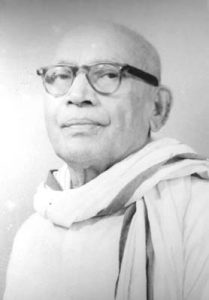
Pattom A Thanu Pillai
KPCC president R. Sankar became Deputy Chief Minister.
Pattom himself had once been a Congress leader. Rumours persisted for years that an understanding had been reached before the election that Pattom would head the government if the alliance won. The Congress had powerful leaders then — R Sankar, PT Chacko and others who had emerged from the liberation struggle against the Communist government.
Consensus proved difficult.
Another factor hovered quietly in political circles. Sankar later remarked that he was denied the chief ministership because he was an Ezhava leader. Many in the Congress believed resistance to elevating him played a role in Pattom’s selection.
The arrangement never settled comfortably inside the Congress.
Pattom’s style irritated sections of the party leadership. Home Minister P.T. Chacko reportedly sent files to the Chief Minister’s office by registered post from the next room. Relations deteriorated steadily. The Congress national leadership also refused to accommodate the Muslim League in the cabinet despite the alliance victory, fearing repercussions in North India. League leader K. M. Seethi Sahib was instead made Speaker.
The coalition soon became unstable.
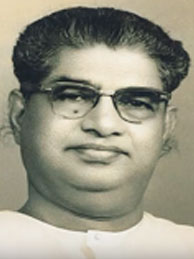
R Sankar
By 1962, pressure mounted within the Congress to reclaim the chief ministership. Sankar and P.T. Chacko openly rebelled against continuing under Pattom’s leadership.
Then came Delhi’s intervention. Union Home Minister Lal Bahadur Shastri held discussions with Congress leaders.
Soon afterward, Pattom A. Thanu Pillai was appointed Governor of Punjab. He resigned as Chief Minister on September 22, 1962.
The next day, Kerala finally got its first Congress Chief Minister.
R. Sankar took office on September 26, 1962.
The PSP walked out in protest after Pattom’s exit. The Congress ministry survived with outside support and independents. It became the first Congress government in Kerala to govern without coalition partners.
It also became the last.
Also Read: As Venugopal emerges frontrunner to be Kerala CM, ball is in Rahul-Kharge court
Congress veterans still speak about the number 63 with unease.
The Sankar ministry began with promise. Midday meals for poor primary school students, old-age pensions and educational reforms marked the period. Yet internal warfare overshadowed governance.
The rivalry between the government and the KPCC leadership deepened. Allegations against ministers surfaced. Then came the scandal that altered Congress politics permanently.
Home Minister P. T. Chacko became embroiled in controversy after his official car met with an accident in Thrissur, which later became infamous as the Peechi incident.
Rumours spread rapidly — about a woman passenger, about impropriety, about personal conduct. The issue turned into political ammunition both inside and outside the Congress.
Chacko resigned from the ministry in February 1964 after Chief Minister Sankar publicly declared he had lost confidence in him.
Months later, Chacko died of a heart attack while handling a legal case in Kozhikode district.
What followed shattered the Congress.
Chacko’s supporters turned against Sankar. When a no-confidence motion came up against the government, 15 Congress MLAs voted against their own ministry. The Sankar government fell. The dissidents later broke away to form the Kerala Congress.
R. Sankar’s political career never recovered. He lost subsequent elections and eventually faded from active politics. Since the fall of that ministry, no single party has governed Kerala on its own.
For Congress leaders, the coincidence lingers: the party had 63 MLAs then. It has 63 again now.
The Congress came back to government in 1970. Yet history repeated itself in another form. The party won 30 seats. The CPI secured only 16. Still, CPI leader C. Achutha Menon became Chief Minister.
The ruling alliance included the Congress, CPI, RSP, Muslim League and PSP.
Many expected K. Karunakaran to emerge as Chief Minister. Instead, Achutha Menon headed the government while the Congress initially supported the government from outside before later joining the cabinet. Karunakaran became Home Minister.
That government entered history as the first in Kerala to complete its constitutional term. Its tenure was extended during the Emergency.
Also Read: KC vs VDS vs RC: Congress in dilemma as Kerala leadership puzzle enters final leg
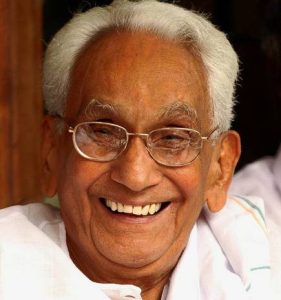
K Karunakaran
The 1977 election brought Kerala’s first 140-member Assembly. It also gave the Congress its second Chief Minister.
Karunakaran took office in March 1977. He lasted barely a month.
The fallout from the Rajan case forced his resignation on April 25, 1977 after adverse observations from the Kerala High Court.
The Congress then turned to a 37-year-old leader who was not even an MLA.
A. K. Antony became Chief Minister on April 27, 1977.
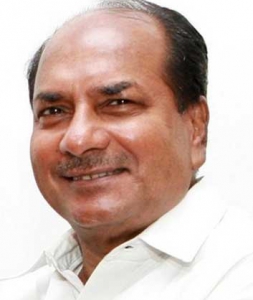
A K Antony
Later, he entered the Assembly through a by-election from Kazhakuttom after Thalekunnil Basheer vacated the seat for him.
Antony’s first tenure was brief too. In 1978, he resigned in protest against the Congress leadership’s stance during Indira Gandhi’s Chikmagalur by-election campaign. Antony had emerged as one of her fiercest critics after the Emergency years.
Karunakaran returned as Chief Minister in 1981. The government survived on a wafer-thin majority.
When Kerala Congress (M) leader Lonappan Nambadan withdrew support in March 1982, the government collapsed.
Fresh elections followed.
Karunakaran returned to power again in 1982. This time, his ministry completed a full five-year term — only the second Kerala government to do so after Achutha Menon’s.
The Congress returned again in 1991 with Karunakaran as Chief Minister.
Midway through the term came communal tensions, factional battles and finally the ISRO espionage controversy.
Pressure for leadership change intensified.
Karunakaran stepped down in 1995.
Antony returned as Chief Minister once again. Like in 1977, he entered the Assembly later through a by-election — this time from Tirurangadi after Muslim League MLA M. Rahmathulla resigned the seat.
Also Read: After CM lobbying, PR battle for ministerial berths begins in Kerala
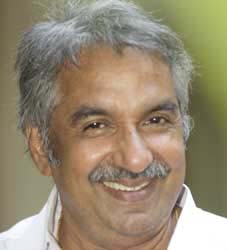
Oommen Chandy
The 2001 Assembly election gave the UDF 99 seats.
Antony became Chief Minister for the third time. Three years later, after the Congress performed poorly in the Lok Sabha elections and factional tensions escalated, he resigned.
That paved the way for the Congress’ third chief ministerial face in Kerala politics — Oommen Chandy.
Ironically, Antony himself proposed Chandy’s name.
Later, Oomen Chandy completed a full five year term in 2011.
Congress’ history in Kerala also carries another recurring pattern.
Several leaders who were widely seen as natural chief ministerial candidates never reached the post.
P.T. Chacko is the most prominent among them. Decades later, Ramesh Chennithala joined that list despite serving as Leader of the Opposition, after the LDF government led by Pinarayi Vijayan secured a second straight term in 2021. Had UDF won that Assembly election, Ramesh would have been the natural choice for CM post.
On the other hand, R. Sankar, A.K. Antony and Oommen Chandy became Chief Ministers without first serving as Leader of the Opposition.
Across ten Congress-led governments in Kerala, only four Congress leaders have occupied the chief minister’s chair — R. Sankar, K. Karunakaran, A.K. Antony and Oommen Chandy.
Out of those ten stints, only two Congress chief ministers completed full five-year terms: Karunakaran and Oommen Chandy.
That record perhaps explains why the present indecision inside the Congress feels less surprising than inevitable.
Kerala has seen this movie before.
Every Congress victory in the state seems to reopen the same unresolved question: who gets the crown, who waits, who compromises and who walks away wounded.
Even with 63 seats in hand, certainty has rarely been part of the Congress story in Kerala.



