

Published May 09, 2026 | 10:59 PM ⚊ Updated May 10, 2026 | 11:09 AM

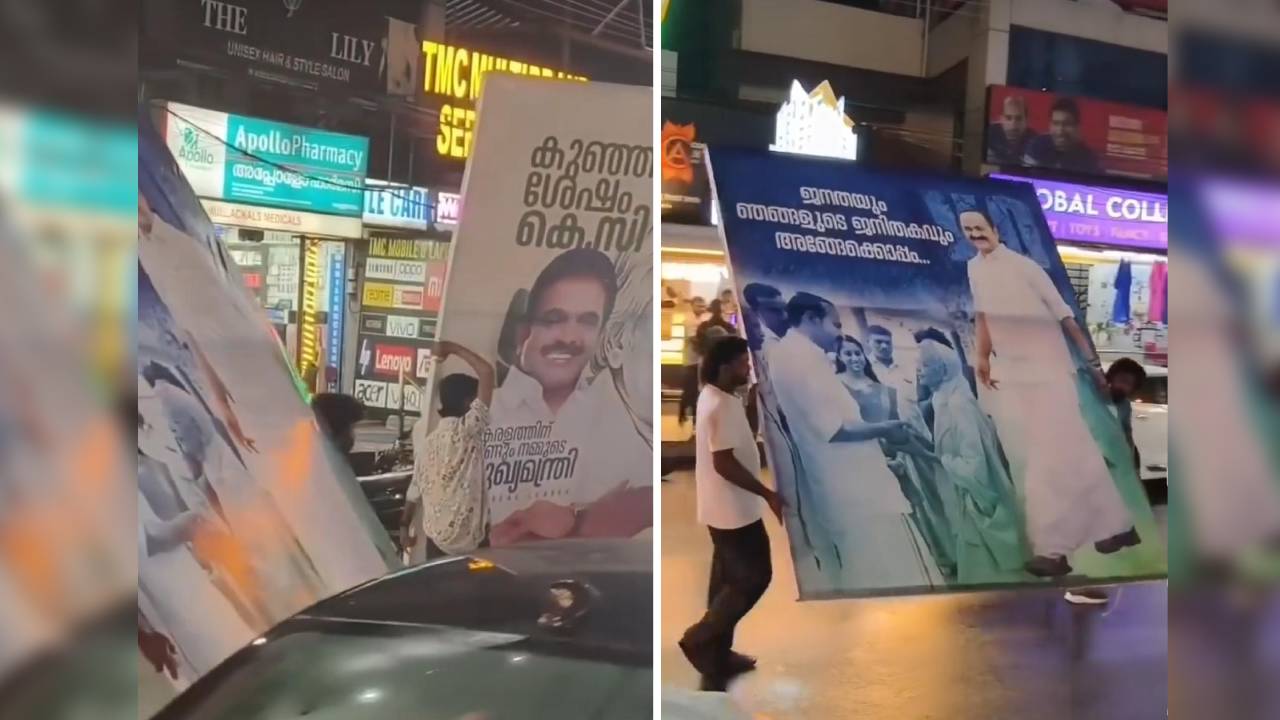
Party workers removing flex boards put up in support of the leaders.

Synopsis: The Congress victory in Kerala has swiftly given way to an intense leadership tussle, with AICC general secretary KC Venugopal emerging as the perceived frontrunner for the chief minister’s post. He reportedly has the backing of a sizeable section of newly elected members and the apparent confidence of the party high command. Yet, with no final decision from Mallikarjun Kharge and Rahul Gandhi, rival camps rallying behind VD Satheesan and Ramesh Chennithala, continue to hold their ground.
Days after the election results reshaped Kerala’s political landscape, AICC General Secretary KC Venugopal has emerged as the strongest contender for the chief minister’s post.
Sections within the Congress indicated that he remains the high command’s preferred choice amid growing support for him from newly elected members. Even so, the final call rests with Congress president Mallikarjun Kharge and Leader of the Opposition in Lok Sabha Rahul Gandhi, as the party leadership struggles to close the final chapter of government formation.
Party insiders also suggested that the central leadership is weighing the possibility of announcing the decision around midnight on Sunday, 10 May, calculating that a delayed declaration could soften the growing public outcry and internal pressure surrounding the leadership issue.
A high-stakes meeting held at Kharge’s residence in New Delhi on Saturday, 9 May, however, ended without a final decision on the leadership question, prolonging the suspense over who will head the new government.
The closed-door discussions, which began around 4 pm and lasted nearly three hours, failed to reach a consensus.
Emerging from the meeting, AICC general secretary in charge of Kerala Deepa Dasmunsi said a decision on the chief minister would be announced “very soon” and “in due time”. She did not set a timeframe.
The leadership vacuum also prompted the party high command to step in with a message of restraint.
The probable candidates — Satheesan, Chennithala and Venugopal — jointly appealed to party workers to avoid demonstrations, social media campaigns, flex boards or banners backing individual leaders in the race for the top post. They also urged their followers to remove publicity materials that were put up.
Such public displays, they cautioned, could damage the party’s image and risk sending out a message that undermines the mandate delivered by voters.
Also Read: Sorry, no Deepa Dasmunsi please; Maken and Wasnik are okay!
Even as the Congress central leadership weighs its chief ministerial choice in Kerala, Dasmunsi made it clear that the final decision on leadership would rest with the party high command—Kharge and Rahul Gandhi.
But asked when the suspense over the chief ministerial choice would end, she replied that there is time until 23 May.
KPCC president Sunny Joseph also sought to assuage the situation, asserting that the party would stand firmly behind the high command’s decision.
“We assured Kharge and Rahul Gandhi that whatever decision they take will be accepted without resentment. Party workers, too, will abide by it,” Joseph said.
He pointed out that the Congress Legislature Party (CLP) had already passed a resolution authorising the high command to select its leader, leaving no room for internal questioning once the decision is announced.
Earlier, Munsi cautioned party workers against public displays of factional support that have embarrassed the leadership. She issued a stern message to the party cadre, warning that the developments unfolding in the state demanded “serious introspection” despite the party’s emphatic electoral victory.
Speaking after discussions with Congress president Kharge, Munsi said the celebrations following the landslide mandate had crossed acceptable limits in several places. Protest marches, competitive flex boards and banners backing leaders for the chief minister’s post, she said, were not in keeping with the Congress culture.
The intervention came amid intensifying factional undercurrents over the chief minister selection process, with supporters of different leaders openly staking claim through public campaigns and displays across the state.
Also Read: Laddus, halted documentary and posters
According to sources aligned with the Venugopal camp, the senior leader has impressed upon the AICC leadership that the party must move swiftly to translate its electoral promises into visible governance measures to consolidate the post-election momentum in Kerala.
Venugopal is learnt to have conveyed that immediate rollout of the flagship “Indira Guarantee” programmes — particularly the proposal for free bus travel for women — could rapidly reshape public sentiment and reinforce the perception of a responsive government in its opening days.
At the same time, the camp maintained that Venugopal also flagged growing pressure from the party rank-and-file regarding recent confrontations with the police during the second Pinarayi Vijayan government.
He is said to have convinced the central leadership that once the new UDF government initiate prompt and visible action against officers accused of assaulting Congress workers—including Alappuzha MLA-elect AD Thomas—it would reassure the cadreand energise the organisation ahead of the government’s first political tests.
Satheesan and Chennithala, however, are learnt to have argued that the decision cannot rest on legislative numbers alone.
Both leaders reportedly stressed the importance of wider political considerations, including the ability to keep allies together, energise party workers at the grassroots and carry the organisation forward after the electoral verdict.
The seniority factor, too, was raised during the meeting, sources indicated.
All three leaders attended the discussions and later held separate one-on-one meetings with Kharge and Gandhi. With none of them willing to soften their position, the deadlock is understood to have continued through the meeting.
Even as Venugopal seems to be holding an edge, camps backing Satheesan and Chennithala maintained that their arguments were placed before the leadership in detail and expressed confidence that a favourable decision could still emerge.
They are also learnt to have flagged the political fallout and possible backlash in the state depending on who is eventually chosen.
Amid the stalemate, there is also speculation within party circles that the leadership could look beyond the three contenders and explore a consensus candidate capable of securing wider acceptability across factions.
However, none of the three camps has confirmed that such a move is under active consideration.
For all the confidence projected after the election verdict, the Congress now finds itself navigating the oldest challenge in its politics—managing ambition after victory.
With the leadership question still unresolved, the party high command appears determined to avoid a rushed decision that could reopen factional fault lines just when the Congress is preparing to return to power in Kerala.
Beyond doubt, even party leaders endorsed that, the delay itself begins to cast a shadow over an otherwise emphatic mandate.
(Edited by Majnu Babu).



