

Published Apr 22, 2026 | 6:05 PM ⚊ Updated Apr 22, 2026 | 6:10 PM

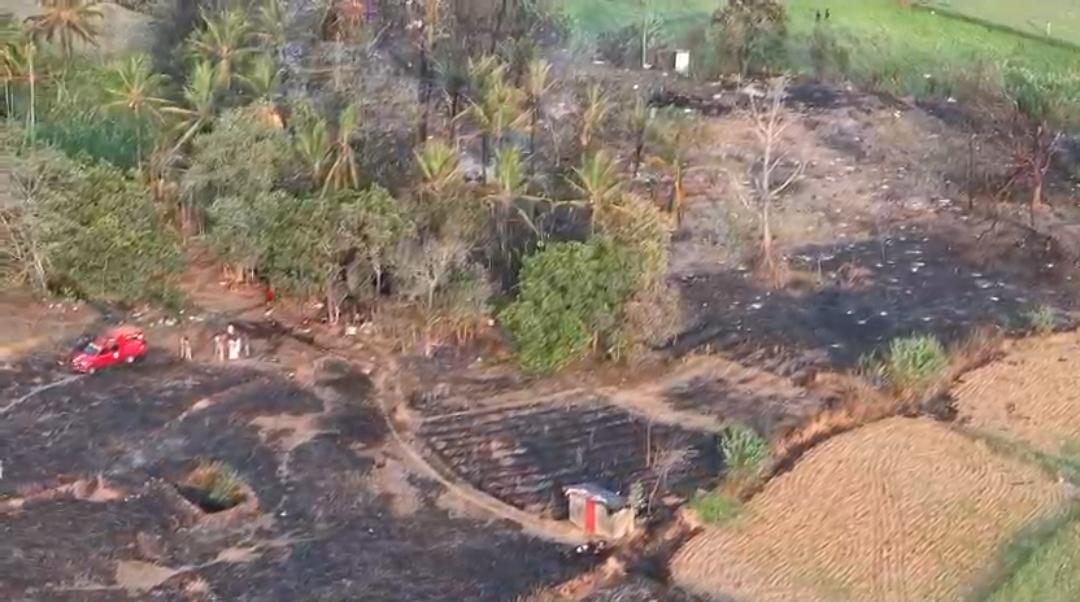
An aerial shot of the site where the blast occurred on 21 April.

Synopsis: The Kerala government has declared the Mundathikode fireworks explosion a state-specific disaster, ordered a judicial probe, and intensified rescue, medical, and identification efforts amid concerns of safety violations. The tragedy, which has cast uncertainty over the fireworks display at the upcoming Thrissur Pooram, has also triggered multi-agency investigations and renewed concerns over systemic failures in regulating fireworks manufacturing.
A day after the devastating explosion at Mundathikode in Thrissur that tore through a fireworks manufacturing unit and left at least 10 people dead, the Kerala government has moved to classify the incident as a “state-specific disaster,” enabling the release of dedicated relief funds and triggering a series of administrative and investigative measures.
Revenue and Housing Minister K Rajan announced the government’s decision after an emergency online Cabinet meeting convened in the presence of Chief Minister Pinarayi Vijayan on Wednesday, 22 April. The meeting was coordinated from the Thrissur Collectorate, where senior officials have been stationed since the tragedy unfolded.
Officials put the death toll at 10, following the death of Praveen, 45, on Wednesday. So far, eight identified bodies have been handed over to their relatives.
A total of 26 body parts were recovered from the site, underscoring the severity of the explosion.
Meanwhile, 11 injured persons continued to undergo treatment at various hospitals, including two on ventilator support. Health department officials said a few injured were sent home.
Also Read: At least 9 dead, dozens injured after explosion at fireworks unit
Invoking provisions introduced by the Disaster Management Division of the Union Ministry of Home Affairs in April 2025, the state government brought the incident under the category of a “state-specific disaster.”
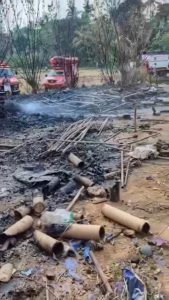
The scene, a day after the blast.
The framework allows states to utilise up to 10% of their annual allocations under the State Disaster Response Fund (SDRF) or National Disaster Response Fund (NDRF) for disasters not formally listed at the national level but deemed significant within local contexts.
Officials said the classification would ensure quicker financial assistance to victims and families, alongside logistical support for ongoing rescue and identification efforts.
The State Executive Committee (SEC) of the Kerala State Disaster Management Authority has been directed to immediately formulate a Standard Operating Procedure (SOP) covering all aspects of the aftermath—from handling remains and conducting DNA sampling to coordinating relief operations and documentation.
In a parallel move, the Cabinet ordered a judicial inquiry into the 21 April incident.
Former Kerala High Court judge Justice CN Ramachandran Nair will head the one-man commission tasked with examining the circumstances that led to the explosion.
The inquiry would look into licensing issues, compliance with safety norms, and the chain of responsibility involving organisers, contractors, and regulatory authorities.
The commission’s terms of reference will be released soon.
Also Read: 25 killed after powerful blast rips through Virudhunagar fireworks factory
At Mundathikode, the scale of destruction has left even experienced rescue personnel shaken.
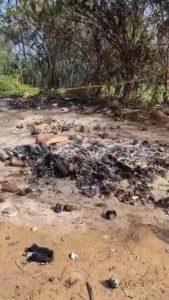
The site on 22 April
The explosion, which occurred around 3.30 pm on 21 April, flattened multiple sheds within a sprawling five-acre compound where fireworks were being prepared for the upcoming Thrissur Pooram.
The unit consisted of eight sheds. Five were engulfed in flames following the initial blasts, including three that reportedly stored large quantities of explosive materials.
The force of the explosions hurled debris across adjacent fields, shattered structures, and ignited nearby vegetation.
Body parts were strewn across the area, complicating both recovery and identification efforts.
Rescue operations, on 21 April, were slowed by continuous secondary explosions and the location of the site amid paddy fields with limited access routes. Fire and Rescue Services teams had to rely on earthmoving equipment to clear pathways before reaching the worst-hit zones.
Also Read: Majesty or misery? Tracing the history of parading elephants in Kerala’s festivals
Authorities said identifying victims would take time.
With many bodies severely disfigured or fragmented, DNA analysis has become the primary method of identification.
A specialised team from the Rajiv Gandhi Centre for Biotechnology has been deployed to assist in the process. Officials confirmed that samples were being collected and matched with relatives of those reported missing.
Minister Rajan described the situation as “deeply distressing,” noting that “only scattered remains were being recovered in several cases.”
Postmortem procedures were underway. A handful of bodies have been released to families, while others were being preserved pending identification.
Also Read: Constant survival struggle for ‘kings of the forest’
Medical teams across Thrissur have been placed on high emergency alert.
According to Cooperation and Devaswom Minister VN Vasavan, treatment was being administered on a war footing.
A coordinated effort involving specialists from multiple government medical colleges was underway. Surgeons, plastic surgeons, and trauma experts have been deployed to handle critical cases.
Of those injured, several remained in intensive care units, while others have been shifted to general wards after stabilisation. Health officials expressed cautious optimism about the recovery of some patients, though the condition of a few remained critical.
Also Read: The Bleeding Gods of Kerala
The investigation has brought together multiple agencies, including the police, Fire and Rescue Services, forensic experts, the Petroleum and Explosives Safety Organisation (PESO), and disaster response teams.
Thrissur MP and Union Minister Suresh Gopi visited the scene and indicated that a central team would also conduct an independent assessment.
He stressed the importance of forensic examination and cautioned about the possibility of unexploded materials remaining at the site. Additional cadaver dogs were expected to be deployed to assist in locating remains.
Authorities were also attempting to reconstruct the sequence of events leading up to the explosion, though progress has been hindered by the destruction of records that could have indicated how many workers were present.
In a related development, the Palakkad District Collector has ordered an immediate halt to operations at a gunpowder manufacturing unit at Vellaramkadavu, Muthalamada.
The facility had been involved in producing fireworks linked to Pooram celebrations.
The stop memo, issued through the local tehsildar, mandated a complete suspension of activities pending further investigation.
Preliminary findings suggested that the Mundathikode unit might have operated without proper authorisation and in violation of safety norms outlined under the Explosives Rules.
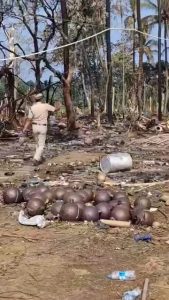
Diffused fireworks
Disaster Management Department officials indicated that the incident pointed to deeper systemic failures in the regulation and oversight of fireworks manufacturing for festivals.
Standard safety protocols required such units to operate only from licensed premises with approved layouts, adequate spacing between sheds, strict limits on the quantity of explosive materials, and controlled manpower in each unit.
Investigators suspected that several of these norms might have been flouted.
The incident also revived discussions around earlier recommendations made after the 10 April 2016, the Puttingal temple fireworks tragedy that killed over 100 people.
The PS Gopinathan Commission, which probed that tragedy, had called for rigorous risk assessments, mandatory inspections, and systematic testing of fireworks materials. It also emphasised training for manufacturers and workers, along with stricter enforcement of licensing norms.
Many of those recommendations, officials privately admitted, remained unevenly implemented.
However, Minister Rajan cautioned against jumping to conclusions and said the priority was on saving lives and identifying the victims.
The impact of the blast has cast a shadow over the conduct of fireworks during this year’s Thrissur Pooram.
Representatives of both Paramekkavu Devaswom and Thiruvambady Devaswom have said they would abide by the government’s decision.
Paramekkavu Devaswom Secretary G Rajesh indicated that public sentiment would also play a role in determining whether fireworks displays should proceed. Thiruvambady representatives echoed the need for a collective decision involving all stakeholders.
A meeting involving officials, Devaswom authorities, and other stakeholders has been scheduled for Thursday, 23 April, subject to necessary permissions from the Kerala High Court, particularly in light of the election code of conduct currently in force.
Eyewitness accounts painted a picture of sudden devastation.
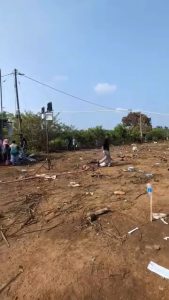
The site where firecrackers were made
Residents described hearing a deafening roar, followed by a series of explosions that shook the ground and sent plumes of smoke into the sky.
Within minutes, the site had turned into a raging inferno. Fire leapt from shed to shed, while debris rained down across surrounding fields. Trees caught fire, and thick smoke reduced visibility to near zero.
Those who rushed to help were forced to retreat repeatedly as fresh explosions erupted.
Even as official figures continued to be updated, one fact remained clear: the human cost has been staggering.
Families have been waiting for news, and many are uncertain about the fate of their loved ones. The absence of records has made it difficult to determine how many workers were present at the time of the explosion.
Authorities were now piecing together information from multiple sources—hospital records, missing person complaints, and local accounts—to establish a clearer picture.
At the same time, the tragedy has reignited a longstanding debate in Kerala—how to balance deeply rooted cultural traditions with the demands of modern safety standards.
For now, Mundathikode stands as a stark reminder of what can go wrong when that balance fails.
(Edited by Majnu Babu).



