

Published Apr 08, 2026 | 8:35 PM ⚊ Updated Apr 08, 2026 | 8:35 PM

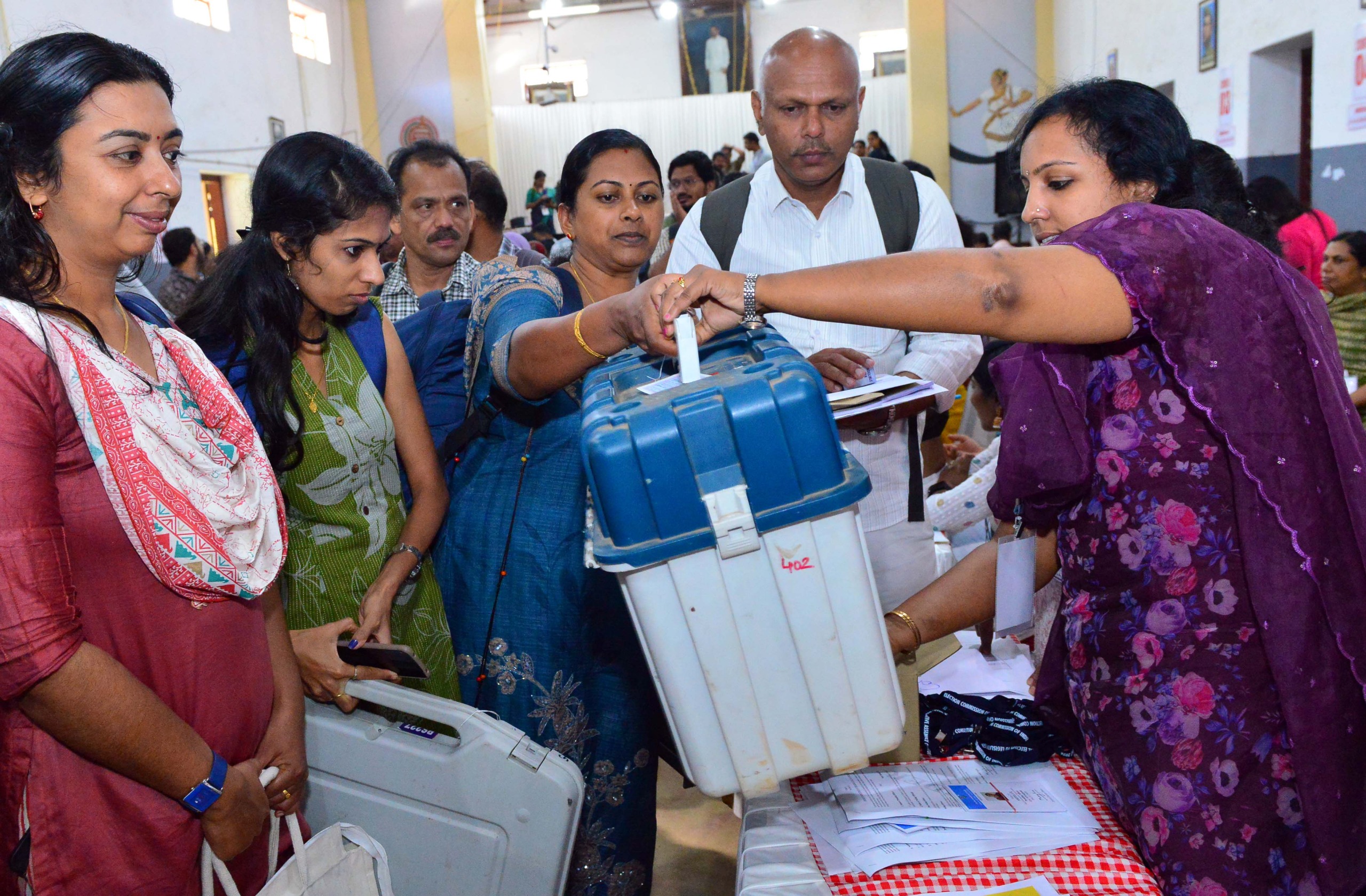
Distribution of polling materials ahead of polls on 9 April. (Supplied)
Synopsis: Kerala heads to the polls on 9 April, with 2.71 crore voters deciding the fate of 140 Assembly constituencies. A massive security and administrative grid is in place, while postal voting has sparked debate. With turnout targets set near 85%, the state awaits whether its electorate opts for continuity or change when results are declared on 4 May.
Kerala stands on the cusp of another electoral verdict. On 9 April, voters across all 140 Assembly constituencies will step out to decide the state’s political course, with polling scheduled from 7 a.m. to 6 p.m. The administrative machinery is in place, security grids are drawn, and a vast electorate is ready.
The scale of participation is striking. Kerala has 2.71 crore voters (2,71,42,952) this time — 1.39 crore women (1,39,21,868), 1.32 crore men (1,32,20,811), and 273 voters from the third gender category. Added to this are 2.42 lakh Non-Resident Indian voters (2,42,093) and nearly 54,000 service voters.
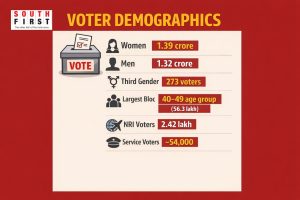
One segment quietly towers over the rest: those aged 40 to 49. With more than 56.3 lakh voters (56,32,036), this group forms the single largest demographic block. In an election shaped by welfare debates and development claims, their choices could tilt results in tightly fought constituencies.
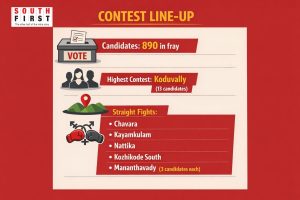
After weeks of nominations, scrutiny, and withdrawals, 890 candidates remain in the fray. The number is marginally lower than the 957 who contested in 2021, but the contests remain intense.
Koduvally in Kozhikode district once again lives up to its reputation, with 13 candidates in the race. At the other end, constituencies like Chavara, Kayamkulam, Nattika, Kozhikode South, and Mananthavady will see straight contests with just three candidates each.
The variation hints at the uneven political terrain — crowded multi-cornered battles in some regions, tightly framed fights in others.
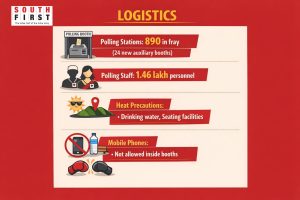
Polling will take place across 30,495 stations, including 24 newly added auxiliary booths. These have been set up in northern districts such as Kasaragod, Kannur, Malappuram, and Palakkad to ensure that no booth has more than 1,200 voters.
With April heat a concern, arrangements include drinking water and seating facilities at polling stations. Mobile phones will not be permitted inside; voters will need to deposit them at designated counters before entering.
A massive workforce of 1.46 lakh polling personnel has been mobilised to manage the exercise.
Security deployment reflects the scale of the exercise. More than 76,000 police personnel, including over 28,000 special officers, have been assigned election duty. The state has been divided into 154 election subdivisions, each overseen by senior officers.
Of the polling booths, around 2,500 have been identified as critical. Reinforcements include 140 companies of Central Armed Police Forces and 20 companies from Tamil Nadu.
Officials say the arrangements are designed to ensure a smooth and transparent polling process across all districts.
Voting has already taken place for several categories. Among voters aged 85 and above who opted for home voting, 98 percent have cast their ballots.
Postal voting has also seen substantial participation. Of the 34,128 election officials who applied under the relevant provisions, nearly 85 percent have already voted. Similarly, over 96 percent of elderly voters and more than 97 percent of differently-abled voters who opted for home voting have exercised their franchise.
At the same time, the postal voting process has emerged as an unexpected flashpoint in the run-up to polling, drawing sharp reactions from both the opposition and election authorities.
CPI(M) state secretary M.V. Govindan has raised concerns over what he describes as procedural complications affecting election staff. In his view, the shift away from the earlier system — where postal ballots could be delivered to voters — has created avoidable hurdles.
Under the present arrangement, eligible voters must visit designated facilitation centres to receive and cast their ballots within a fixed window. According to him, this has led to delays and uncertainty, with many officials unsure about timelines and procedures. He has argued that the lack of clarity and the time-bound nature of the process could prevent a section of employees from exercising their franchise.
Leader of Opposition V.D. Satheeshan has taken the matter further, writing to the Election Commission of India seeking urgent intervention.
In his communication, he points to multiple complaints from government employees across districts who were unable to access postal ballots at facilitation centres. He notes that the earlier home-delivery model had made participation easier, while the current requirement to physically visit centres between 1 April and 8 April has introduced practical constraints.
He has also highlighted the situation of health department personnel — doctors, nurses, and paramedical staff — many of whom are on compulsory duty linked to election arrangements. Their schedules, he argues, leave little room to travel to facilitation centres within the stipulated timeframe.
Satheeshan has called for an extension of the facilitation period and additional measures to ensure that no eligible voter is left out due to logistical issues.
Election authorities have rejected the suggestion that voters are being excluded, maintaining that the system is functioning as intended.
Chief Electoral Officer -Kerala Dr. Ratan U. Kelkar has stated that structured arrangements have been put in place to assist all eligible voters, particularly those on election duty. According to officials, 154 voter facilitation centres have been operating across the state from 7 a.m. to 6 p.m., with additional access points at training centres on 6 and 7 April, and at distribution centres on 8 April.
Control rooms have been set up in each returning officer’s office to directly coordinate with polling personnel, ensuring they receive timely information about where and how to vote. Help desks and signage have also been deployed to guide voters at these centres.
Officials point to participation figures to support their position. Of the 34,128 election staff who applied for postal voting, 28,990 — roughly 85 percent — have already cast their votes. High turnout has also been recorded among elderly and differently-abled voters who opted for home voting.
To encourage participation, polling day has been declared a paid holiday under the Representation of the People Act. This applies to all employees, including daily wage and casual workers.
Even those working outside their constituency are entitled to leave to travel and vote. Employers violating these provisions face penalties.
In 2021, the state recorded a voter turnout of 74.06 percent. Yet, the real story of 2021 lay not in turnout figures, but in what voters chose to do with their mandate.
For decades, Kerala’s electorate had followed an almost predictable pattern—swinging between two coalitions every five years. That rhythm was disrupted decisively.
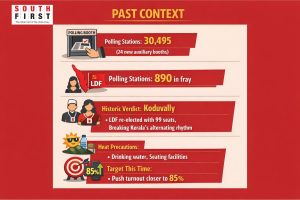
LDF, led by CM Pinarayi Vijayan, returned to power with 99 seats, improving on its already strong showing of 92 seats in 2016. It marked the first time in Kerala’s modern political history that an incumbent government was voted back with such clarity.
The numbers told a deeper story of consolidation.
LDF’s vote share climbed to 45.28 percent, up from 43.35 percent in the previous Assembly election. In raw terms, that translated to over 94 lakh votes. Even more striking was the contrast with the 2019 Lok Sabha polls—the Left front secured 10.73 percentage points more in 2021, pointing to a significant shift in voter mood between national and state contests.
UDF, meanwhile, found itself struggling to convert incremental gains into electoral success. Its vote share in 2021 edged up by 0.78 percentage points compared to 2016, but this marginal improvement did little to alter its position. The alliance ended with 41 seats, well below the threshold needed to mount a serious challenge.
Compared to its 2019 Lok Sabha performance, UDF’s vote share actually dropped by 7.87 percentage points, suggesting a loss of momentum at the state level.
To understand 2021 fully, one has to look back at 2016. That election had already signalled a shift in Kerala’s political landscape.
LDF had returned to power with 92 seats, holding a vote share of 42.58 percent, maintaining a clear four-point lead over UDF, which slipped to 38.6 percent. The seat gap was wide enough to be described as a landslide, even within Kerala’s tightly contested electoral culture.
2016 also marked a moment of disruption in another sense.
BJP opened its account in the Assembly for the first time, with senior leader O. Rajagopal winning from Nemom in Thiruvananthapuram. With a vote share of 14.62 percent, BJP’s presence hinted at a potential shift away from the state’s long-standing two-front system.
That possibility, however, did not sustain itself in 2021.
BJP-led NDA lost its lone seat, with its vote share slipping to 12.47 percent. The result effectively restored the bipolar nature of Kerala politics, even as it underscored the limits of BJP’s expansion in the state.
The 2021 verdict carried significance beyond Kerala.
At a time when Left governments had receded in states like West Bengal and Tripura, Kerala stood out as an exception. The electorate not only retained the Left but did so with a stronger mandate, signalling a rare instance of pro-incumbency in a state known for its critical and often alternating voter behaviour.
This time, election authorities had set their sights on significantly raising voter participation, aiming to push turnout levels to around 85 percent, even hinting at surpassing the long-standing benchmark of 80.5 percent set in 1987.
Whether a higher turnout sharpens anti-incumbency or strengthens the incumbent’s hold remains an open question.
In Kerala, where even small shifts in voter behaviour can redraw the political map, participation levels often carry signals beyond the numbers. For now, the speculation will continue—but the answer, as always, rests with the ballot.
4 May will tell whether the state leans toward continuity or change.


