

Published Sep 07, 2026 | 5:00 PM ⚊ Updated Sep 07, 2026 | 5:00 PM

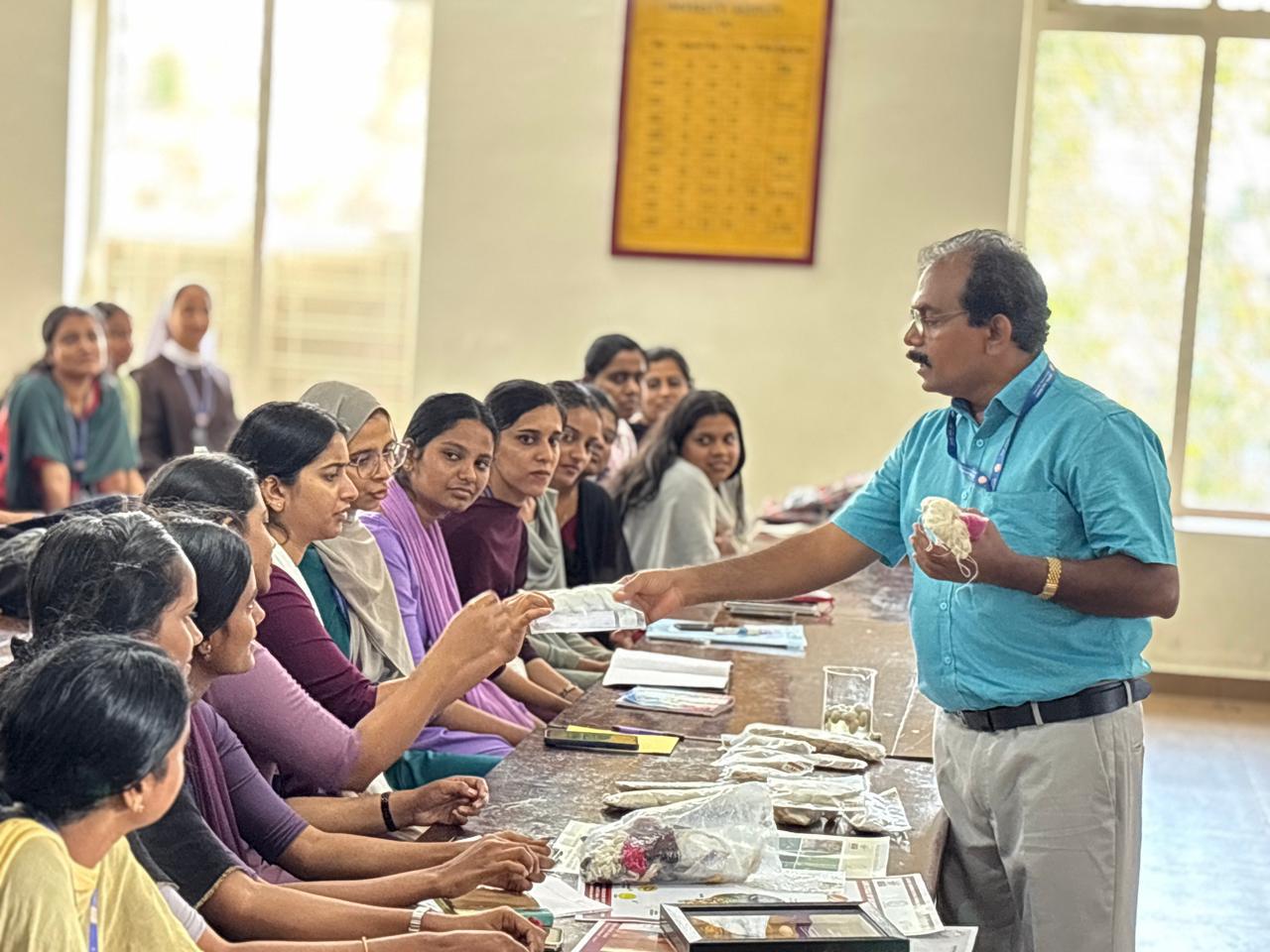
One of the technical sessions conducted at the campus on sericulture.

Synopsis: Students of Vimala College in Thrissur have turned a small classroom experiment with silkworms into V-Weave. This ambitious campus start-up aims to take sericulture from mulberry cultivation to a campus-branded Keralam silk saree and shawl. The initiative hopes to inspire young entrepreneurs and open the door to a larger silk economy in Keralam, creating new opportunities in farming, production, design and livelihoods.
A handful of silkworms, which a group of students fed out of curiosity with leaves from a mulberry tree on a college campus, have now spun a much bigger dream.
Students of the Zoology Department at Vimala College, Thrissur, have entered the world of sericulture—farming mulberry trees, rearing silkworms and harvesting silk cocoons.
What began as a small experiment has grown into an ambitious campus start-up with dreams of producing campus-branded silk sarees and shawls.
At the college’s off-campus site at Padukad, students are learning an industry not merely from textbooks but from the soil, the mulberry leaf and the silkworm. V-Weave is a first-of-its-kind sericulture campus start-up led by Zoology students.
The college also claims the rare distinction of being the first college campus in Keralam to take up silkworm cultivation in this manner.
The project has a larger purpose: to introduce young people to an agro-based industry that could eventually become a source of entrepreneurship and livelihood.
“We are trying to bring students from the campus to the silk industry and make them self-sufficient. This initiative will help in developing entrepreneurial awareness among students,” Principal Prof. (Dr.) Sister Beena Jose said.
Also Read: Catching Gen Z founders early in India
The story of V-Weave can be traced back to an award the college’s Bhoomithrasena Club received. The club is a student-led initiative functioning under the Directorate of Environment and Climate Change, Kerala.
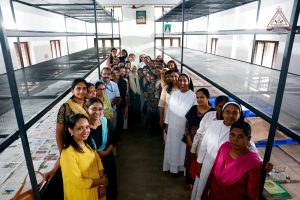
The team behind the V-Weave initiative.
The club received the State-Level Best Bhoomithrasena Club Award last year, along with a small cash prize.
The students and teachers began discussing how to put the money to meaningful use.
The initial plan was simple. The college has an off-campus site at Padukad spread over four to five acres, and about one acre was to be used for planting fruit trees.
But another idea soon took root.
Sericulture is part of the Zoology syllabus, and students are required to study the agro-based industry of rearing silkworms for the production of raw silk. Why not create a facility where students could gain practical experience instead of limiting their learning to classrooms?
Around this time, the Silk Mark Organisation of India (SMOI), Palakkad chapter, organised a session for the students.
PC Johny, Senior Technical Assistant with SMOI, handled the session and brought silkworms.
At the end of the programme, a few silkworms were handed over to the department to be preserved as specimens.
“But curiosity took us in another direction,” recalled Prof. (Dr.) Feebarani John, Head of the Zoology Department and the originator of the V-Weave initiative.
The college had a mulberry tree on its campus. The students began feeding the silkworms with its leaves.
A few days later, they spotted cocoons.
That small experiment changed the original plan. The proposed orchard gave way to mulberry cultivation and silkworm rearing.
“Once the idea materialised, we began visualising it as a start-up that could give students an understanding of entrepreneurship and eventually become a source of income,” Feebarani said.
Also Read: Fifth-grader from Telangana who made social media stop and listen
The project received technical support from the sericulture sector.
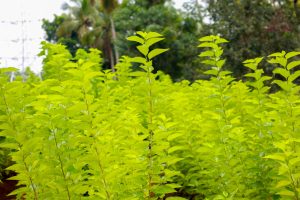
V-1 variety of mulberry.
Siamala M, Scientist-D, and Anitha, Senior Technical Assistant at the Silkworm Seed Production Centre, Palakkad, were immensely helpful to the initiative, the college authorities said.
The students began cultivating the V-1 variety of mulberry, also known as Victory-1. It is a dominant irrigated mulberry variety in South India, particularly in Karnataka, Andhra Pradesh and Tamil Nadu.
Developed at the Central Sericultural Research and Training Institute, Mysuru, V-1 is known for its high leaf productivity. Under irrigated conditions, it can yield around 60 to 70 tonnes of leaves per hectare annually. Its thick, succulent leaves, with high moisture content, make it suitable for silkworm rearing.
The students also received silkworm moths in the double-hybrid laying category in August.
Their efforts soon produced results. On 2 September, the students harvested their first batch of silk cocoons.
For the young participants, the harvest was more than an academic exercise.
It was the first tangible product of a process they had watched from its earliest stages—from raising mulberry plants to feeding silkworms and finally seeing them spin their cocoons.
The initiative is being carried out in collaboration with the Central Silk Board, the Silk Mark Organisation of India and the Poverty Alleviation Department of the state government.
“We aim to bring out a campus-branded Keralam silk saree eventually,” Feebarani said.
The department has already drawn up plans for the next stages of the project.
A mulberry nursery is on the cards, along with awareness classes for local people interested in sericulture.
The team is also planning to develop value-added products from cocoons, with work on that front expected to begin in October.
But the biggest dream is to take the silk produced through the initiative further down the value chain.
“We want to bring out a silk saree and a Keralam shawl from the silk produced here this year itself. We may join hands with the Khadi Board for this purpose,” Feebarani said.
Watch: Barefoot College celebrates 50 years of working with rural communities
Though said to have immense potential, the stark reality is that sericulture has yet to gain a major foothold in Keralam.
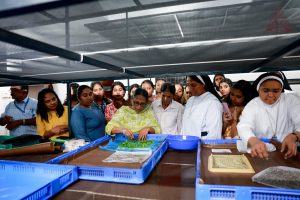
From one of the training sessions carried out at the campus on feeding mulberry leaves to silkworms.
At present, the industry has a limited presence in only a few districts, including Thrissur, Palakkad, Wayanad and Idukki.
Agriculture Department officials point to Karnataka as an example of what a strong sericulture sector can achieve.
Sericulture has long been an integral part of Karnataka’s rural economy, helping create livelihood opportunities and strengthen rural communities.
Karnataka’s leadership in bivoltine silk production and the substantial incomes earned by many sericulturists demonstrate the sector’s economic potential, officials said.
A similar model, adapted to Keralam’s conditions, could create new opportunities here as well.
“If Vimala College is taking up such an initiative by bringing young minds into the sector, it is laudable,” an official said.
The challenge, however, does not end with the harvesting of cocoons.
An Assistant Sericulture Officer echoed the concern, saying that Keralam’s efforts in sericulture should also focus on what happens after cocoon production.
“Greater attention must be given to the post-cocoon sector, particularly silk marketing, positioning and branding. Consistent quality standards and stronger testing mechanisms are important for building consumer trust,” the officer said.
For the V-Weave team, this is precisely where the campus experiment hopes to travel—from cultivation to cocoon, and eventually to yarn, fabric, design and a finished product.
The initiative received a major endorsement when Chandy Oommen, MLA, inaugurated V-Weave and the first silk cocoon harvesting programme.
“Keralam should have a silk economy. The potential of sericulture initiatives should emerge from campuses in a way that will boost the state’s economy,” he said.
Sericulture and the silk industry are highly relevant to the self-employment sector, he noted.
A silk economy, encompassing the entire chain—from agriculture and silkworm rearing to yarn production, weaving, design, branding, marketing and export—could strengthen Kerala’s economy.
Other colleges, he said, should consider the Vimala College initiative as a model.
“An integrated project like a Silk Economy Mission should be started, focusing on colleges in the state. This campus initiative at Vimala College will be brought to the attention of the Chief Minister,” Chandy Oommen said.
For now, the journey has begun with mulberry leaves and a group of students willing to experiment.
At Padukad, the cocoons harvested this week carry within them a much larger possibility: a subject taught in a Zoology classroom could one day become an enterprise, a livelihood and perhaps even the beginning of a distinctly Keralam silk identity.
(Edited by Majnu Babu).



