

Published Apr 08, 2026 | 2:31 PM ⚊ Updated Apr 08, 2026 | 2:31 PM

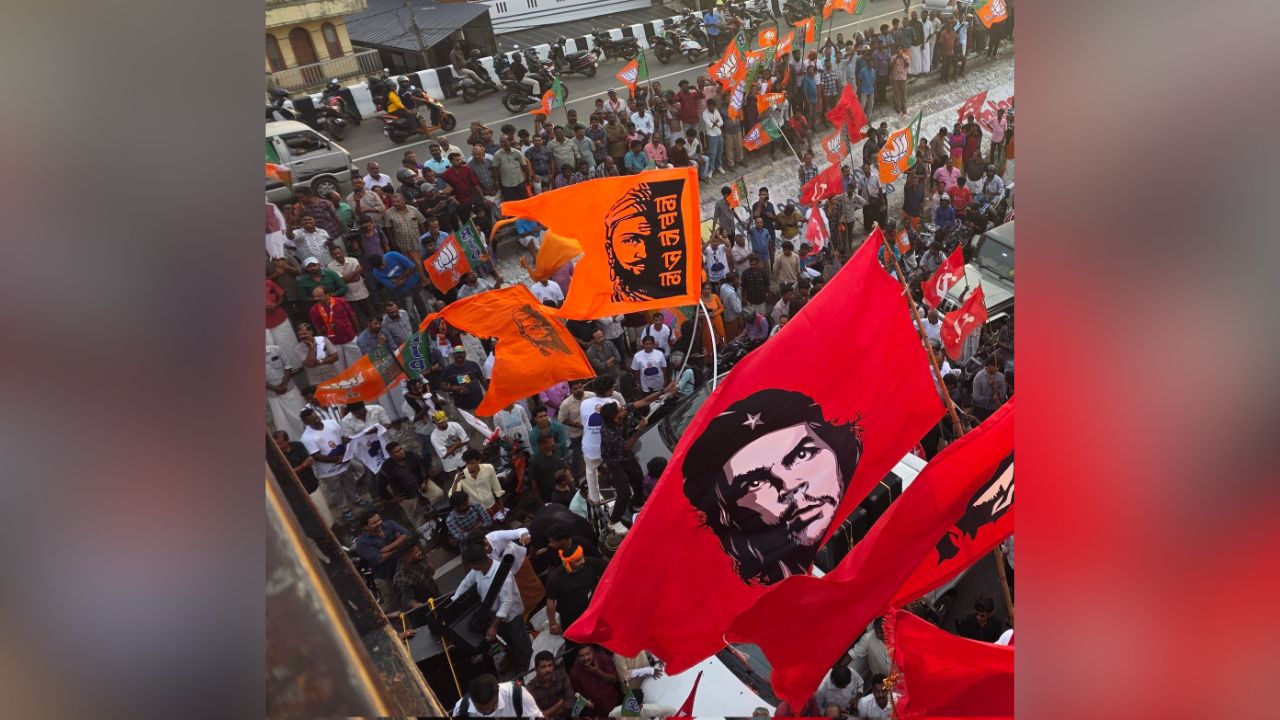
An image from a poll rally in Thiruvananthapuram. (RajeevRC.FB/Facebook)
Synopsis: On the eve of polling, southern Kerala isn’t swinging in one clear direction; it’s fragmenting, with voters caught between judging a decade-old government and the familiar faces they deal with every day, leaving contests tighter and more unpredictable than they appear. For Pinarayi Vijayan’s LDF, the bet rests on local credibility holding firm against a quiet but uneven undercurrent of fatigue that the UDF hopes will finally tip the balance.
With only a few hours left before the state moves to polling stations on 9 April, the political mood across southern Kerala feels less like a wave and more like a quiet churn.
There is no single emotion binding voters across Thiruvananthapuram, Kollam, Alappuzha, and Pathanamthitta. Instead, there are fragments — approval here, irritation there, hesitation everywhere.
Thirty-nine constituencies stretch across this southern arc —14 in Thiruvananthapuram, 11 in Kollam, nine in Alappuzha, and five in Pathanamthitta. On paper, it is a compact region. On the ground, it is a maze of local equations.
At the heart of this election lies a deceptively simple question: Will voters judge the government, or the MLA they know?
For the ruling LDF led by Chief Minister Pinarayi Vijayan, the gamble is clear. Renominate incumbents, lean into local performance, and trust that familiarity outweighs fatigue. For the UDF, the hope runs in the opposite direction; 10 years of continuous governance by the LDF accumulated enough discontent to override individual goodwill.
Meanwhile, the NDA is watching closely, almost patiently. Their pitch is sharper this time, less about isolated gains and more about reshaping the contest itself. Its argument — that the LDF and UDF are not rivals but variations of the same political habit — is aimed at voters who feel let down by both fronts. Discontent, in this reading, is not just a mood but an opening.
Whether that message lands is another question. But the NDA senses movement in the margins—first-time voters, the quietly frustrated, those who have drifted between fronts without finding much to hold on to.
Across Kerala, the narrative has been framed as a test of anti-incumbency against the decade-long rule of Chief Minister Pinarayi Vijayan and the LDF. But in the South, that narrative keeps splintering.
Here, elections are not being discussed in abstract terms like governance fatigue or macroeconomics alone. It’s more about who showed up when needed.
Southern Kerala does not speak in one voice. It murmurs, argues, weighs and often refuses to commit.
In Thiruvananthapuram city, the conversations are sharp but inconclusive. In Kollam’s interiors, loyalty and personal equations still hold surprising weight. In Alappuzha, rebellion within the Left has unsettled old certainties. In Pathanamthitta, fatigue is visible — but not always decisive.
What emerges is not a sweeping anti-incumbency wave, nor a uniform endorsement of sitting MLAs. It is something more layered.
A voter in Kazhakootam puts it bluntly: “We are not voting for a government. We are voting for the person we see every week.”
Yet another, barely a kilometre away, shrugs: “This time, it’s about change. Too many years, same faces.”
Both sentiments exist. Often within the same household.
By fielding a large number of sitting MLAs again, the Left has made a deliberate wager: Constituency-level performance can absorb whatever dissatisfaction exists with the government as a whole.
The Opposition UDF is making the opposite bet. Its leaders argue that ten years is long enough, that fatigue — visible in local body elections and parliamentary trends — will eventually seep into every booth, no matter how strong the local candidate appears.
Between these two claims lies the voter.
In the capital district, the mood is anything but decisive.
Nemom, Vattiyoorkavu and Kazhakootam — three seats often spoken about in the same breath — tell three slightly different stories.
In Nemom, the conversation has narrowed. Many voters quietly describe it as a direct contest between V Sivankutty and Rajeev Chandrasekhar. Congress candidate KS Sabarinadhan still figures in the arithmetic, but on the ground, some feel the race has tightened into two poles.
Usha, a tailor in Estate ward, shrugs when asked for a prediction. Development has happened, she said. But that doesn’t make the outcome obvious. Shahul, a teashop owner, offered a similar answer. He senses a close fight but avoids naming a winner.
Not everyone agrees that Congress has faded. A roadside tender coconut vendor, Chellappan, insisted the contest is still triangular, even if uneven. What stands out is not consensus, but hesitation. Voters are weighing quietly.
Kazhakootam is harder to read. It’s a constituency of contrasts — IT professionals, migrant workers, coastal families. Sitting MLA Kadakampally Surendran of LDF retains organisational strength, but V Muraleedharan has injected new energy, particularly among newer residents. Congress candidate Sharatchandra Prasad is present, though not dominant.
An autorickshaw driver near Technopark put it plainly: Activity is visible from all sides, but dominance is not. A vegetable vendor shifts the focus — roads, waste, water. Promises versus lived reality. That gap, she suggests, may decide votes more than party slogans.
Vattiyoorkavu moves in yet another direction. Here, no one is willing to write off anyone. LDF’s VK Prasanth has a record. K Muraleedharan brings familiarity. R Sreelekha represents a growing third force.
Raveendran, a grocery shop owner, summed it up best: “Everyone has something going for them. That’s why it’s confusing.”
In these three constituencies alone, one pattern is clear — there is no sweeping anti-incumbency. But neither is there unquestioned loyalty.
If Thiruvananthapuram is about tight contests, Kottarakkara in Kollam is about something else, loyalty being tested.
KN Balagopal, the sitting MLA and finance minister, is contesting on a record of visible development — IT parks, institutional projects, and infrastructure upgrades. His campaign has been methodical, almost relentless.
On the other side stands Aisha Potty, once a CPI(M) face, now the UDF candidate. Her personal popularity cuts across party lines. Even those who disagree with her switch admit to a lingering affection.
This is where the equation gets complicated.
A shopkeeper praised Balagopal’s performance without hesitation. Another voter, equally firm, says Potty “was always accessible” and still commands goodwill.
The contest has an unusual tone. It isn’t framed as good versus bad, but good versus good. Even committed party workers admit to a certain emotional confusion.
Add to this R Reshmi, herself a party-switcher, and the contest becomes less about ideology and more about individual equations.
What stands out in Kottarakkara is not anti-incumbency. It is confusion; of loyalties, of perceptions, of choices.
Balagopal may have the organisational edge. But Potty’s personal connect has introduced an emotional dimension that numbers alone cannot capture.
Still, there is a sense that organisation may outweigh sentiment here.
In Alappuzha’s Ambalappuzha, the script flips. Here, anti-incumbency is not just directed at the government — it has taken the form of rebellion within the ruling camp.
G Sudhakaran, once a towering figure in the CPI(M), has walked out and is now contesting with UDF backing. His opponent, H Salam, represents the official party line.
The irony is hard to miss. Salam once managed Sudhakaran’s campaigns. Now they are on opposite sides.
However, the presence of a familiar face now standing against the party has created unease within its own ranks.
The contest has turned deeply personal. For some voters, it is about loyalty — to the party or to the individual. For others, it is about fatigue with internal power struggles.
Francis, a fisherman in the area, said, “We know Sudhakaran. We have seen him for years. That matters.”
Another voter, Raveendran, countered, “If everyone who loses a position leaves the party, what does that say?”
Ambalappuzha is no longer just a constituency. It is a test case for how much internal dissent can amplify anti-incumbency.
Voters there are not just choosing between candidates; they are navigating questions of loyalty, betrayal, and change.
For some, Sudhakaran represents continuity of a different kind. For others, his shift reinforces doubts about political opportunism.
In Aranmula, the narrative turns again.
Health Minister Veena George is campaigning on development, roads, electricity, and welfare outreach in remote areas. Yet the pushback is sharper here than in some neighbouring constituencies.
UDF candidate Abin Varkey has focused his campaign on the idea of accumulated fatigue. Ten years, he argued, is enough. The BJP’s Kummanam Rajasekharan adds a third axis, making the contest harder to call.
Here, anti-incumbency is more visible. Conversations often drift toward governance issues, especially in the health sector. Yet, it is not overwhelming.
A resident from a rural pocket acknowledged improvements in infrastructure but questions whether they have been evenly distributed. Another voter said, “Work has been done. But people are not fully satisfied.”
This is the paradox of Aranmula. Dissatisfaction exists, but so does recognition of work done.
The result is a contest that feels open; less about sweeping sentiment, more about turnout and last-minute decisions.
Kerala’s political instinct has long been cyclical. For decades, power see-sawed between the LDF and the UDF every five years. That rhythm was broken when Pinarayi Vijayan led the LDF to consecutive wins in 2016 and 2021 — the latter emphatic, with 99 seats and over 45 percent of the vote.
Yet, beneath that break from tradition, recent signals suggest a reset may be underway. The UDF’s commanding performance in the 2025 local body polls did more than boost morale; it hinted at a restlessness that is now shaping the larger contest.
There is irritation, and even fatigue, but it refuses to consolidate into a single sweeping sentiment.
Economic anxieties sit at the centre of voter conversations. Then there are governance concerns. Allegations ranging from corruption to lapses in law and order have lingered in public discourse. Delayed welfare payments, instances of custodial deaths, and complaints about an increasingly centralised style of administration have added to the unease.
Local issues complicate the picture further. Human-wildlife conflicts in forest fringe belts and other issues create microclimates of anger that vary from constituency to constituency.
Sensing opportunity, the UDF has gone all in. The message of “change” is landing, but whether it translates into votes uniformly across the state remains uncertain.
The LDF, for its part, is not conceding ground easily. It leans heavily on its governance record, claiming to eliminate extreme poverty, large-scale housing schemes, infrastructure expansion, and crisis management during floods and the pandemic.
Equally crucial is its organisational depth. The cadre network remains disciplined and deeply embedded, capable of mobilising support at the booth level.
The contest is not binary everywhere. The BJP-led NDA, though unlikely to challenge for power, has expanded its footprint. It could influence outcomes in tightly fought seats, particularly in the south. Even a handful of seats swinging due to triangular contests could alter the broader arithmetic.
As one UDF leader put it, “What we are witnessing is not a wave election. It is a mood election; subtle, layered, and deeply local. In such a scenario, victory is rarely loud; it is assembled quietly, seat by seat.”
That, perhaps, is the larger picture. Anti-incumbency exists; few deny it. But it is diffused, inconsistent, and entangled with countervailing factors: Welfare delivery, organisational strength, and opposition fragmentation.
(Edited by Muhammed Fazil.)


