

Published Aug 19, 2026 | 7:30 AM ⚊ Updated Aug 19, 2026 | 7:30 AM

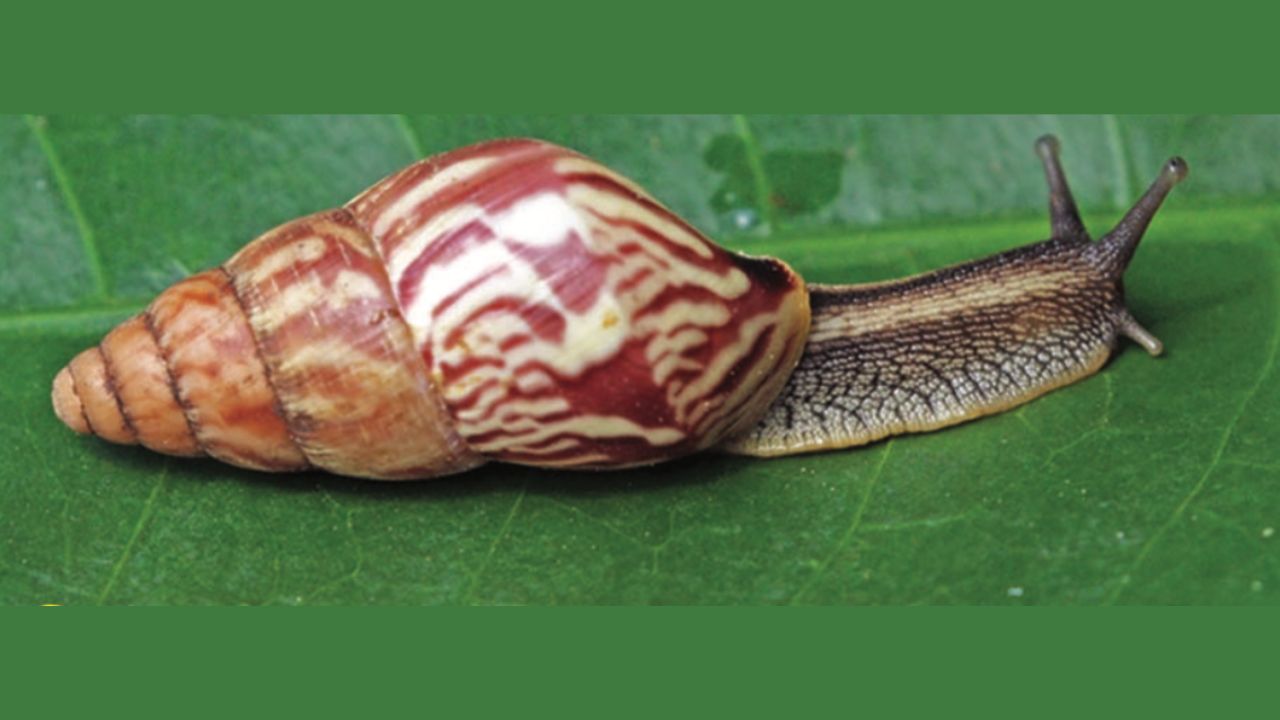
The Giant African Snail (Courtesy: KAU)

Synopsis: Kerala is seeing a fresh surge in Giant African Snail infestations after weeks of rain, with the invasive pest spreading from farms and homes to even school campuses across several districts. Farmers, residents and authorities are being urged to act together to contain the fast-breeding snail, which threatens crops, native ecosystems and public health.
The rains may have eased across Kerala, but they appear to have left behind another problem for the state’s farmers.
With the weather turning largely dry and sunny after spells of heavy rain, the Giant African Snail is once again making its presence felt in several parts of Kerala, triggering concern over fresh infestations and the possible spread of the invasive pest. Scientifically known as Achatina fulica Bowditch, the species is considered one of the most destructive land snail pests in the world.
The latest reports of significant infestations have come from Idukki, Thrissur, Kannur, Malappuram and Kottayam districts.
The prolonged spells of rain and the resulting high moisture levels have created favourable conditions for the pest to multiply rapidly.
The Kerala Agricultural University (KAU) has called for a coordinated response involving local self-government bodies, various government departments, farmers and the general public. According to the university, containing the pest at an early stage is critical, as community-level intervention can play a major role in preventing its spread to new areas.
The Food and Agriculture Organization (FAO) lists it among the major invasive pests, while the Global Invasive Species Database has placed it on its list of the “100 World’s Worst” invasive species.
The snail has been reported to feed on at least 500 plant species.
This snail is also regarded as a public health concern because it can act as a carrier of organisms responsible for human diseases.
Also Read: ‘Have we lost Wayanad forever?’ A resident’s anguished plea
From school campuses in Malappuram to residential areas and farmlands in Kottayam, Thrissur, Idukki and Kannur, the Giant African Snail, the invasive pest is multiplying rapidly, damaging vegetation and raising concerns over possible health risks.
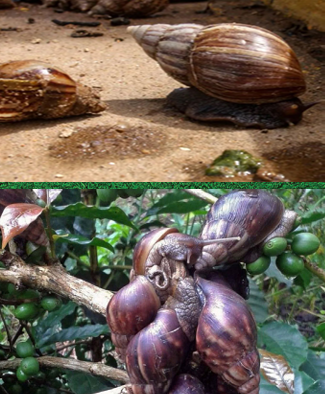
Giant African Snail
courtesy – KAU
In Thirunavaya panchayat in Malappuram, the infestation has now reached school premises, turning playgrounds, compound walls and even classroom surroundings into breeding grounds for the snail.
Teachers say removing the snails has become part of their daily routine, while students are being repeatedly warned against touching them.
The presence of the snails in areas frequented by children has added a health dimension to what was initially seen mainly as an agricultural nuisance.
Health experts have warned that Giant African Snails can act as carriers of the rat lungworm parasite (Angiostrongylus cantonensis), which can cause eosinophilic meningitis in humans.
Contact with snail mucus may also cause allergic reactions in some people.
Thirunavaya has been dealing with the infestation for several years, but its spread into school campuses has caused fresh concern. Children are particularly vulnerable to accidental contact as they play on grounds, walk along walls and move around areas where the snails are found.
The problem has also been reported from Poonkunnam in Thrissur, where residents have raised complaints over the presence of giant African snails.
In Kaduthuruthy panchayat in Kottayam, residents say the infestation has been worsening for months, particularly in the fourth ward covering Pulikkuttummel, Ethakuzhi and Kapikad areas.
Hundreds of snails can be seen clinging to roadside walls, house compounds, wells and other damp surfaces. Residents say the creatures have also spread through drains and along roadsides, making it difficult to move around their homes without encountering them.
The snails are damaging vegetables, ornamental plants and other crops cultivated around houses. Residents say the infestation has reached a point where even routine activities such as eating outdoors or stepping into their courtyards have become difficult.
So far, they allege that no coordinated control operation has been undertaken by the panchayat or the agriculture and health departments. Many households have resorted to using salt to kill the snails.
Residents are seeking immediate intervention, including measures to contain the infestation within the affected areas before it spreads further. They have also demanded the use of appropriate control measures around identified hotspots, including the spraying of recommended chemicals within a buffer zone.
Also Read: 13 done, 589 to go: miles to go for Kerala’s 100-day plan
Kannur has been among the districts badly affected by the spread of the the Giant African Snail.
What was once largely reported from coastal and low-lying areas has increasingly appeared in interior and hilly locations.
The snails have been reported from Irinavu, Cherukunnu, the Kannapuram railway station area, Pappinissery, Mayyil, Kayaralam, Kuttiattoor, Madakkara, Alavil and Payyannur.
Residents say the snails become particularly active at night, feeding on leaves and damaging plants in household gardens, farms and fields. Their numbers increase in areas with dense vegetation, creepers and persistent moisture, which provide favourable conditions for their survival and breeding.
Apart from destroying crops and household plants, their presence around wells and other water sources has prompted concerns about contamination and hygiene.
At the Bison Valley panchayat in Idukki, the species has emerged as a serious threat to cardamom plantations, with the pest reported from six wards and causing extensive damage to crops.
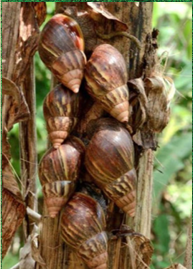
A rout of Giant African Snails
courtesy – KAU
A team from KAU, which inspected the affected areas, said coordinated action by farmers and the local body would be crucial to containing the infestation.
The team pointed to the successful containment of African snails in Ezhukone panchayat in Kollam, where joint efforts by farmers and local authorities helped bring the situation under control.
African snail infestations have been reported in Idukki since 2018. The pest has since spread to several panchayats, raising concern among plantation farmers.
According to the KAU team, the accumulation of fallen leaves and organic matter in Bison Valley plantations is creating favourable conditions for the snails to multiply. Clearing such breeding grounds will require the collective participation of farmers, the team said.
The team also demonstrated the use of food traps to attract and destroy the snails, urging farmers to adopt such methods as part of a coordinated campaign to prevent further spread.
Also Read: Kerala HC asks state to mediate in Orthodox-Jacobite dispute in case of law and order issues
With the existence of favourable conditions for a sharp increase in the population of the the Giant African Snail, the KAU call for coordinated action by local bodies, government agencies, farmers and the public.
The pest which feeds on more than 500 plant species including banana, papaya, jackfruit, okra, brinjal, cabbage, arecanut, rubber and coffee may also thrive in poultry farms, timber yards and areas where organic waste and household garbage accumulate.
KAU has stressed that sanitation and the removal of potential breeding sites should form the first line of defence.
Weeds, crop residues, organic waste, discarded gunny bags and accumulated garbage should be cleared from homesteads, farms, poultry units and public spaces. Such clean-up measures can significantly reduce places where the snails hide, lay eggs and multiply.
The university is also conducting district-level awareness and community action programmes, combining surveillance, sanitation drives and organised snail collection.
Panchayat-level pest scout teams, working with the Agriculture Department, local bodies and trained volunteers, have been recommended to keep watch for fresh infestations and identify hotspots before the population becomes difficult to control.
Also Read: Sabarimala temple to open on 16 August for Chinga Masa pooja
According to the KAU, adult snails and egg masses are best collected during the early morning or evening, when the pest is more active.
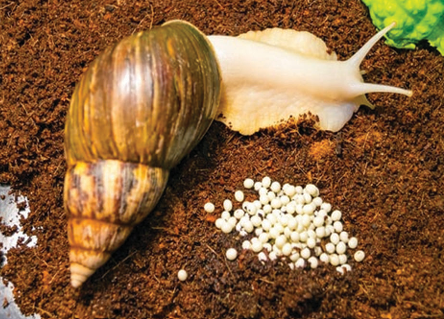
A Giant African Snail with its eggs
courtesy – KAU
Gloves should be used while handling them. KAU recommends destroying the collected snails by immersing them in a 25 percent salt solution, prepared by dissolving 250 grams of salt in one litre of water.
Another option is to bury them in pits at least two metres deep, away from water sources, after treating them with salt or copper sulphate before covering the pit with soil.
Traps can also be used to bring down snail numbers.
A bait made from 500 grams of wheat flour, 200 grams of jaggery and 20 grams of yeast mixed with water can be placed in shallow containers or on wet gunny bags in the evening. Fermented fruit and leaves of papaya, banana and cabbage can also attract the snails. The traps should be checked the next morning and the snails collected for safe destruction.
KAU has recommended chemical barriers in areas prone to infestation. A 1 percent copper sulphate solution, prepared by mixing 10 grams of copper sulphate in a litre of water, can be applied along field boundaries. Tobacco dust or borax can also be used as barrier treatments. Where snails gather on walls and tree trunks, a 6 percent copper sulphate solution, containing 60 grams per litre of water, has been recommended.
For crop application, the suggested concentration is 3 grams of copper sulphate per litre of water. Copper sulphate treatment, however, should not be used on cucurbit crops such as cucumber, bitter gourd, snake gourd, pumpkin and ash gourd, or in paddy fields.
KAU has also cautioned against inadvertently transporting the pest from infested locations. Agricultural machinery, planting materials and vehicles should be carefully inspected and cleaned before being moved to other areas.
Also Read: From Messi dream to messy affair: Inquiry flags lapses, Pinarayi-Abdurahiman under scrutiny
Native to Africa, the Giant African Snail has travelled far beyond its original range and established itself across tropical and subtropical regions.
Its expansion outside Africa began in the early 19th century. India recorded its first known presence in West Bengal in 1847, following its introduction through Mauritius.
The snail typically lives for three to five years, though some survive up to nine. It reaches sexual maturity within a year and is a simultaneous hermaphrodite, carrying both male and female reproductive organs. Self-fertilisation is uncommon except in very small populations.
Usually, two snails mate, a process that can last six to eight hours. Eggs are laid eight to 20 days later in nests in soil, leaves or stones. A snail may produce 100 eggs in its first year, 500 in its second and up to 1,000 over its lifetime. In warm, humid conditions, eggs hatch in about 11 days.
Its appetite makes the species particularly destructive. the Giant African Snail feeds on vegetables, teak, rubber, coffee, tea and horticultural and medicinal plants, with agricultural losses often greatest soon after an infestation begins.
FAO notes that it also eats sand, tiny stones, animal bones and concrete, apparently to obtain calcium. The ecological consequences are wider still. It competes with native snails, disrupts food chains and can alter ecosystems.
The snail may carry the rat lungworm Angiostrongylus cantonensis, linked to eosinophilic meningoencephalitis, and Aeromonas hydrophila. Infection is mainly associated with eating raw or undercooked snails. Its faeces can spread Phytophthora palmivora, which causes black pod disease in cacao.
For people living in areas with infestations, the snail can become a persistent nuisance. Dead snails create foul odours, while calcium carbonate shells can reduce soil acidity and alter vegetation.



