


Published Jul 09, 2026 | 9:00 AM ⚊ Updated Aug 10, 2026 | 11:18 AM

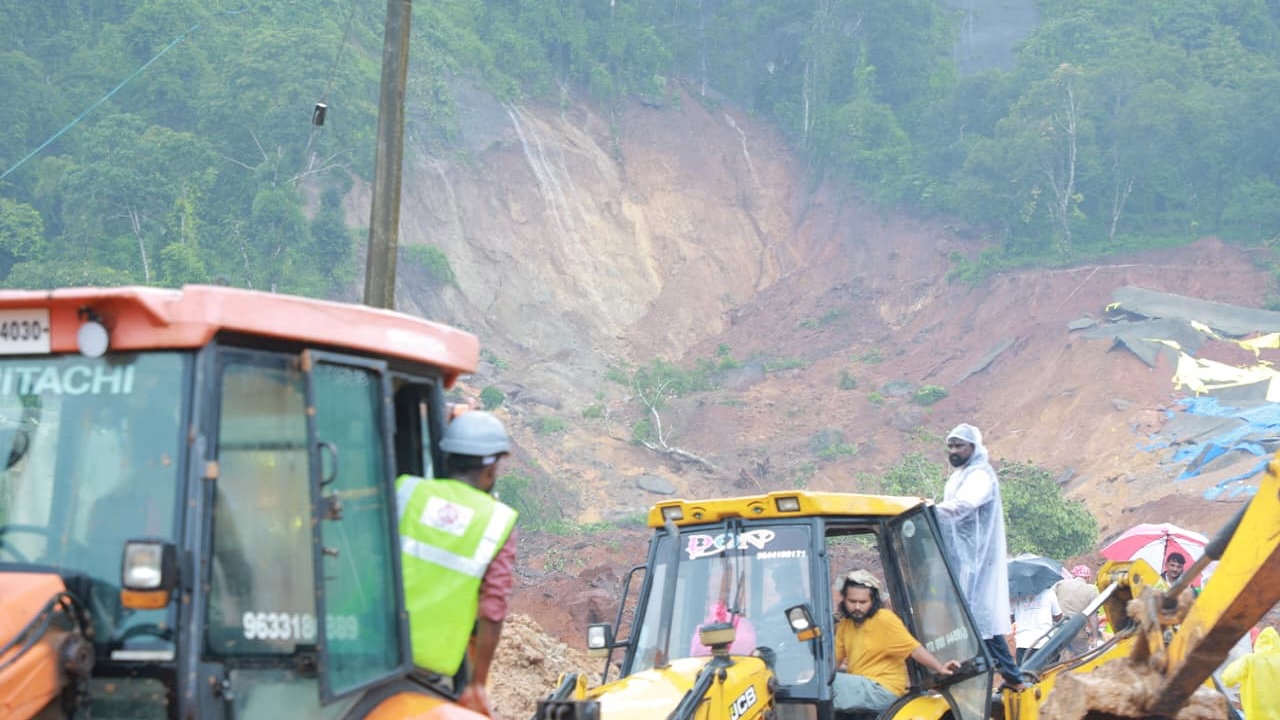
Rescue operations are continuing at the site

Synopsis: The fatal debris flow near the Anakkampoyil–Kalladi–Meppadi tunnel construction site has renewed scrutiny of one of Kerala’s most controversial infrastructure projects. Based on government records accessed by South First, the project progressed despite disputed claims in approval documents, repeated scientific warnings over landslide and groundwater risks, demands for additional studies by expert panels and a legal challenge pending before the Kerala High Court.
Rescue teams and cadaver dogs are still searching for people reportedly trapped under debris near the construction site of the proposed Anakkampoyil–Kalladi–Meppadi Twin-Tube Tunnel Road in Wayanad.
Three people were killed after a soil piping incident triggered by incessant heavy rainfall struck the twin-tunnel construction site near Meenakshi Bridge at Kalladi in Meppadi on Tuesday, 7 July. Five people are still missing.
The tragedy has once again brought Kerala’s most debated infrastructure project under intense public scrutiny.
While authorities are yet to establish what had triggered the debris movement, the questions being raised today are not new.
Long before excavation began, scientists, environmentalists, appraisal committees, tribal rights activists and even the Kerala High Court had debated whether one of the state’s largest road projects was being pushed through one of the Western Ghats’ most fragile landscapes without sufficient scientific certainty.
South First-accessed government records, environmental appraisal documents and court filings that revealed that the project has been marked by repeated scientific concerns, disputed environmental claims, demands for additional studies, and a prolonged legal battle before finally receiving environmental clearance.
Also Read: ‘Man-made disaster’: Death toll in twin-tunnel site collapse rises to 3
The proposed Anakkampoyil–Kalladi–Meppadi tunnel is among Kerala’s biggest road infrastructure projects.
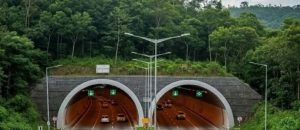
Artist’s rendition of the proposed twin tunnel.
Planned as an 8.753-km (earlier announced as 8.6 km) unidirectional twin-tube, four-lane tunnel beneath Vavulmala, the project aims to create a direct link between Kozhikode and Wayanad, reducing dependence on the landslide-prone Thamarassery ghat road.
Estimated to cost ₹2,043.74 crore, the tunnel stretches beneath Vavulmala, which rises nearly 7,500 feet above sea level, towards the Chembra Peak region in the Wayanad hill ranges of the Western Ghats.
The project requires 36.873 hectares, including 17.263 hectares of forest land. Of this, 16.269 hectares are needed for the underground tunnel, while another 0.994 hectares are required for surface infrastructure.
Stage-I forest clearance was granted by the Union government in March 2023, while compensatory afforestation has been proposed over 17.53 hectares of private land in the Wayanad South Forest Division.
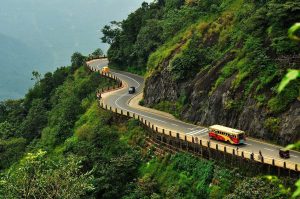
The tunnel has been proposed as a better alternative to the existing Thamarassery ghat road.
The previous LDF government consistently projected the tunnel as a permanent solution to the recurring problems along the existing 11.5-km Thamarassery ghat road, arguing that repeated landslides, traffic congestion, and monsoon closures made widening the existing highway impractical.
While laying the foundation stone on 5 October 2020, the then Chief Minister Pinarayi Vijayan described it as a transformative project that would integrate Wayanad more closely with the rest of Kerala and reduce travel time considerably. He said the tunnel will be completed within three years.
He also asserted that “no one will be allowed to obstruct development.”
Also Read: Will Wayanad tunnel road spell doom?
Documents revealed that the Kerala Public Works Department (PWD), while seeking environmental clearance from the Union Ministry of Environment, Forest and Climate Change in May 2022, submitted several declarations that are now being questioned.
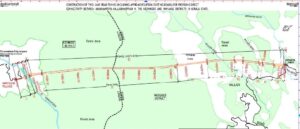
The proposed Twin Tunnel (2+2 Lane) with a four-lane approach from Aanakampoyil to Meppadi in Kozhikode and Wayanad districts. (Sourced)
The proposal prepared by the Executive Engineer, PWD Kozhikode, stated that the project did not fall within an Ecologically Sensitive Area (ESA), was not located inside any protected area, the Forest Rights Act was not applicable and that the land proposed for compensatory afforestation was outside the project area.
However, official records contradicted several of these statements.
The tunnel alignment passes through ESA villages, including Thiruvambady in Kozhikode and Vellarimala in Wayanad. Environmental groups alleged that these facts were omitted while seeking central approval.
Records further showed that compensatory afforestation has been proposed over 17.53 hectares of private non-tribal land within the Wayanad South Forest Division, contrary to the impression created in the original submission that the compensatory land was unrelated to the project area.
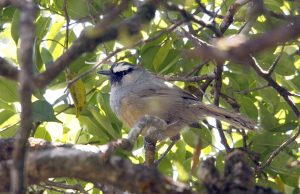
Banasura laughingthrush (Ferns Nature Conservation Society)
The ecological significance of the landscape is equally striking.
Part of the Nilgiri Biosphere Reserve falls within a 10-km radius of the alignment. The region supports the endangered Banasura laughingthrush and Nilgiri blue robin (Nilgiri shortwing), five bird species listed under the IUCN Red List, three additional vulnerable species, 14 Western Ghats endemic species, 29 Schedule I species and 155 Schedule II species protected under the Wildlife (Protection) Act, 1972.
The project also passes close to tribal settlements.
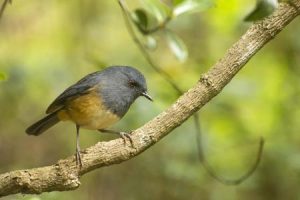
Nilgiri blue robin.
Four tribal settlements lie within 500 metres to 1.5 km of the alignment. The nearest is the Aranamala Kattunayaka Unnathi with 27 families. Altogether, nearly 32 tribal families from Mammikunnu, Kuppachi, Kalladi and Aranamala live close to the proposed tunnel.
These communities face risks from habitat disturbance, groundwater depletion and construction-related impacts.
Also Read: A Kerala tunnel road project at a crossroads
The proposal underwent scrutiny during the 158th, 162nd, 163rd, 166th, 170th, 173rd, 177th, 179th and 180th meetings of the State Expert Appraisal Committee (SEAC) before it was reconsidered at its 181st meeting on 1 March 2025.
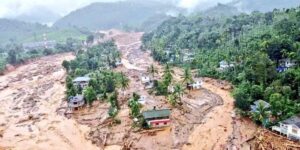
The 2024 Wayanad landslides were one of the deadliest disasters in Kerala’s history. (X)
Throughout the appraisal process, the committee repeatedly highlighted deficiencies in geological investigations, hydrological assessments and environmental safeguards. SEAC noted that the tunnel alignment passed through terrain devastated by major landslides in 2019 and 2024.
The tunnel’s Kalladi portal is barely 800 metres from the Puthumala landslide site, while the Mundakkai-Chooralmala landslide disaster zone is merely about 5 km away. Historical records indicated repeated landslides across this landscape since the 1960s.
The committee observed that the area represented an environmentally fragile, high landslide hazard zone, where large-scale infrastructure projects are generally discouraged. It warned that the diversion of 17.263 hectares of forest land could intensify human-wildlife conflict, particularly affecting elephant corridors.
The appraisal also recorded risks of unexpected groundwater inflows, geological instability, seepage, subsidence and even seismic disturbances associated with large-scale rock excavation.
And most importantly, SEAC observed that deep fracture-controlled aquifers had not been fully mapped because seismic refraction and deep resistivity surveys could not be completed owing to difficult terrain and wildlife presence.
It further noted that the PWD had not carried out adequate geological and hydrological investigations before seeking environmental clearance.
CSIR-Central Institute of Mining and Fuel Research (CSIR-CIMFR), Dhanbad, recommended stage-wise controlled blasting supported by detailed blast design and firing patterns to minimise vibration. Yet, SEAC acknowledged that there are no universally accepted Peak Particle Velocity (PPV) values capable of predicting landslides because geological responses vary from place to place.
Despite documenting these concerns, SEAC granted environmental clearance, subject to 25 conditions. Experts have questioned several of those conditions.
One condition sought the preparation of detailed landslide susceptibility maps, although the committee had already recognised the entire corridor as highly landslide-prone, with major disasters striking the area in 2014, 2019 and 2024.
Another condition required that rock excavation should not generate surface vibrations, despite the appraisal itself acknowledging that blasting inevitably produces vibrations whose impacts cannot be predicted with certainty.
Experts argued that vibration-free tunnelling under Wayanad’s geological conditions is technically unrealistic.
Another major criticism was regarding the absence of detailed hydrological studies.
Scientists have repeatedly pointed out that long tunnels can intercept underground aquifers, alter groundwater movement and dry up perennial springs sustaining downstream ecosystems and local communities.
No comprehensive scientific assessment examining these risks has been made public.
Also Read: Elephants sans passage, people without peace
The proposal also faced scrutiny before the Expert Appraisal Committee (EAC) of the Union government.
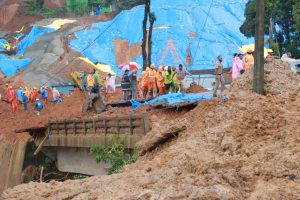
Three people were killed — five others are missing — in a soil piping incident that struck the twin-tunnel construction site on 7 July.
During its 397th meeting, the committee deferred the project and directed the PWD to produce detailed scientific studies on landslide vulnerability, geological stability and biodiversity through reputed national institutions.
When the proposal returned in May 2025, it included studies by Dr K Soman, former scientist of the Centre for Earth Science Studies, blasting assessments by CSIR-CIMFR, landslide vulnerability mapping by the Geological Survey of India, Automated Weather Stations installed following India Meteorological Department advice and monitoring of the endangered Banasura Chilappan by the Salim Ali Centre for Ornithology and Natural History.
These studies concluded that elevation differences of 17.8 metres near the Iruvazhinjipuzha side would prevent flooding even during extreme rainfalls and found no evidence that the tunnel would create drainage-related hazards.
The environmental clearance was subsequently challenged before the Kerala High Court by Wayanad Prakrithi Samrakshana Samithi. The petition argued that clearance had been granted mechanically despite the project being located near the landslide-affected Mundakkai and Chooralmala regions.
It further alleged that Konkan Railway Corporation Ltd, appointed as the Special Purpose Vehicle, had engaged KITCO Ltd for carrying out an Environmental Impact Assessment (EIA) despite lacking accreditation for conducting an assessment of this nature.
The petition also questioned the changing stand of the Central Expert Appraisal Committee, pointing out that its 283rd meeting in December 2021 had returned the proposal after concluding that it did not fall under the EIA notification. The same committee recommended environmental clearance during its 401st meeting in May 2025.
The petitioners argued that the recommendation merely echoed SEAC’s decision taken on 1 March 2025 — a day before the committee’s tenure expired.
After examining the records, a Division Bench comprising Justices AK Jayasankaran Nambiar and Jobin Sebastian dismissed the petition in December, holding that no procedural irregularity was found in the grant of environmental clearance.
Also Read: Will Silkyara tunnel collapse force Kerala to rethink its planned underpass?
The recent tragedy has revived those unresolved scientific questions. Dr KG Thara, former member of the Kerala State Disaster Management Authority, questioned both the scientific basis of the project and the authorities’ response.
“The project has a fundamental drawback. First and foremost, it is being implemented in an ecologically fragile region. If there was a naturally occurring triggering factor—which the authorities concerned must scientifically establish—then, when combined with the unscientific dumping of excavated soil, it could have contributed to this incident.”
She also challenged the government’s argument that the tunnel is necessary to improve emergency healthcare access to Wayanad.
“If the argument is that the tunnel is needed to improve access during medical emergencies, then my question is: how much would it cost to build a multi-speciality hospital in Wayanad? Even if it costs ₹200 crore or ₹500 crore, it is nowhere close to the tunnel project’s estimated cost.”
“Only a geomorphological and geohydrological study has been carried out in the area. It has been reported that the PWD warned the contractor in June to remove the dumped soil. If that directive was ignored, what action followed? Who was held accountable? The District Disaster Management Authority and the District Collector are responsible for ensuring such warnings are acted upon,” she said.
“They should have intervened and investigated the matter. Merely saying that the contractor did not comply despite being warned is not an acceptable explanation. A case should have been registered. The Disaster Management Act itself contains provisions to initiate legal action in such situations,” Dr Thara added.
(Edited by Majnu Babu).



