

Published Aug 16, 2026 | 7:00 AM ⚊ Updated Aug 16, 2026 | 7:00 AM

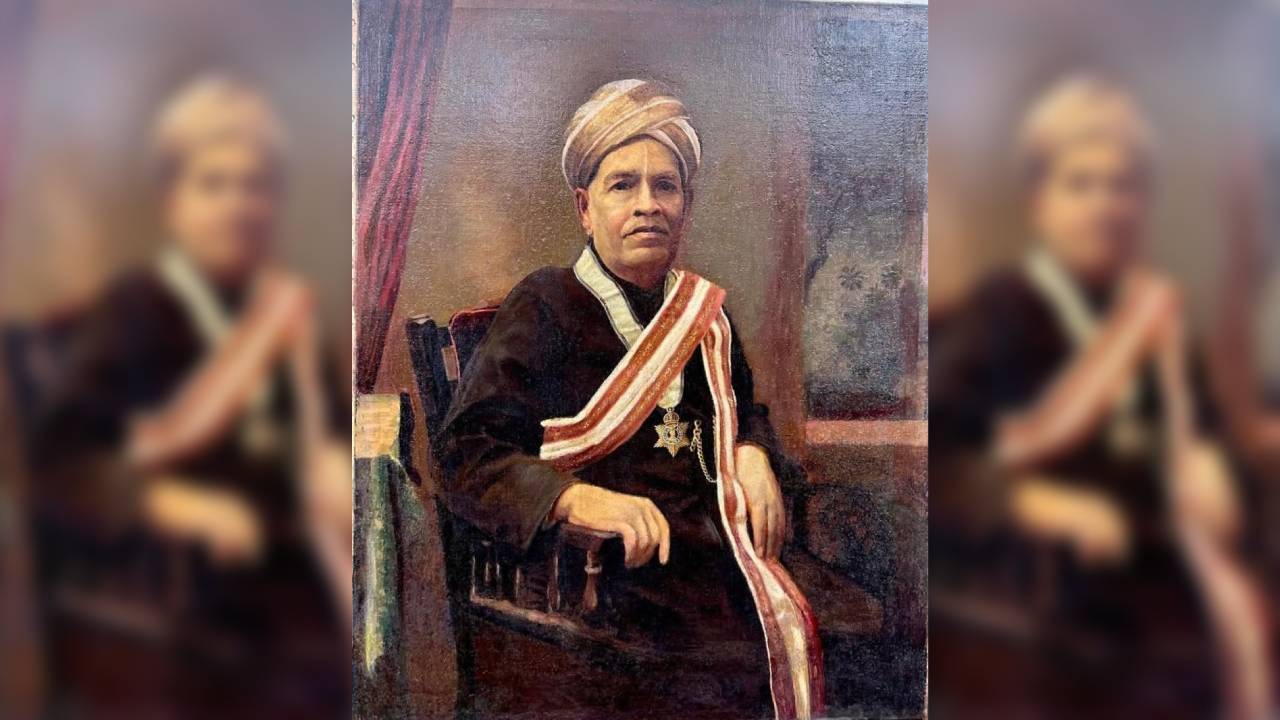
V Nagam Aiya. (Courtesy - Raja Ravi Varma Heritage Foundation).

Synopsis: A century and two decades after its publication, V Nagam Aiya’s Travancore State Manual still offers an unparalleled glimpse into the land, people and institutions of erstwhile Travancore. The Manual grew out of years of painstaking research and documentation. Then, in 1938, came the sweeping revision.
On 16 August, 120 years ago, a painstaking work that sought to capture Travancore in all its complexity was dedicated to the erstwhile state — a book that would go on to become one of the most valuable windows into the history, people and institutions of southern Kerala.
The Travancore State Manual, authored by Diwan Bahadur Sir Veeraraghavapuram Nagam Aiya, was no ordinary official publication.
Aiya, then the senior-most officer in the Travancore service, spent years gathering and organising material for the work, much of it while discharging his duties as Dewan Peishkar. As the project neared completion, he was placed on special duty as the full-time State Manual Officer.
The result was an encyclopaedic three-volume work of more than 1,820 pages, covering Travancore’s geography, history and administration alongside its forests and wildlife, agriculture, commerce, industry, education, economy, social life, religion, and the everyday conditions of its people.
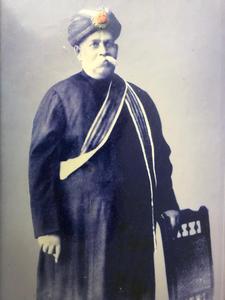
V Nagam Aiya dedicated the Manual on 16 August 1906.
Commissioned by then Travancore king Mulam Thirunal Rama Varma, it was modelled on District Manuals of Madras. Aiya’s Manual was intended to do more than record facts.
Aiya wanted it to give even a stranger to Travancore a picture of the land and its people that would otherwise take decades of residence and study to understand.
That ambition is perhaps what has kept the work relevant long after Travancore, which it had described, disappeared from the political map.
Educator and legislator TK Velu Pillai later revisited and updated the Manual, publishing a revised version in 1938, 32 years after Aiya’s original work.
A century and two decades later, Aiya’s volumes remain a remarkable record of a region in transition — and an invitation to revisit Travancore through the eyes of the civil servant who spent years documenting it.
Also Read: Rediscovered records reveal Kerala’s forgotten role in mapping magnetic equator
The Manual, prepared under the direction of Moolam Thirunal, did not take shape overnight.
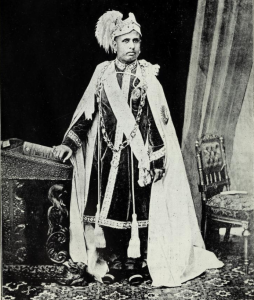
Travancore king Rama Varma, popularly known as Mulam Thirunal.
Its author, Aiya, traced its origins to an idea Dewan T Rama Rao first placed before him nearly 14 years before the Manual finally took form.
In the preface to the monumental work, Aiya recalled that Rama Rao had asked him first to prepare the Census Report and then take up the State Manual.
The Dewan obtained the Maharaja’s sanction and official orders were issued in the last quarter of 1891. But Rama Rao retired a few months later, and the project was left in abeyance.
For the next six years, during the Dewanship of S Shungrasoobyer, nothing came of the proposal. Aiya noted that the Dewan did not attach much importance to it.
The project was revived in 1901 by Dewan K. Krishnaswamy Rao.
Aiya began working on it intermittently, finding time amid the demanding duties of the Settlement Department. Only in December 1904 was he able to take up the Manual as a full-time assignment.
The bulk of the work was contained in its three closely printed volumes—the result of the sustained effort that followed.
Aiya did not understate the scale of the undertaking.
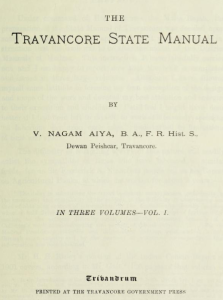
The front page of The Travancore State Manual
“The labour involved in the task was truly gigantic,” he wrote, explaining that the work often required him to sift through an enormous mass of records of every description to find even a small piece of information.
What began as a plan for a single, moderate-sized volume eventually expanded into three substantial volumes.
Aiya argued that the wealth of material gathered and the effort invested in the research made such an expansion necessary. He considered it a “false economy” to discard the results of extensive research merely to reduce the amount of printing.
He also took pride in the scope of the finished work, observing that the Travancore State Manual was fuller and more comprehensive than the Manuals of Madras.
At the same time, Aiya acknowledged that the pioneering work could have its defects and shortcomings.
Even with those limitations, he felt that the Manual represented a successful beginning in what was then a novel field of official documentation.
Also Read: How tapioca evolved from famine food to everyday staple
In his three-volume work, Aiya offers a detailed account of Travancore’s physical landscape, people, culture, economy and system of administration, covering a wide range of subjects that together provide a picture of the region at the time.
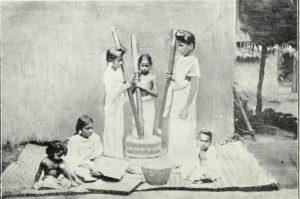
One of the photographs included in the Manual
The first volume is largely devoted to Travancore’s physical and natural features. Its six chapters cover the region’s physical description, climate, rainfall and meteorology, flora and fauna, archaeology, and history. Together, they trace both the land’s natural character and the historical developments that shaped it.
The second volume turns to the people and social life. It contains detailed sections on the census and population, religion and caste, the Malayalam language and literature, education and public health. The volume thus provides a glimpse into the demographic, social and cultural life of the period.
The third volume focuses on Travancore’s economic life and administration. It covers agriculture, economic conditions, trade and commerce, means of communication, arts and industries, land tenures and land taxes. It also records details of administration, legislation and the statute book, along with the gazetteer.
Also Read: Encyclopaedia lays bare Kerala’s unequal, casteist past
The next major change to the Manual came in 1938.
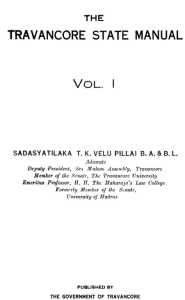
The front page of the revised Travancore State Manual
But it was another 32 years before the work was taken up for a far more extensive revision.
This time, TK Velupillai was entrusted with the task.
What began as a plan to revise the existing manual eventually grew into a four-volume work running to nearly 4,000 pages.
Velupillai himself explained in the preface that the Government had initially expected only a revision. That approach soon changed.
“The bulk of the book,” he wrote, “would therefore have to be rewritten.”
The reason was simple: much had changed since the earlier manual.
Scholarship on Travancore, Malabar and South India had expanded, scientific methods had advanced, and new areas of research had opened up. A manual prepared decades earlier could no longer be updated by adding a few pages or correcting old references.
Geology was one example.
The chapter in Aiya’s State Manual had been written before Travancore had its own Geological Department and relied largely on the observations of Dr W King and Dr R Bruce-Foote. By the time Velupillai took up the work, geological research had moved ahead considerably, helped by the wider use of the microscope and years of fieldwork by Travancore’s geologists.
The change was equally striking in the chapters on flora and fauna.
Together, the two subjects occupied only 87 pages in the earlier manual. In Velupillai’s revised work, they took up 245 pages.
That expansion also meant the original deadline could not be maintained.
The Government had initially sanctioned seven months for the work. The period was eventually extended to 29 months.
Velupillai was given another concession to make the undertaking possible.
The Government relieved him of his teaching duties at His Highness the Maharaja’s Law College so that he could devote himself full-time to the State Manual. As the work progressed, he said, he was also forced to suspend his practice at the Bar.
The result was no longer merely a revised edition of an old administrative record.
Velupillai’s work sought to bring together the history, geography, science and changing body of knowledge on the region in a substantially rewritten and expanded form.
Meanwhile, an official of the Archives Department cautioned that historical manuals such as these need to be read with caution, particularly because they were government-funded projects produced within the administrative framework of their time.
The official noted that the information recorded in them could, in some cases, reflect the priorities, perceptions and interests of the administration that commissioned them.
“These works are invaluable as historical references, but they cannot necessarily be treated as the final word on every issue. The details have to be read in the context in which they were produced and, wherever an opinion or conclusion is being drawn, cross-checked with other sources before arriving at a final assessment,” the official said.
(Edited by Majnu Babu).



