

Published Nov 13, 2026 | 3:34 PM ⚊ Updated Nov 13, 2026 | 3:34 PM

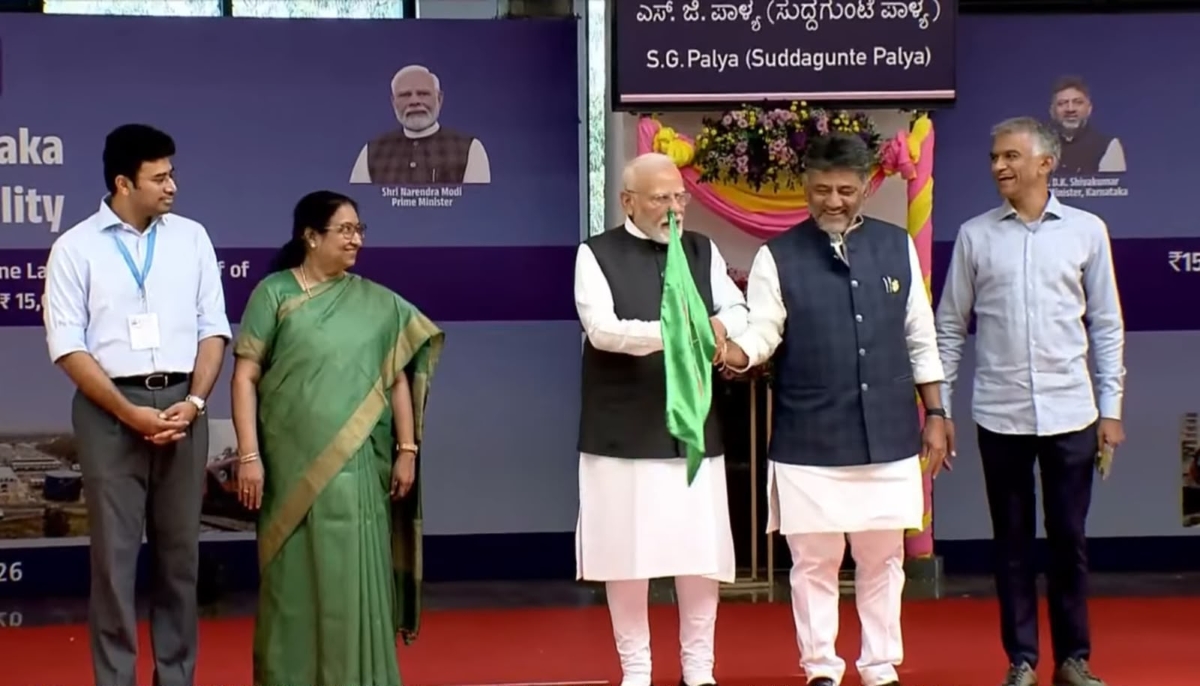
PM Modi inaugurates Namma Metro Pink Line

Synopsis: At the Pink Line inauguration, which took Namma Metro past 103 km, Chief Minister D. K. Shivakumar urged the Prime Minister to ease the State’s metro cost burden. He sought time-bound approvals, city-specific costing, shared forex risk and operational losses, and Red Line approval. He also sought ₹62,482 crore drought relief, better sugarcane prices, and a rethink on Western Ghats eco-sensitive zones.
Prime Minister Narendra Modi on Friday, 13 November, inaugurated the 7.5-km elevated section of Namma Metro’s Pink Line, connecting Kalena Agrahara and Tavarekere in south Bengaluru.
Addressing the gathering at IIM Bengaluru, Karnataka Chief Minister DK Shivakumar called for Prime Minister Narendra Modi’s cooperation between the Union and State governments. “When the Centre and the State moves together, the nation moves forward,” he said.
Further invoking poet Kuvempu’s message Shivakumar said, “We must work across boundaries…narrow boundaries.”
Chief Minister DK Shivakumar, Governor of Karnataka Sudha Yadav, Greater Bengaluru Development Minister Krishna Byre Gowda and Bengaluru South MP Tejasvi Surya were among those present at the event.
The newly opened stretch comprises six stations – Kalena Agrahara, Hulimavu, IIMB, JP Nagar 4th Phase, Jayadeva Hospital and Tavarekere. The project has been developed at a cost of around ₹3,470 crore.
Following the inauguration, Modi travelled by Metro from Tavarekere to IIMB station.
Also Read: Meat-eaters anti-social? Shops shut in Anekal citing security concerns ahead of Modi’s visit
Seeking cooperation in expanding the city’s Metro network and addressing the financial challenges involved in its development, the chief minister said, “Metro projects may have a 50:50 partnership, but the actual financial burden on the state is much higher,” pointing to the costs of central taxes, State taxes, foreign loans and operational expenses.
He called for state corporations and national banks to provide loans at cheaper interest rates and said delays in project approvals led to cost escalations. “Project costs must reflect recent prices and conditions and should be based on each city rather than national averages,” he said, seeking a mechanism to share additional costs arising from delays, including operational cash losses.
“Our ambition is to reach 500 km under your guidance. Less time in traffic and more time with families,” he said.
Following the event, Shivakumar also submitted a memorandum from Karnataka government to the Prime Minister, about the Centre’s assistance towards the issues he outlined in the speech.
In the memorandum, the chief minister gave the following suggestions:
Noting that only 8–9% of Bengaluru is covered by roads against the 18–20% a city needs, Shivakumar said the State planned double-decker structures, with road flyovers below elevated metro lines.
Karnataka’s proposal for the 42-km Phase 3 stretch has been significantly reduced, though similar structures exist in Nagpur and Pune.
He asked for permission to build double-deckers wherever feasible, safe and economically justified, with Karnataka bearing the additional cost.
He also pressed for approval of the Red Line (Phase 3A) from Sarjapur to Hebbal, submitted in January 2025 and revised with reduced costs at the Centre’s request, saying delay will only raise costs.
Also Read: Math of 7.5-km line that PM will inaugurate: BJP vs Congress dispute over who pays for Namma Metro
He also sought Central assistance to address the drought situation in Karnataka, pointing out that of 240, 226 taluks had been declared drought-affected following the second-lowest South-West Monsoon rainfall in 70 years.
“We have suffered due to droughts. I request NDRF assistance. I will come forward with an all-party delegation,” he said.
In the memorandum, he noted in detail: “Nearly 58 lakh hectares of crops have suffered damage, with estimated losses of ₹62,482 crore. Our villages are facing drinking water shortages and fodder for cattle is becoming scarce. There is an urgent need to come to the rescue of our farmers.”
Further stating that the state government sought ₹62,482 crore under NDRF, he urged early approval and release of NDRF assistance, for which memorandums have been sent.
Shivakumar also raised issues concerning sugarcane farmers, including their demand for better prices, revision of the minimum selling price of sugar and intervention on ethanol allocation and pricing.
Farmers are demanding ₹5,500 per tonne, well above the FRP of ₹3,650 for 2026-27. Shivakumar said the MSP of sugar has stayed at ₹31 per kg since 2019 while market prices are higher, and called for a revision.
He also asked for a more realistic FRP that accounts for returns from by-products like ethanol and power.
The Environment Ministry’s draft notification, based on the Kasturirangan Report, identifies 20,668 sq km across 1,449 villages in 10 districts as Ecologically Sensitive Areas.
Shivakumar said, while Karnataka supports conservation, the livelihoods of about 1,500 villages are at stake.
He noted that the State has sought a ground-level survey for over a year and that the Legislature passed a unanimous resolution, and asked the Centre to reconsider the notification in consultation with Karnataka.
(Edited by Sumavarsha, with inputs from Varsha Gowda)



