

Published May 22, 2026 | 8:00 AM ⚊ Updated May 22, 2026 | 8:00 AM

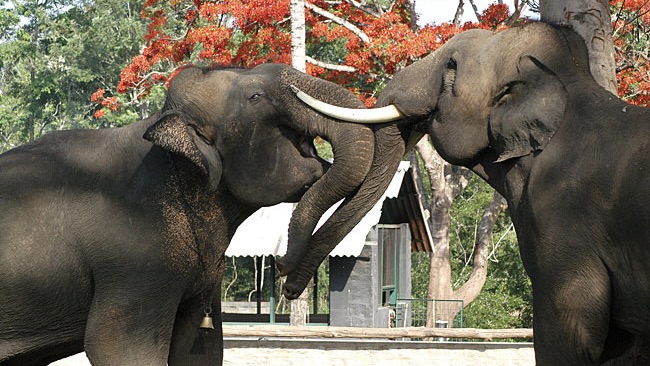
While elephants are known for their intelligence and capacity for gentleness, they remain wild animals – a fact often overlooked.

Synopsis: The death of a 33-year-old tourist at Karnataka’s Dubare Elephant Camp after she was caught in a fight between two tuskers has put the functioning of wildlife tourism camps under scrutiny. Experts said the incident points to wider problems linked to captivity, shrinking elephant habitats and the growing commercialisation of wildlife tourism.
Nestled in the foothills of the Western Ghats, nearly 230 kilometres west of Bengaluru in Karnataka, the Dubare Elephant Camp has long been one of Kodagu’s most popular tourist attractions. Home to around 150 captive elephants, the camp offers visitors an experience unlike a safari or zoo – close interaction with the animals. Activities include scrubbing elephants in the Cauvery river, massaging them with oil, and feeding them ragi, jaggery, sugarcane, bananas and coconuts.
Last Monday, 33-year-old Juneshe, a tourist from Chennai, arrived at the camp with her husband, Joel, and their five-year-old child. Like many other visitors that day, the family signed up for the elephant grooming activity. They were bathing and grooming Marthanda, a 53-year-old elephant, in the shallow waters of the Cauvery when another elephant—26-year-old Kanjan—was brought nearby.
Without warning, Kanjan attacked Marthanda, repeatedly stabbing him with his tusks and knocking the older elephant off balance. In the chaos, Marthanda collapsed into the shallow river, trapping Juneshe beneath his massive body.
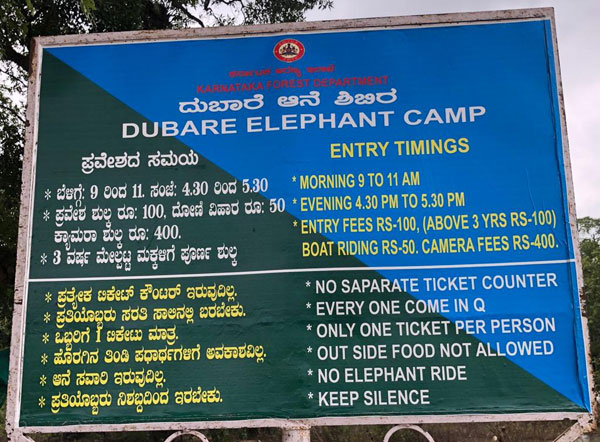
Home to around 150 captive elephants, the camp offers visitors an experience unlike a safari or zoo.
Joel escaped with their child and desperately tried to rescue his wife. After strenuous efforts, he and another person finally pulled her out from beneath the elephant. Juneshe was rushed to a nearby hospital in Kushalnagar, but she had suffered severe head injuries after hitting rocks in the riverbed. Despite treatment, she was later pronounced dead. The following day, Marthanda too succumbed to the injuries he sustained in the attack.
The incident, caught on camera, has put the spotlight on the functioning of wildlife tourism camps such as Dubare. Joel accused the camp of inadequate safety arrangements and the absence of an immediate emergency response. Others have pointed to lapses in safety protocols, poor handling and training of captive elephants, and violations of established conservation and tourism guidelines.
Wildlife activist Joseph Hoover said the incident was the result of the “pent-up frustration” of a free-ranging animal confined for long periods in captivity.
Also Read: Why Karnataka transport employees are striking work from 20 May
Elephants occupy a deeply significant place in South Indian culture. They are worshipped, celebrated, and often associated with divinity, wisdom and strength. Yet, while elephants are known for their intelligence and capacity for gentleness, they remain wild animals – a fact often overlooked.
“Historically speaking, elephants and humans… we look at it from the Maharaja’s time. But that was a different scenario altogether – a different era, and things were not so bad back then as it is today,” wildlife activist Joseph Hoover told South First.
According to Hoover, the relationship between humans and elephants has changed dramatically over the last two decades because of rapid environmental disruption and shrinking habitats. “If you talk about 20 years ago, occasionally we used to hear about an elephant coming into the farmlands. But in the last few years, from 2020 specifically, it has escalated. Animals are more often in city areas because their corridors have been destroyed and fragmented – because of all the linear projects and ecotourism projects which have come in,” he said.
Historically, captive elephants in Karnataka were mainly used by forest departments for timber logging, transport and temple ceremonies. But from the early 2000s, camps such as Dubare Elephant Camp and Sakrebyle Elephant Camp increasingly became ecotourism hubs aimed at boosting state tourism revenue. Visitors were encouraged to interact closely with elephants through bathing, feeding and grooming activities, often blurring the distinction between trained behaviour and the unpredictability of a wild animal.
However, as Hoover stressed, “Elephants are elephants. They’re also wild animals.”
The tragedy at Dubare has drawn further scrutiny because both elephants involved in the incident—Marthanda and Kanjan—were reportedly in musth, a periodic condition in male elephants marked by heightened aggression and a sharp increase in reproductive hormones. Experts said elephants in musth are particularly unpredictable and should be kept away from public interaction.
“There are signs when the elephant is entering the musth period. The elephants start secreting a thick fluid from their ears. There are specific guidelines that say elephants are supposed to be kept away from any interaction during this period. It is the mahout’s responsibility to keep them in a period of isolation,” wildlife conservationist Colonel CP Muthanna said. “The standard operating procedure has not been followed.”
Also Read: The hijab order Karnataka got half right
Ecotourism in Karnataka has grown rapidly over the years, with wildlife experiences increasingly packaged and marketed as immersive, educational encounters with nature. Elephant camps, jungle safaris and river-based tourism have become central to the state’s tourism economy, particularly in ecologically sensitive districts such as Kodagu.
But critics said the line between ecotourism and exploitation has steadily blurred. “There is no ecotourism now, there is only invasive tourism,” wildlife activist Joseph Hoover said.
The Dubare Elephant Camp is among the biggest tourist attractions in Kodagu district, drawing thousands of visitors every year. In 2024 alone, Kodagu reportedly attracted more than 45 lakh tourists, leading to severe congestion at popular destinations such as Abbey Falls and Bhagamandala. The influx has also caused localised ecological damage, deteriorating infrastructure and increasing instances of human-animal conflict in areas surrounding the Nagarhole Reserve.
For conservationists, the tragedy at Dubare is not an isolated incident but a symptom of the wider pressures mass tourism has placed on a fragile ecosystem. “This whole incident is a reflection of overtourism. If you see the video, there are so many elephants, so many people in the water. There has to be some sort of discipline, some regulations to bring down the footfall of tourism – especially in Kodagu,” wildlife conservationist Colonel CP Muthanna said.
“It is a reflection of a larger problem. How can a tiny district, ecologically fragile, take such a huge footfall of tourists?” he added.
After the Dubare accident, Karnataka Forest Minister Eshwar Khandre directed officials to immediately implement stricter safety measures across elephant camps in the state. The measures include enforcing a minimum distance of 100 feet between tourists and elephants, restricting visitors to fixed viewing zones during elephant bathing sessions, and prioritising crowd management around captive animals.
“Understanding the behavior of elephants and other wildlife is extremely difficult. Their instincts remain intact despite training. Henceforth, tourists should not touch elephant trunks, stand beside elephants for photographs, bathe them or feed them bananas, jaggery or sugarcane,” the minister said.
The state government has also ordered the preparation of a comprehensive Standard Operating Procedure (SOP) for visitor safety at elephant camps. Under the proposed directives, activities such as close physical interaction with elephants, close-up photography, direct feeding and tourist participation in bathing sessions are expected to be strictly prohibited.



