

Published Apr 24, 2026 | 7:00 AM ⚊ Updated Apr 24, 2026 | 7:00 AM

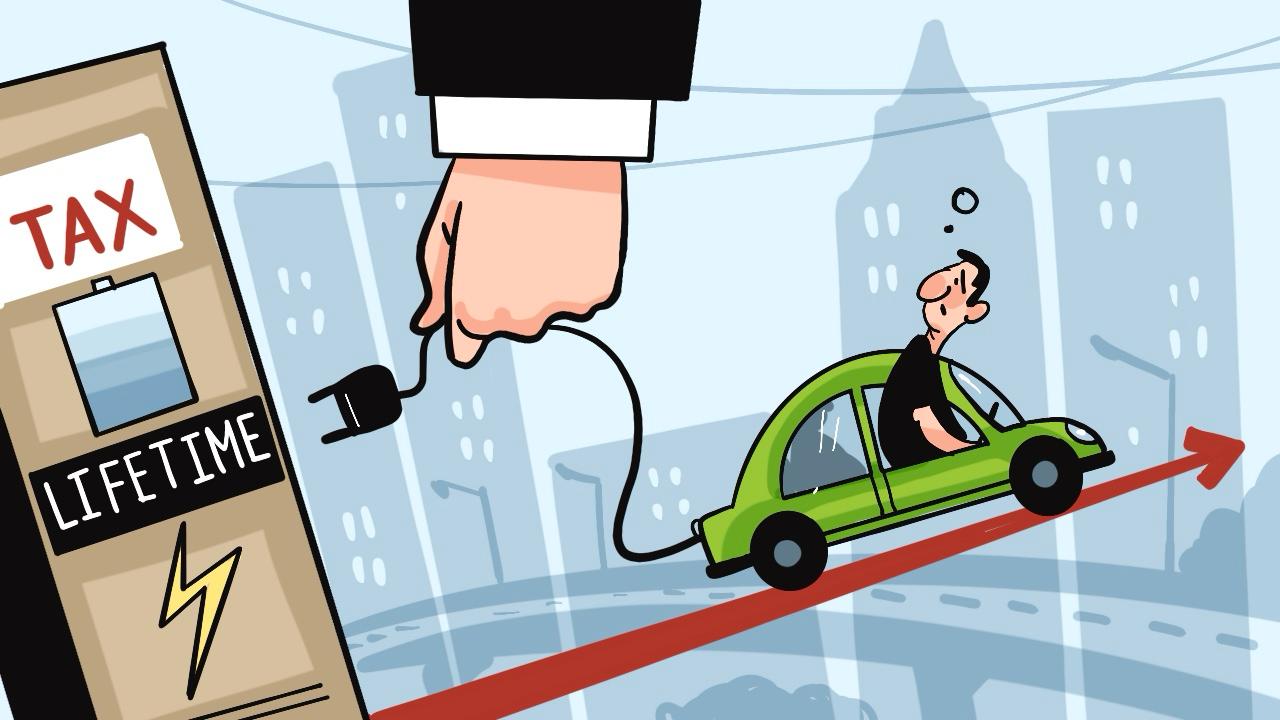
EV taxation Karnataka.

Synopsis: At a time when the sales of electric vehicles are peaking across the country, particularly in Karnataka, the state government passd a law to impose lifetime taxes on them. Users noted that taxing EVs has disincentivised their purchases, especially given that the lack of tax, to an extent, compensated for their higher prices compared to petrol- or diesel-fueled vehicles.
Karnataka ranks second in the country in terms of the sale of electric vehicles (EVs), with 60,800 four-wheelers sold over the past five years, according to data from the Vahan dashboard of the Union government.
On the heels of that, on 26 March, the state government passed the Karnataka Motor Vehicles Taxation (Amendment) Bill. This amendment imposes a lifetime tax on electric vehicles (EVs), except two-wheelers. This amendment comes at a time of a surge in EV purchases across the country.
According to data from the Federation of Automotive Dealers Association, in the 2025-26 fiscal year, India witnessed an 83 percent surge in EV passenger vehicle sales, with approximately two lakh registrations.
Speaking to South First, Deepak Shah, a Bengaluru resident, said that he bought an EV four-wheeler “to avoid pollution; and because they are noiseless cars; and operational costs are comparatively low,” due to which there is no need to give it to service often to check the engine.
Users also noted that taxing EVs has disincentivised their purchases, especially given that the lack of tax, to an extent, compensated for their higher prices compared to petrol- or diesel-fueled vehicles. Now, the higher prices have led to scepticism about their benefits compared to other vehicles.
In the environmental perspective, Selomi Garnaik, Climate and Energy campaigner at Greenpeace India, said, “They have zero tailpipe emissions, which means they do not directly release pollutants like nitrogen oxides or particulate matter on roads. That can help improve urban air quality, especially in congested cities like Bengaluru, where vehicular pollution is a serious concern.”
The importance of EVs has increased manifold due to the global fuel crisis set out by the conflict in West Asia.
Also Read: Union government to come out with detailed guidelines for investment under EV policy
The Karnataka Motor Vehicle Taxation Act, 1957, was amended to generate ₹250 crore from “the different categories of vehicles which will be registered in the year 2026-27.” The amendment received the Governor’s assent on 9 April, thereby ending the tax exemption provided to lower-priced EVs in the state.
Before the amendment, only EVs priced above ₹25 lakh were subject to a lifetime tax. However, as per the amendment, all battery-operated four-wheelers will be taxed based on their cost. To streamline this, the amendment established a tiered system of taxes on electric cars, jeeps, and omnibuses.
If the vehicle’s cost is below ₹10 lakh, the tax is five percent of its cost; if the vehicle’s cost is between 10 and 25 lakh, the tax is eight percent of its cost; and if the vehicle’s cost is above 25 lakh, the tax is 10 percent of its cost.
In addition to taxing EVs bought after the date of notification (10 April), the amendment also establishes taxation for those that have already been registered, with the tax depending on when they were registered. Such taxes range from 93 percent if the EV was bought less than two years ago to 25 percent if it was bought more than 15 years ago.
Karnataka’s Transport Minister Ramalinga Reddy, in the legislature, justified the Bill stating that its main intention is effective tax collection, rather than just meeting targets. He said, “We cannot exceed the target. It depends on the number of vehicles registered in the year. We may get an additional four to five per cent from penalties, etc. There is no intention for greater tax collection beyond the set goal.”
Also Read: Why summer 2026 is likely to be hotter than 2025 in Karnataka
However, the state government’s move has been criticised for being introduced during a global oil crisis caused by the West Asia conflict. Yaduveer Wadiyar, the MP of Mysuru-Kodagu, said on a post on social media platform X, “At a time when policy should be accelerating the transition away from fossil fuels and advancing climate goals, the Karnataka Congress government has chosen to levy lifetime taxes on electric vehicles — a regressive and counterproductive move.”
Residents who have their EV four-wheelers registered in Karnataka have also criticised the government’s taxation. Shah said that while this is not going to impact his decision to buy another EV, he is “Not happy with the government.”
He also added, “While we are ready to pay taxes, the government has to give us proper roads and infrastructure, which it is not,” and that the problems of dust and noise pollution, which can be addressed by the use of EVs, are not effectively taken care of by the government.
Kiran, a Bengaluru resident, told the South First that “Now the prices of EVs is 20 or 25 percent higher than that of petrol and diesel vehicles, which was to an extent compensated by a tax exemption, but when you are adding a road tax, you are discouraging purchases of EVs,” and that there is no point in taking a risk by purchasing EVs.
He also said he planned to purchase another EV in the future, but has kept the plan on hold due to the introduction of a lifetime tax. This view was amplified by Garnaik, who said, “Removing taxes on EVs must have encouraged more people to consider buying them, especially because EVs usually cost more upfront than regular petrol or diesel cars.”
Garnaik painted a larger picture, saying this is an “Opportunity to rethink transport priorities” and that the government should invest more in public transport, which matters more to regular commuters than private incentives.
She said, “The focus should not be only on taxing EVs. It should be on building a transport system where choosing a bus is easy, affordable, and dependable. That would be the real long-term solution for congestion, pollution, and unequal access to mobility.”
She added that the government’s move should be assessed not only for its impact on EV sales, but also for whether it pushes the government to build a transportation system that serves people first, rather than cars.
(Edited by Muhammed Fazil.)



