

Published Oct 16, 2026 | 9:30 AM ⚊ Updated Oct 16, 2026 | 9:30 AM

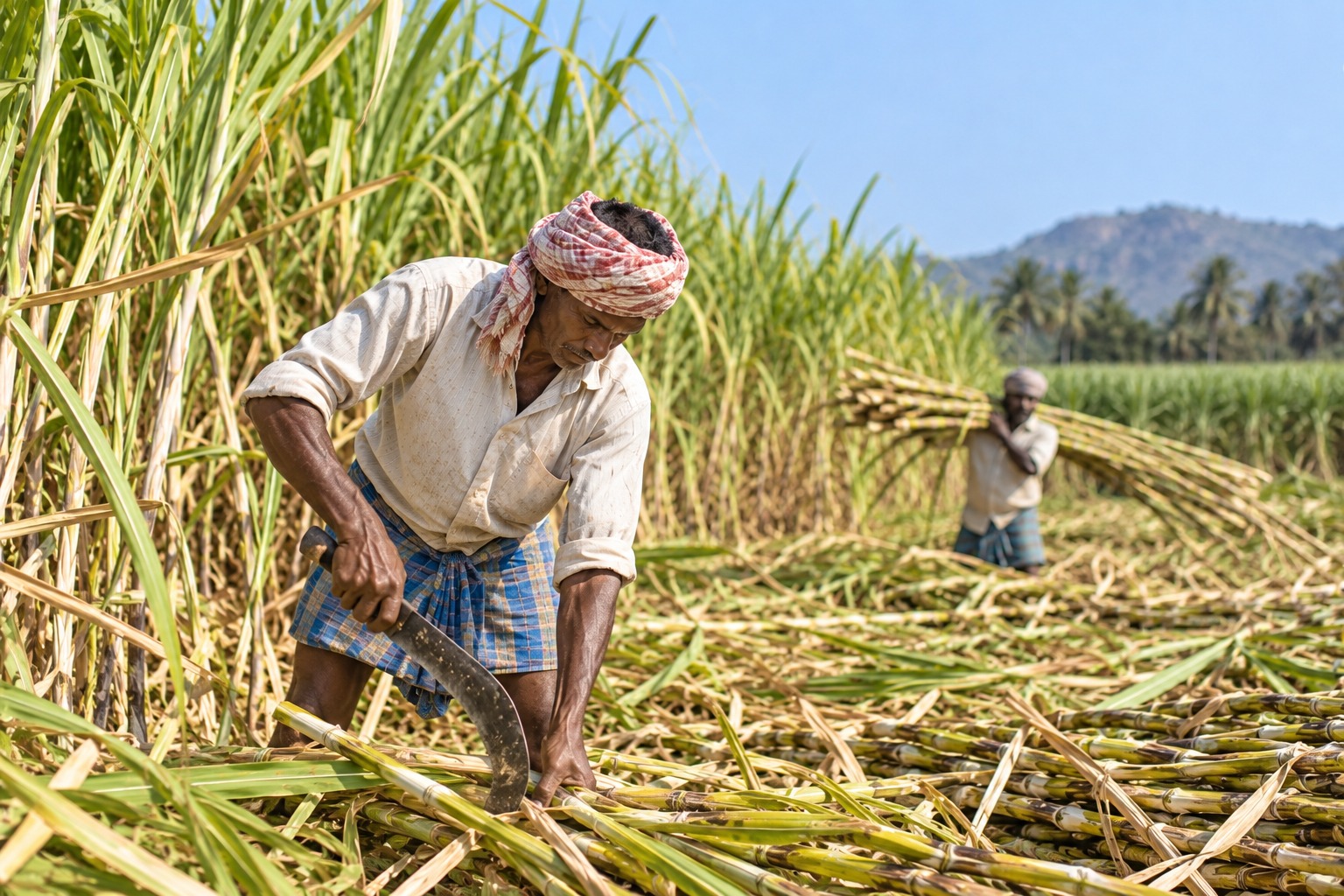
Farmers demand an MSP of ₹60/kg for sugar, implementation of the Swaminathan panel's recommendations, and procurement of ethanol.

Synopsis: As Karnataka’s sugarcane farmers demand ₹5,500 per tonne, rising cultivation costs, disputed recovery rates and mills’ claims of financial unviability reveal the economic tensions behind the protests.
Protesting sugarcane farmers in Karnataka disrupted highway traffic, demanding ₹5,500 per tonne, higher FRP, and other concessions.
They also demanded a minimum support price of ₹60/kg of sugar, implementation of the Swaminathan Commission recommendations, and procurement of ethanol produced in the state.
The Centre has fixed a Fair and Remunerative Price (FRP) of ₹3,650 a tonne for the 2026–27 sugar season, up from ₹3,550 in 2025–26, based on a sugar recovery rate of 10.25%.
Farmers receive an additional ₹35.60 per tonne for every 0.1 percentage point increase in sugar recovery above 10.25%, with a corresponding reduction for lower recovery rates.
However, the Centre has fixed a minimum FRP of ₹3,383 per tonne for mills reporting recovery rates of 9.5% or below.
According to the Centre, the estimated cost of sugarcane production for 2026–27 is ₹1,820 per tonne under the A2+FL calculation, which includes paid-out expenses and the imputed value of family labour.
Also Read: Sugarcane farmers continue NH-48 blockade for second day
For Manjunath Palahalli, a sugarcane farmer from Mandya district, cultivating the crop for more than a year leaves little money after meeting the expenses. With an average yield of 50 tonnes per acre, he said rising labour costs, harvesting charges and delays by sugar factories were eating into the farmers’ earnings.
“We get ₹3,383 per tonne, but cultivation itself costs around ₹1,500 per tonne, including seeds, fertilisers and labour. I also bear the harvesting and transportation costs, which are another ₹1,200–₹1,300,” he said.
At these rates, his total expenditure works out to ₹ 2,700–₹2,800 per tonne. For a 50-tonne harvest, gross earnings would be approximately ₹1.69 lakh, leaving just ₹29,150–₹34,150 after the expenses he identified, over a cultivation cycle stretching 14–15 months.
“Normally, sugarcane should be harvested within 11–12 months. But sometimes we have to wait longer because the factories do not take the crop on time,” he said.
Manjunath also questioned the sugar recovery rates reported by mills, alleging that factories showed recovery below 9% despite the Centre’s FRP benchmark.
” Sugar mills report a lower recovery rate and also have the benefit of additional revenue generated from ethanol, molasses and other by-products, while we do not have that luxury,” he alleged.
Ningappa, a 71-year-old sugarcane farmer from Kadappati in North Karnataka, has been cultivating sugarcane for around three decades. He said an acre typically yields 40–50 tonnes, with cultivation expenses of approximately ₹30,000 per acre.
He said factories previously paid around ₹3,000 per tonne, while the rate had reportedly increased to ₹3,200 following the protests.
However, he alleged that payments were often delayed and that some farmers had yet to receive the additional amounts promised.
“Whatever profit we make goes towards expenses. We survive because our family members work on the farm, and we do not calculate wages for their labour,” he said. Ningappa added that contractors arranged harvesting and transportation, while the reported sugar recovery rate in his region was around 10.2 –10.7%.
Also Read: Ethanol may cut oil imports but pose enormous risks to water and food security
Basavaraju, another sugarcane grower, argued that recovery-linked pricing disadvantages farmers in southern Karnataka, where he said sugar recovery typically remains around 9.5%–9.8%, compared with rates exceeding 11% in parts of northern Karnataka.
He demanded that the existing benchmark be reduced from 10.25% to 8.5%, arguing that the current system does not adequately reflect the conditions growers face in southern Karnataka.
He also highlighted differences in harvesting arrangements.
“In North Karnataka, factories themselves bring the sugarcane and do the work. In these parts we ourselves must pay labourers and get it transported,” he said.
He urged Karnataka to provide an additional ₹300–₹400 per tonne in state assistance and alleged that some factories had yet to clear earlier payments owed to growers. For Basavaraju, the dispute extends beyond the price fixed for sugarcane.
“Whatever profit comes from by-products, how much should go to farmers and how much to factories? The government should analyse that,” he said.
He argued that mills should disclose their profits and losses annually, giving growers a clearer picture of revenue distribution.
A mill owner from the Bagalkot district said paying farmers ₹5,500 per tonne was “completely unviable.”
He said that if mills conceded to the ₹5,500 per tonne demand, mills would spend an additional ₹1,000 per tonne on harvesting and transportation and ₹500 on processing, taking the total estimated cost to ₹7,000 per tonne, excluding interest expenses.
At an average sugar recovery rate of 10.5%, a tonne of cane produces 105 kg of sugar, generating approximately ₹4,725 at a selling price of ₹45 per kg. With additional revenue of ₹250 from power generation and ₹500 from molasses, total estimated revenue would reach ₹5,475, leaving a shortfall of ₹1,525 per tonne, he said.
He also disputed claims that farmers receiving ₹ 3,200 per tonne were necessarily being paid below the Centre’s FRP.
“₹3,200 is the net payment which is going to the farmer. You have to add harvesting and transportation cost to it,” he said.
He explained that mills in North Karnataka generally arrange harvesting and transportation, unlike in parts of South Karnataka, where farmers bear these expenses. Adding ₹1,000 in such costs would bring the gross cane value to ₹4,200 per tonne, he said.
The mill-owner said sugar recovery rates also varied geographically, ranging from approximately 8.5–9.5% in South Karnataka to 10–11 in parts of North Karnataka, depending on soil conditions, irrigation, climate and cane varieties.
On ethanol earnings, he said only some mills had production facilities and claimed that procurement constraints limited additional revenue.
“You are increasing the price of the raw material, and you are not increasing the price of the finished product,” he said, arguing that the Centre must raise the minimum selling price of sugar if mills are to meet farmers’ demands.
Mysuru district Raitha Sangha president Vasu Kumaraswamy said growers in his region were demanding ₹4,000–₹5,000 per tonne, arguing that payments should reflect revenue generated from sugar, ethanol and other by-products rather than depend on subsidies.
He estimated that an acre of sugarcane could yield around 70 tonnes on average, rising to 80–90 tonnes under favourable conditions.
At the current payment of ₹3,100 per tonne cited by the farmer, a 70-tonne harvest would earn ₹2.17 lakh. These figures represent gross earnings before deducting cultivation, harvesting and transportation costs.
He alleged that harvesting delays of one to four months beyond the normal year-long crop cycle further increased farmers’ difficulties.
“Whatever the cost of cultivating is, the income we get is lower than that,” Kumaraswamy said.
“If a shop owner doesn’t get a profit, he will close it. But a farmer considers farming a duty and continues, hoping that next year or the year after will be better,” he added.
Amid the agitation, the Centre on Wednesday, 14 October, constituted a committee headed by former NITI Aayog member Ramesh Chand to examine farmers’ demands for higher cane prices, sugar recovery testing, weighing discrepancies and deductions for mechanically harvested cane.
The decision followed a 12 October meeting between farmer representatives from Karnataka and Maharashtra and Union Ministers Shivraj Singh Chouhan and Pralhad Joshi.
The panel will also review demands to revise sugar’s ex-mill minimum selling price, considering production costs and mill viability. It will consult farmers, mill associations and state governments before submitting recommendations.
For farmers like Manjunath, who faces rising cultivation costs and delayed harvesting, and Ningappa, who relies on unpaid family labour to keep expenses down, the question is whether the committee’s recommendations will translate into better returns or leave them facing another year of uncertainty for farmers across Karnataka.
(Edited by Majnu Babu).



