

Published Sep 29, 2026 | 7:25 PM ⚊ Updated Sep 29, 2026 | 8:36 PM

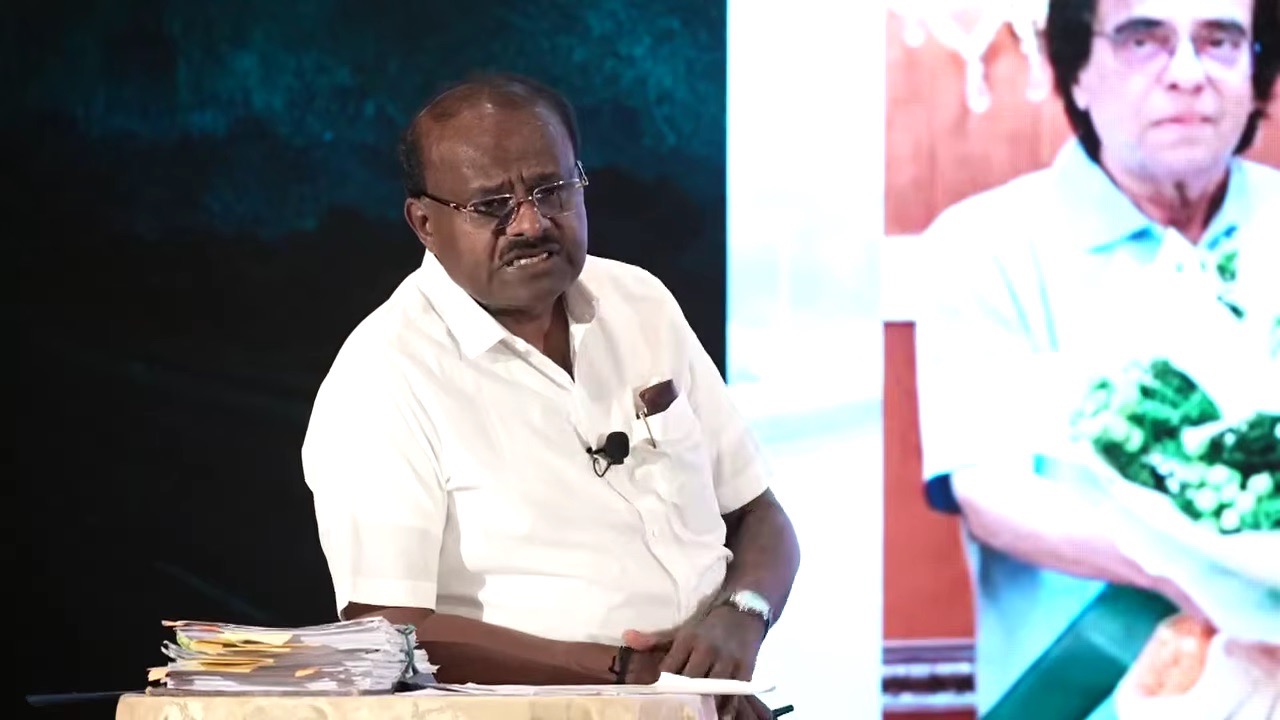
Union Minister HD Kumaraswamy

Synopsis: Union Minister and JD(S) leader HD Kumaraswamy levelled serious allegations against Karnataka Chief Minister DK Shivakumar, saying the latter’s wealth increased to ₹1,413 crore from ₹4 crore in two decades by fraudulent means committed while implementing the NICE Road project connecting Bengaluru with Mysuru. Alleging that the scam had cost the State exchequer ₹30,000 crore as of 2008, the JD(S) leader demanded Shivakumar’s resignation.
Union Minister of Heavy Industries and JD(S) leader HD Kumaraswamy on Tuesday, 29 September, levelled explosive allegations of graft against Karnataka Chief Minister DK Shivakumar in the implementation of the Bengaluru–Mysuru Infrastructure Corridor, commonly known as the NICE project.
He also alleged that the Chief Minister misused his office to pave the way for the alleged scam and colluded with officials to produce falsified documents to facilitate the illegal purchase of land notified for the project.
Addressing a media conference in Bengaluru, the former Chief Minister cited government affidavits, MoUs, the project’s Outline Development Plan, court orders and property deeds to make a wide range of allegations against Shivakumar and Ashok Kheny, managing director of Nandi Infrastructure Corridor Enterprises Limited, which built and operates the BMIC.
Kumaraswamy said the documents showed deviations from the Framework Agreement (FWA) signed in 1997 for the project, illegal changes in the alignment and land allocation, and the execution of a 2002 tripartite agreement, when Shivakumar was Urban Development Minister and chairman of the Bangalore-Mysore Infrastructure Corridor Area Planning Authority (BMICAPA), that permitted the sale of land.
He alleged that the changes enormously benefited private parties, including the Shivakumar family, and caused a ₹30,000-crore loss to the State exchequer as of 2008.
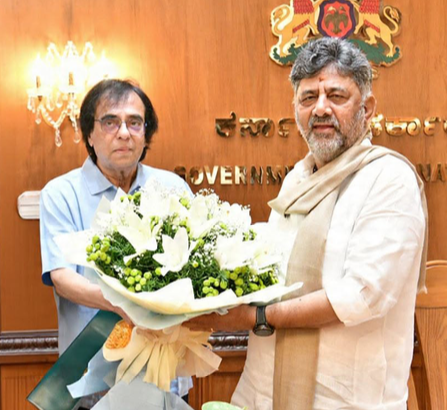
Ashok Kheny with DK Shivakumar.
“[DK Shivakumar] has converted BMICP into a ‘golden goose’. The first thing was that HDD (HD Deve Gowda) got a bad name; the next thing is that DK-AK are collecting ₹3 crore in tolls every day and developing land in and around BMICP lands, directly or through benamis, and have become rich, richer and richest at the cost of farmers. He does not bother about the larger public interest. As the High Court confirmed on 29 July 2026, ‘only project proponents and benamis have become rich’. This means the rich are becoming richer and richest, while poor farmers are becoming poorer and poorest. This is called the BOOT system: that is, booting the common man and farmers,” Kumaraswamy said.
He noted that a 2016 report of the Karnataka Legislative Assembly House Committee examined the project’s deviations under the Congress government headed by Siddaramaiah and found that the 2002 tripartite agreement between the State, NICEL and NECEL violated the 1997 FWA.
Kumaraswamy also asked why TB Jayachandra, then Law Minister, had remained silent on the issue.
“He is still sitting right there beside them, poor fellow. For some reason, he isn’t opening his mouth now. After the House Committee submitted that report, he has been silent. I don’t know why he has become silent,” he said.
Also Read: Karnataka plans road grid beyond GBA
The Bengaluru–Mysuru Infrastructure Corridor began as an MoU signed in 1995 by a consortium led by the American civil engineering firm Vanasse Hangen Brustlin and the HD Deve Gowda-led Karnataka government to develop an expressway between Bengaluru and Mysuru.
Subsequently, BMICAPA developed an Outline Development Plan (ODP) to develop five self-sustainable new townships along the corridor, preserve lakes, tanks, and natural valleys, and retain 77% of the total area in agricultural zone.
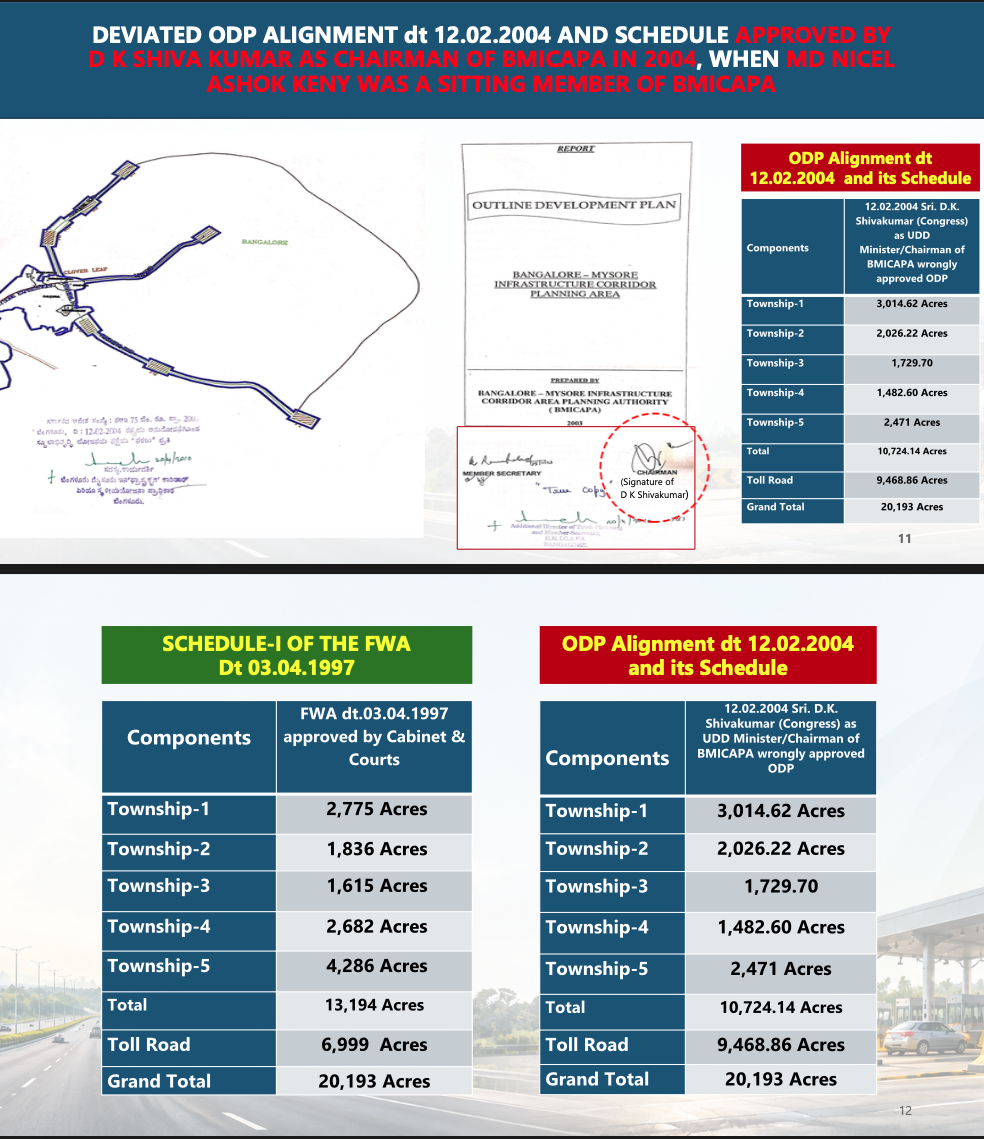
Changes to the Outline Development Plan.
The FWA specified the alignment and land requirements for the project’s peripheral road, link roads, townships and other components.
Kumaraswamy alleged that these were altered through the Outline Development Plan (ODP) dated 12 February 2004, when Shivakumar was Urban Development Minister and chairman of BMICAPA and Kheny was a member of the authority.
The changes included redistributing land between project components. According to the figures cited by Kumaraswamy, the FWA provided 6,999 acres for the toll road and 13,194 acres for five townships. The 2004 ODP increased the toll-road requirement to 9,468.86 acres, while reducing the township allocation to 10,724.14 acres. Kumaraswamy also alleged that the alignment, villages and survey numbers were changed.
“What happened here is like this: suppose we have some problem and go to a doctor. The doctor tells us that they will give us treatment, and they treat us for the illness we actually have. But along with that treatment, they remove one of our kidneys on one side and our liver on the other side. That is how these changes have been made, you see, in several places,” Kumaraswamy said.
“The situation here is the same. The project Framework Agreement showed 20,193 acres, and they retained that overall figure. But they changed it wherever they wanted. Wherever they wanted, they removed the “kidney”; wherever they wanted, they removed the “liver.””
The Karnataka Legislative Assembly House Committee, in its 2 December 2016 report, also found that the 2002 tripartite agreement between the State, NICEL and NECEL was in violation of the FWA and that the 2004 ODP had been approved by the then Urban Development Minister without Cabinet approval, according to the report cited by Kumaraswamy.
In its 19 May 2020 judgment in BMICAPA v. NICEL, the Supreme Court held that Article 7.1 of the FWA required prior State approval for deviations from the agreed project and found that no such approval had been obtained before the court.
In its 29 July 2026 judgment, the Karnataka High Court examined the project’s subsequent implementation. Referring to the changes in the ODP and the redistribution of land, the court said in paragraph 72: “In our view, it is a fraud on the statute and Constitution. The State authorities are accomplices in this fraud and gross breaches and violations of the FWA.”
Also Read: Why are Congress leaders blaming their own five guarantees?
Kumaraswamy said the changes to the project framework opened up BMIC land for private development. He pointed in particular to the 9 August 2002 tripartite agreement between the State, NICEL and NECEL, which provided for the development and sale of land, including land at interchanges and Township-1.
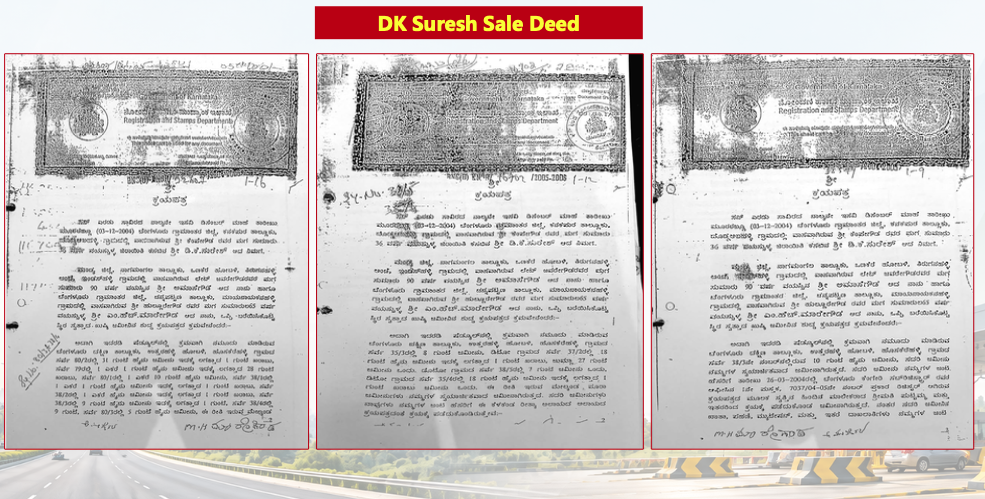
Purported sale deeds.
A Cabinet decision in 2007, when Kumaraswamy was the Chief Minister, subsequently directed that land falling within the road and interchange portions of the BMIC project could not be sold or alienated. It also called for steps to cancel the provisions of the 2002 agreement that permitted such transactions.
Despite this, Kumaraswamy alleged, NICEL continued to issue no-objection certificates (NOCs) for transactions involving BMIC land. He cited transactions involving DGM Realities, Umang Realtech, Ajmera Housing Corporation, Dhammanagi Developers and Darshita Housing, among others. He alleged that some of the beneficiaries were connected to the families of Shivakumar, DK Suresh and Kheny.
He said NICEL issued about 420 NOCs, including for properties that had earlier been notified for acquisition for the BMIC project. He also alleged that some transactions involved benami holders.
One case he cited was the 10-acre Hosakerehalli property. The land was notified for acquisition for the BMIC project in 1998. According to Kumaraswamy, Suresh purchased it on 3 December 2004, while the acquisition proceedings were pending, and subsequently entered into a joint development agreement with Sobha Developers. He also cited multiple records showing deeds involving members of the Shivkumar family.
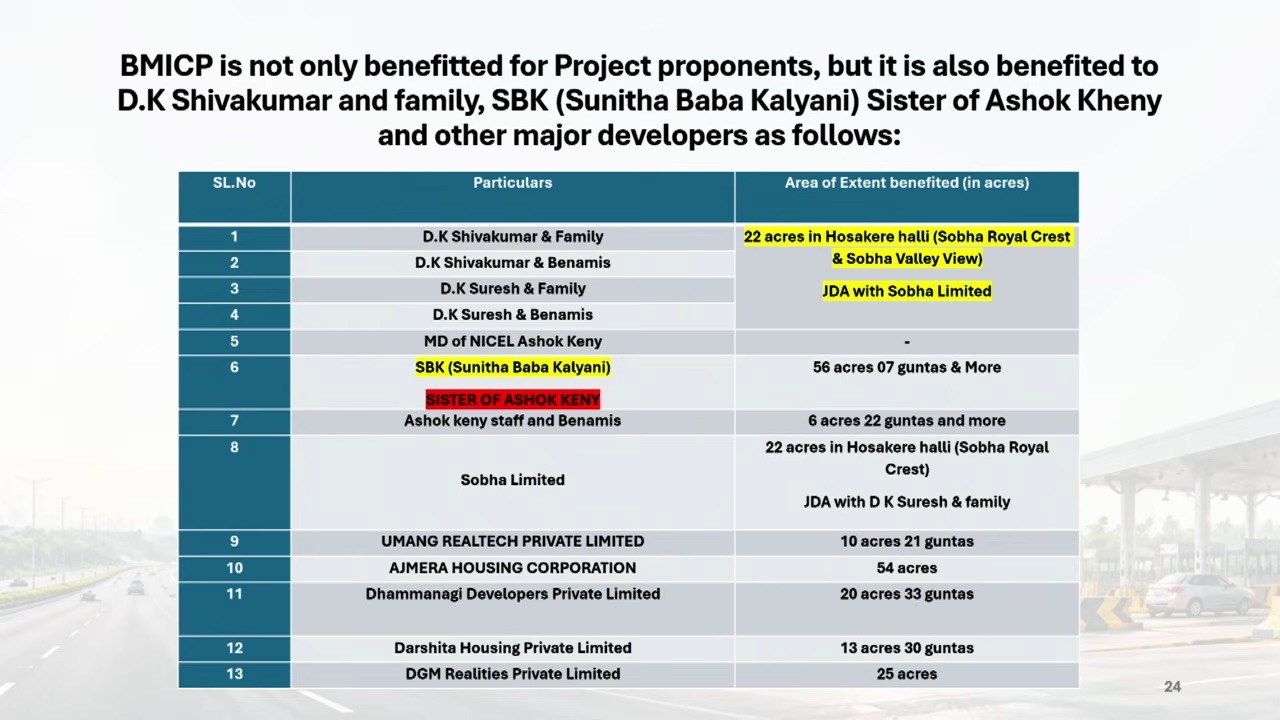
Alleged beneficiaries of the land deals
“Leave aside the people at the top. They even gave an NOC to the person who cooks food at his house—someone known as Ramesh. I don’t know how he got the land,” Kumaraswamy said.
NICEL issued an NOC to Sobha on 9 January 2015, stating that the land was not required for the BMIC project. The Karnataka High Court quashed the acquisition notification on 5 April 2016.
“The NOC was issued in 2015. Sobha Developers submitted an application saying, ‘We are entering into a joint venture. Give us an NOC for this.’ The total area was 10 acres. They obtained an NOC for those 10 acres. This land had already been notified by the government/KDPA in 1997–98. This was notified land. They purchased the notified land. After purchasing it, they entered into a joint venture with Sobha Developers. Sobha Developers then applied for an NOC. They approached the NICE authorities,” he said.
“The NICE authorities gave the NOC. They wrote to the KDPA, saying, in effect, that they did not require this land for the project and that it could be released. How did this happen? This is what I am pointing out as an example of how these irregularities took place.”
Kumaraswamy noted that Sashi Kiran Shetty, who was then senior counsel for Suresh, secured the NICEL NOC and represented him in the proceedings that culminated in the High Court order. Shetty became Karnataka’s Advocate-General after the Congress government returned to power in 2023.
Also Read: Congress MLC wants party-led govt to suspend Gruha Lakshmi
Kumaraswamy said the alleged scam had cost the State exchequer ₹30,000 crore as of 2008, based on the government and court records cited in his presentation. He said the loss would amount to about ₹3 lakh crore at current land values.
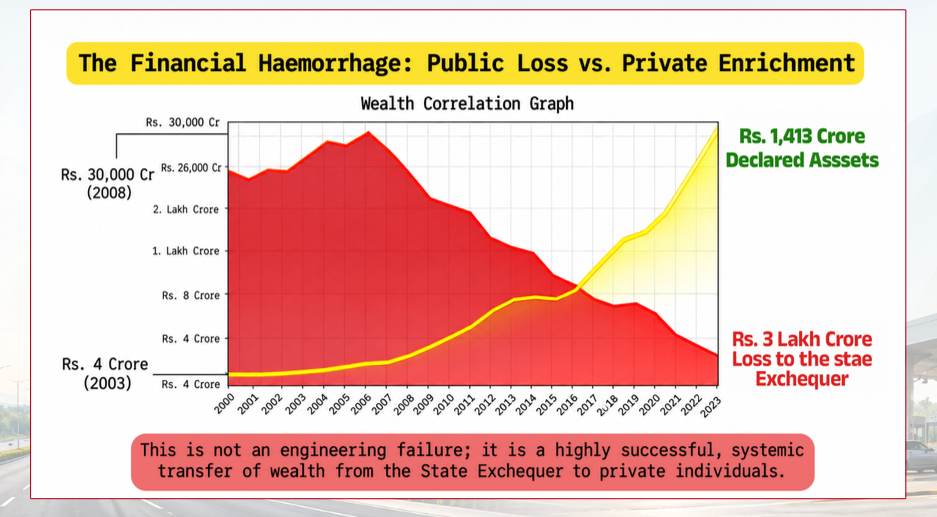
Purported loss to the state exchequer.
He also accused Shivakumar of illegally accumulating assets through the alleged scam, pointing to the hundreds-fold increase in the Chief Minister’s declared wealth between 2003 and 2023.
“We showed the graph from 2004 to 2024. Their assets went from ₹4 crore to ₹1,413 crore,” he said.
Kumaraswamy said the alleged transactions had come at the cost of farmers whose land was acquired or notified for the BMIC project. He accused the government of failing to act despite having the power to intervene.
“Today, I am asking the Chief Minister of this State: If you do not have the power to act on this matter, resign and come out. Let the people decide. Give those who come forward an opportunity to show whether they have the power or not,” he said.
“There is looting being carried out in the name of this project. Do you have the power to stop it? Today, I believe you have lost your moral authority,” he said.
(Edited by Majnu Babu).



