

Published Aug 25, 2026 | 6:42 PM ⚊ Updated Aug 25, 2026 | 6:42 PM

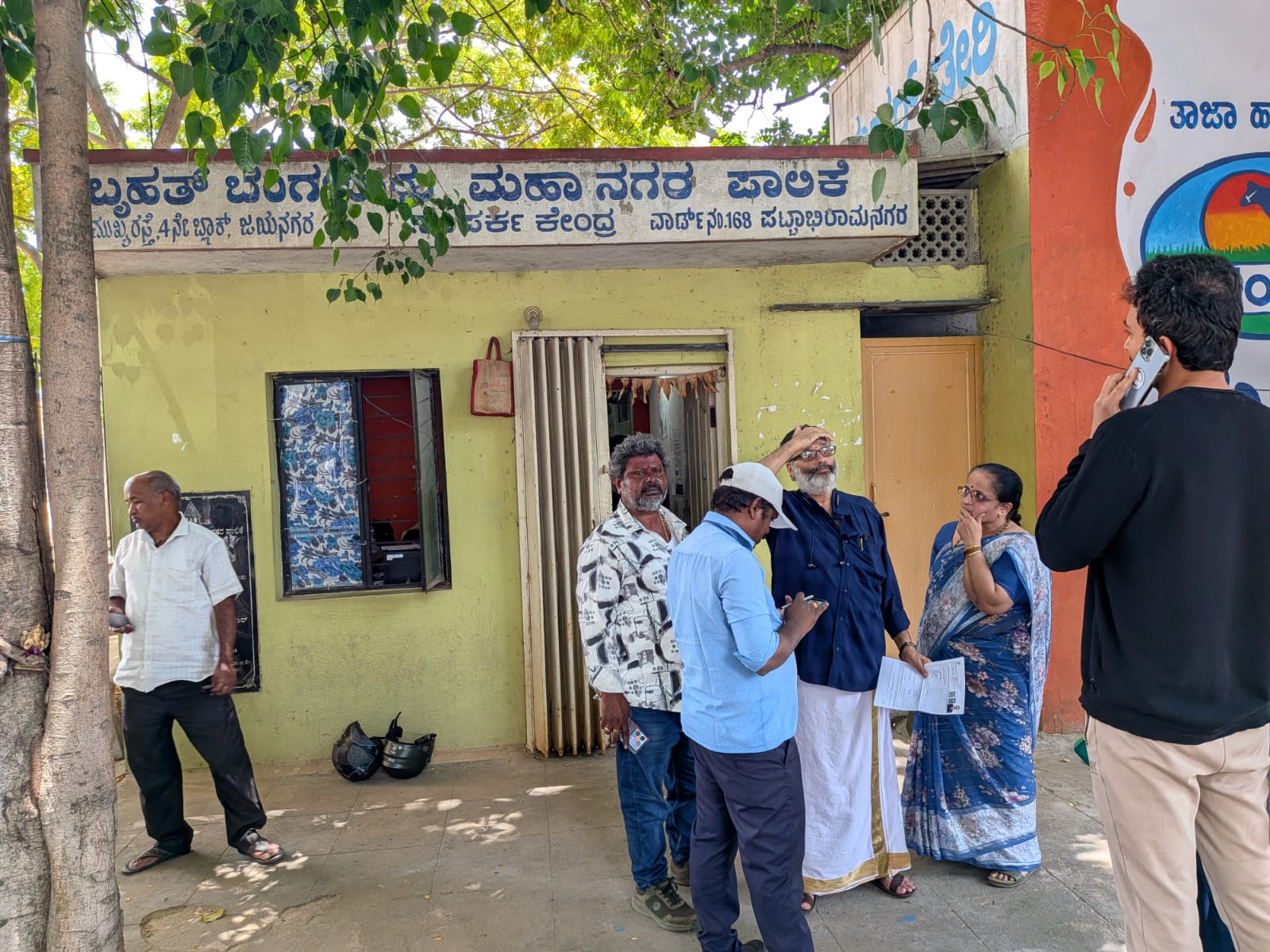
Voters at a facilitation centre in Bengaluru's Jayanagar.

Synopsis: Karnataka Chief Minister DK Shivakumar has urged the Election Commission to extend the time for claims and objections during the ongoing Special Intensive Revision of electoral rolls in the state. He noted that nearly 1.08 crore of the state’s 5.54 crore electors had been placed in the ASDDO category, alongside 43.8 lakh who had been issued notices over ‘logical discrepancies’.
Karnataka Chief Minister DK Shivakumar has urged the Election Commission of India to extend the period for claims and objections during the ongoing Special Intensive Revision (SIR) of electoral rolls in the state, ensure full compliance with the prescribed procedure, give voters adequate time to respond to verification notices, and increase the number of election officers handling applications and objections.
In a letter addressed to Chief Election Commissioner Gyanesh Kumar on Tuesday, 25 August, Shivakumar said nearly 1.08 crore of Karnataka’s 5.54 crore electors—almost one in five—had been placed in the Absent, Shifted, Dead, Duplicate and Others (ASDDO) category.
Following the publication of the draft electoral roll on 24 August, verification notices were expected to be issued to about 43.8 lakh electors over “logical discrepancies” or the absence of a link to the 2002 electoral roll.
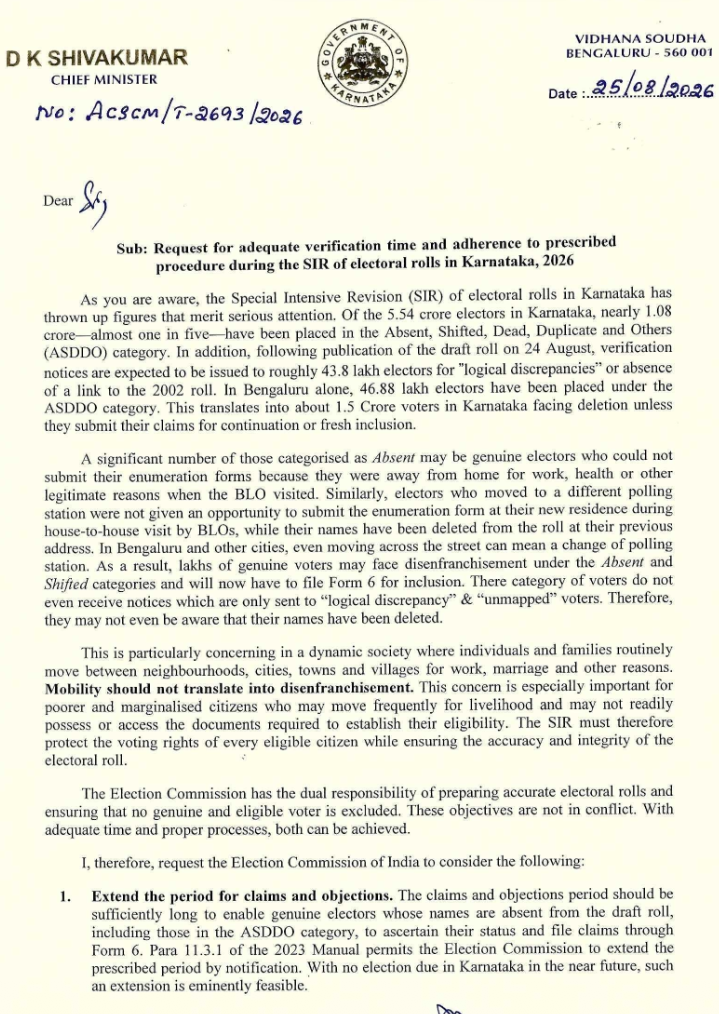
A copy of the letter.
In Bengaluru alone, 46.88 lakh electors had been placed under the ASDDO category, he said.
The Chief Minister said a significant number of voters classified as “Absent” could be genuine electors who had been unable to submit their enumeration forms because they were away from home for work, health reasons or other legitimate purposes when Booth Level Officers visited.
Similarly, electors who had moved to a different polling station were not given an opportunity to submit enumeration forms at their new residences during house-to-house visits, while their names had been deleted from the electoral roll at their previous addresses, he said.
The Chief Minister noted that in Bengaluru and other cities, even moving across the street could mean a change of polling station. As a result, lakhs of genuine voters could face disenfranchisement after being classified under the “Absent” or “Shifted” categories and would now have to file Form 6 for inclusion.
These voters did not even receive notices, which were issued only to electors facing “logical discrepancies” or classified as “unmapped”, Shivakumar said. They might therefore not even be aware that their names had been deleted.
“This is particularly concerning in a dynamic society where individuals and families routinely move between neighbourhoods, cities, towns and villages for work, marriage and other reasons. Mobility should not translate into disenfranchisement. This concern is especially important for poorer and marginalised citizens who may move frequently for livelihood and may not readily possess or access the documents required to establish their eligibility. The SIR must therefore protect the voting rights of every eligible citizen while ensuring the accuracy and integrity of the electoral roll.”
“The Election Commission has the dual responsibility of preparing accurate electoral rolls and ensuring that no genuine and eligible voter is excluded. These objectives are not in conflict. With adequate time and proper processes, both can be achieved.”
Shivakumar said an extension of the prescribed period was “eminently feasible”, citing Paragraph 11.3.1 of the 2023 Manual, which permits the Election Commission to extend the period through a notification. With no election due in Karnataka in the near future, he said, there was no practical impediment to granting such an extension.
He also sought full implementation of the prescribed procedure for identifying omissions and errors in the draft roll.
He asked the Chief Electoral Officer to specifically direct District Election Officers to convene Ward Committee meetings in urban areas and Gram Sabhas in rural areas, after adequate advance publicity.
At these meetings, the draft roll should be read out and omissions and errors identified, as contemplated under Paragraph 11.2.4(vi) of the 2023 Manual, he said.
The Chief Electoral Officer’s DO letter dated 20 August referred to the provision but did not specifically direct that such meetings be held, Shivakumar said.
“A mere reference to the provision risks becoming pro forma compliance rather than an effective mechanism for identifying and correcting errors.”
Shivakumar said the proposed period of about 45 days for issuing notices and disposing of cases involving “logical discrepancies” and the absence of a link to the 2002 roll was “highly compressed”.
Giving an elector about a week to respond, followed by a second notice, could place an unreasonable burden on working people, migrants and the elderly, particularly when documents had to be obtained or travel was required, he said.
He sought a minimum of three to four weeks for each elector to respond and furnish the required documents, arguing that this was necessary to provide a meaningful opportunity to establish eligibility before any adverse decision was taken.
The Election Commission had appointed Additional Electoral Registration Officers to deal with the large volume of objections and applications expected to be filed for inclusion. However, Shivakumar said the arrangement would be inadequate to handle the enormous workload within the available time.
“The unrealistic deadlines combined with inadequate manpower could result in avoidable errors and unfair exclusions.”
He also asked the Commission to consider appointing Additional District Election Officers in districts with high numbers of ASDDO cases and “logical discrepancies”.
The Karnataka government, he said, was ready to provide all possible assistance, including mobilising the local administration for Gram Sabha and Ward Committee meetings, undertaking widespread publicity to reach affected voters, and providing any other coordination or logistical support required by the Commission.



