


Considering the challenges thrown at them, Dr Latha and her team adopted a design-as-you-go approach to construct the bridge.

Published Jun 06, 2025 | 7:31 PM ⚊ Updated Jun 06, 2025 | 7:31 PM

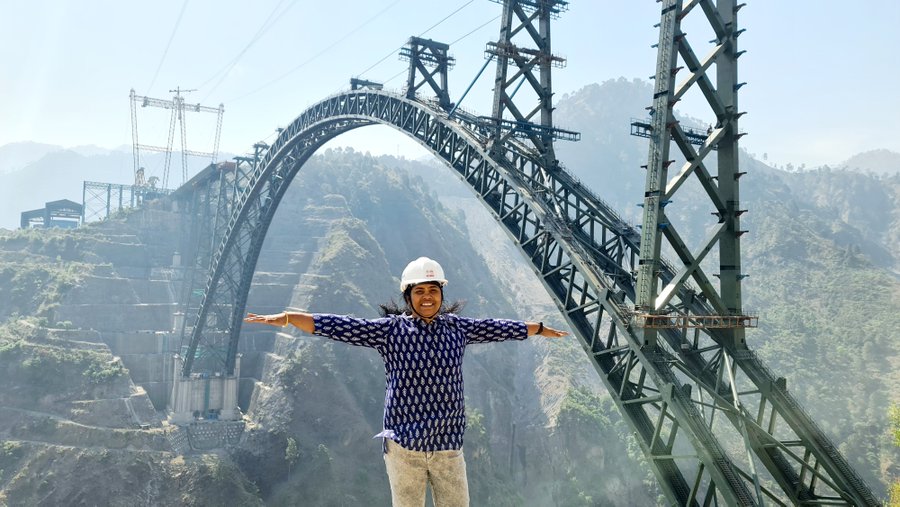
Dr Madhavi Latha Gali at the construction site (IISc/X)
Synopsis: Dr Madhavi Latha was the primary geotechnical consultant of the Chenab Rail Bridge — the world’s highest single-arch railway bridge — dedicated to the nation on Friday.
Prime Minister Narendra Modi inaugurated the engineering marvel, the Chenab Rail Bridge, on Friday, 6 June. The bridge stands as India’s pride and is the world’s highest single-arch railway bridge, linking Jammu with Srinagar.
Standing tall at 359 metres above the riverbed, the 1,315-metre-long bridge dwarfs the Eiffel Tower by 35 metres and has a stated lifespan of 120 years. Built to withstand wind speeds up to 260 kmph and seismic activity, the bridge was constructed at a cost of ₹1,486 crore.
The bridge took close to two decades to complete. In between, the project hit a roadblock in 2008 due to site conditions and a new railway alignment. The project restarted in 2010 and chugged along to become an architectural marvel.
Even as the Prime Minister dedicated the bridge to the nation, the Indian Institute of Science (IISc) in Bengaluru swelled with pride. Dr Madhavi Latha Gali, a Geotechnical Engineering Professor at the Department of Civil Engineering of the institute, was the force — who dedicated 17 years of her life — for the bridge.
On 28 May 2025, the Women’s Special issue of the Indian Geotechnical Journal published an article, “Design as You Go: The Case Study of Chenab Railway Bridge.” Written by Dr Latha, the article detailed the challenges she had faced in constructing the bridge over the past 17 years and key learnings.
Dr Latha — the primary geotechnical consultant — and her team, in fact, lacked a concrete design as they embarked on the task. “The construction of a civil engineering marvel like the Chenab bridge posed many challenges from planning to completion. A rigid design with fixed dimensions and pre-determined solutions would not have been feasible, considering the continuously evolving geological and geotechnical conditions,” she noted in the article.
The solution? “The design-as-you-go approach adopted in this project made the construction of the bridge possible despite the critical challenges encountered in every stage during the 17 years of its construction period,” she added.
The Chenab Bridge consists of an unsupported steel arch of about half a kilometre in length resting on the left and right abutments on the slopes and eight piers resting on the slopes, four on each side.
Dr Latha explained the significance of the bridge. “Connecting Jammu and Kashmir by train with the rest of the country has been India’s dream for more than a century. The USBRL (Udhampur-Srinagar-Baramulla Rail Link) project, dedicated to this purpose, was declared as India’s national project in 2002,” she said.
“The project covers 272 km from Udhampur to Baramulla through the gigantic Himalayan mountains and consists of 38 tunnels in total. The bridge coming between Katra and Qazigund over the River Chenab, connecting two hills, is the world’s highest railway bridge to date, standing at a height of 359 m above the riverbed. Planning of the bridge started in 2005, and it was finally completed in 2022,” Dr Latha wrote.
She worked closely with the Northern Railway and the contractor, Afcon Infrastructure, designing the bridge on the go and making it a reality.
An alumna of the Indian Institute of Technology-Madras, Dr Latha taught at IIT-Guwahati before joining the IISc in 2004.
Her research interests include micro to macro of geomechanics, sustainable soil reinforcement, earthquake geotechnical engineering, and rock engineering.
She is the first recipient of the Best Woman Researcher in Geotechnical Engineering award from the Indian Geotechnical Society. She has also received Prof SK Chatterjee outstanding researcher award of IISc, Woman achiever award by Karnataka Book of Records, and SERB POWER fellowship. She is listed in the top 75 women in STEAM of India.
When Dr Latha joined the IISc, she was the first female faculty member. Her major challenge then, however, was not academic.
“Back then, there were no exclusive toilets for women in the department. There were only men’s toilets,” IISc said on its website before quoting her: “I had to really fight to get a women’s toilet in the geotechnical engineering building.”
Today, both IIsc and Dr Latha are proud of their achievements at the institute. Now, the Chair of the Centre for Sustainable Technologies (CST), Dr Latha, is happy that there are almost as many female students as males in the department.
“I would say the ratio is 40-60,” the IISc website quoted her.
“Over the years, she has tried to make her lab more inclusive for her female students, for example, by making helpers assist women students in experiments that require heavy lifting so that they can keep pace with male students. Her door is always open for female students to share their concerns, she says. ‘Being a woman, I make sure I understand what they need.'”
Soon after the bridge was inaugurated, IISc took to X. “We are proud of Prof Madhavi Latha & her team’s contribution to the #ChenabBridge inaugurated by Hon’ble PM Narendra Modi. The team worked on stability of slopes, design & construction of foundations, design of slope stabilisation systems, incl. rock anchors to withstand hazards.”
Economist and writer Sanjeev Sanyal drew attention to Dr Latha’s unwavering determination. “Madhavi Latha, one of the awesome engineers who helped build the Chenab bridge. She began looking at the issue 17 years ago!! The bridge has four times the steel at the Eiffel Tower – held together in a mountainous, earthquake-prone zone,” he wrote on X.


