

Published Apr 17, 2026 | 4:00 PM ⚊ Updated Apr 17, 2026 | 4:00 PM

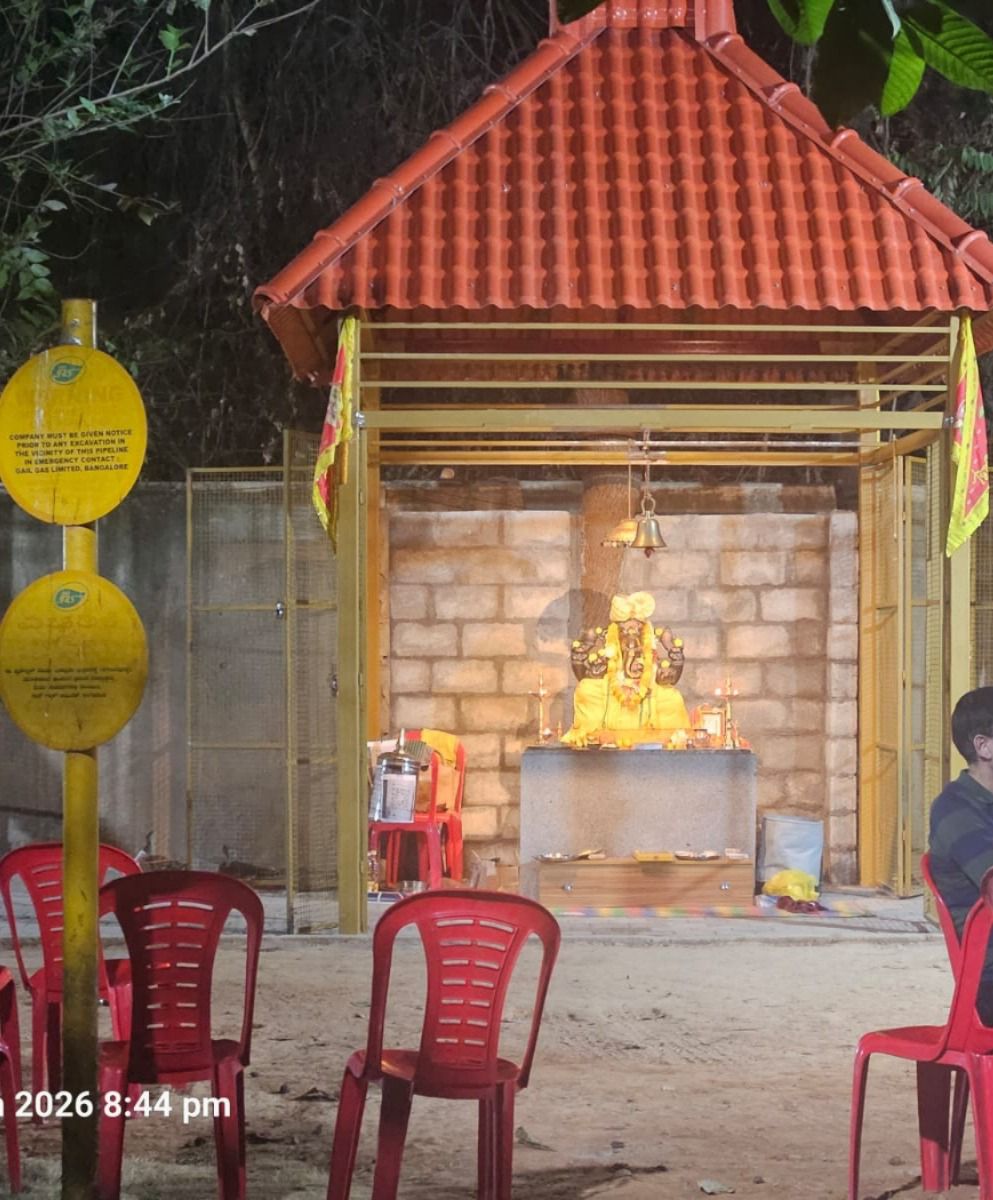
The temple was constructed in a common area. (Supplied)

Synopsis: The SNN Raj Serenity at Bengaluru’s Yelenahalli is caught in a dispute after a section of residents decided to construct a temple in a common area. Those opposed to the idea moved the court and received an order to maintain the status quo till 1 June.
Residents of an apartment complex in Bengaluru are a divided lot after a section of dwellers started constructing a temple for Lord Ganesha — the remover of obstacles, according to the Hindu mythology — in a common area.
The issue even reached a court of law, which ordered the residents’ association to maintain the status quo until 1 June.
A section of residents of SNN Raj Serenity at Yelenahalli, Begur, alleged that a permanent concrete structure was being constructed in the common area, and a Ganesha idol was installed on 20 March. The construction was led and supported by a majority of the apartment owners’ association (11 out of 20).
However, those opposed to the construction challenged both process and legality of the construction. They argued that no unanimous consent was obtained from all apartment owners, and that the project went ahead without mandatory approvals from the Greater Bengaluru Authority (GBA).
“The common area of the apartment belongs to everyone. We are not supposed to create an exclusionary structure in the common area. This is a community where everyone lives,” a resident, opposed to the construction, told South First, requesting anonymity.
The dispute has since reached the court. The protesting residents filed a civil suit before the Principal Civil Judge, Bengaluru Rural, on 23 March. Two days later, the court ordered both parties to maintain the status quo until the next hearing on 16 April.
On Thursday, 16 April, the court extended the status quo until 1 June.
Parallelly, an initial Non-Cognisable Report (NCR) was registered at Begur Police Station on the day of the construction, and complaints have been escalated to the Bengaluru City Police Commissioner.
Also Read: Why summer 2026 is likely to be hotter than 2025 in Karnataka
The issue dates back to November 2024, when an idol was placed in the common area outside the main gate of SNN Raj Serenity, reportedly without authorisation.
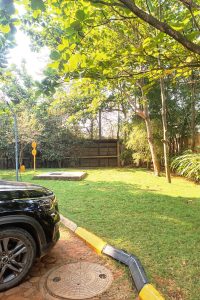
The common area before the construction. (Supplied)
Following police intervention and objections from the then management committee, the idol was relocated to the E Block recreation room.
The Association had then engaged a legal counsel, who advised in writing that ‘new erection of structure without prior approval of the authorities (the then BBMP) is illegal and doing it shall be subject to potential prosecution.’ The counsel advised that any such proposal must first be incorporated into the sanctioned building plan and approved by the authorities.
However, the association members moved to construct the place of worship once again in March in a “pre-planned early morning operation.” Their main argument was based on an Extraordinary General Body Meeting (EGM) held in December 2024, to seek opinions from residents about the construction.
Of the 533 members who attended the meeting, 481 voted in favour of the temple while 209 opposed. Another 1,168 members abstained. However, residents said that the minutes of the meeting reiterated that the votes were a non-binding expression of interest, not a mandate to construct the structure.
“There is a growing concern that the RWA is providing an incorrect representation of the community’s consensus to external parties while ignoring internal legal objections,” the residents alleged in a representation.
Also Read: Karnataka’s SSLC third language row under scrutiny
Under Section 6 of the Karnataka Apartments Ownership Act, 1972, each apartment owner shall be entitled to an undivided interest in common areas and facilities in the percentage expressed in the Declaration.
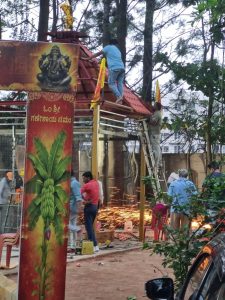
A section of residents said the structure was illegal.
“The common areas and facilities shall remain undivided, and no apartment owner or any other person shall bring any action for partition or division of any part thereof, unless the property has been removed from the provisions of this Act,” Sub-section 3 of the Act stated.
Under the proposed Karnataka Apartment (Ownership and Management) Bill, 2025, a minimum of 75 percent formal consent from individual apartment owners is required for effecting major alterations or redevelopment of existing complexes. The Bengaluru Apartments Federation (BAF) has been seeking urgent implementation of this Bill and its provisions.
Meanwhile, the protesting residents lodged a complaint with the Chief Engineer and Assistant Executive Engineer, Bengaluru South City Corporation. They urged the GBA to initiate an official inspection of the site and issue instructions on the violations to the association president.
“They orally observed that the structure doesn’t look like a temporary structure. They said they will have an internal discussion, but we haven’t heard anything else from them after that,” another resident said.
The GBA engineer in charge, Begur, did not respond to South First‘s calls for a comment.
Also Read: Karnataka Platform-Based Gig Workers Act, 2025 rules notified
This is not the first time that apartment complexes have witnessed attempts to construct temples on their premises.
In 2025, 15 residents of Prestige Falcon City apartment in Bengaluru’s Konankunte Cross complained that a temple had been allegedly illegally constructed in the buffer zone of a stormwater drain or rajakaluve located in the complex.
They filed a petition in the Karnataka High Court raising questions about a resolution dated 18 April 2025, which was passed by the apartment owners’ association, allowing the alleged illegal construction activities.
The court directed the Deputy Commissioner for Bengaluru South to inspect the premises and issued notices to the Falcon City Apartment Owners’ Association and the BBMP.
In 2024, a pedestal was reportedly constructed to set up an idol of a Hindu deity in another gated community, Provident Welworth City. K Mathai, the then president of Provident Welworth City Residents’ Welfare Association, accused MLA SR Vishwanath of backing the temple plan.
While addressing a press conference, Mathai claimed that other communities were demanding a place for a mosque and a church after the construction of the platform came to light.
In 2016, the Karnataka High Court directed the BBMP to initiate criminal proceedings against the construction of a temple in an area designated as ‘setback’ in an apartment in Rajajinagar.
In its judgement, the court noted that an area left as a setback (the minimal open space surrounding a building) is required under the building bylaws; the same shall not be used for any purpose other than for which the sanction has been obtained.
In its response to a query a resident had raised under the RTI Act, the BBMP said it had not given any permission for the construction.
(Edited by Majnu Babu)



